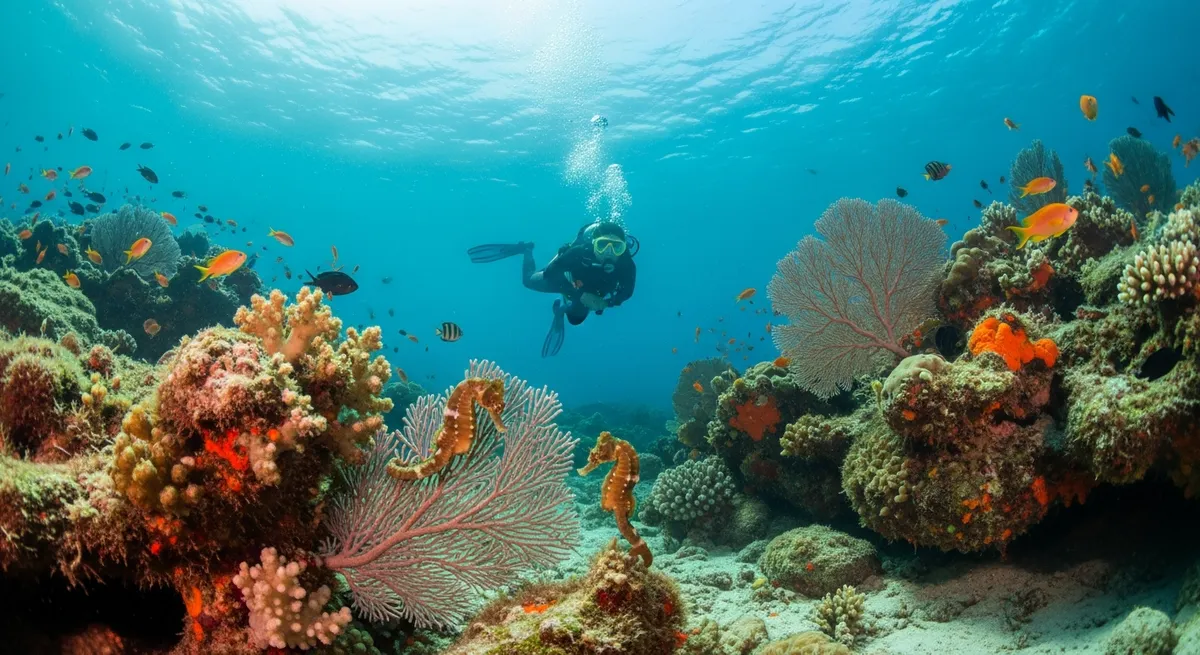
Diving in Santa Marta & Tayrona
Why dive here
Santa Marta & Tayrona offers some of Colombia's richest diving, with 517+ marine species recorded in the area - including barracuda, blue sharks, dolphins, eagle rays and hammerhead sharks. Water ranges 28-30°C, warmest June, July, September.
Santa Marta’s main draw is its easy access to Tayrona National Park. We think that’s where the magic really happens. Imagine granite boulders, smoothed over eons, tumbling into the Caribbean, creating a unique habitat. The water here feels different, cooler, a mix of mountain runoff and ocean current. We love the drift dives around the outer reefs, keeping an eye out for bridled dolphins slicing through the blue. You’ll spot plenty of puffers tucked into crevices, their eyes following your every move. It’s not about huge pelagics here, more about the smaller details - lesser rock shrimp waving their antennae from tiny ledges, or the flashes of dwarf wrasse darting between coralline brittle stars. Visibility can vary, especially after heavy rains, but on a good day, it's a solid 15-20 meters. Our favourite time to visit is May to October, when the seasonal turtle nesting activity brings a quiet buzz to the area. For something a bit different, ask about the deeper spots where lawyer and viperfish have been occasionally seen - a true deep diver's reward.
Santa Marta & Tayrona Dive Site Map
Dive sites and dive centres in Santa Marta & Tayrona
Santa Marta & Tayrona Dive Sites
41 dive sites in Santa Marta & Tayrona
Arrecife coralino
Arrecife Coralino. The name alone tells you what you're in for: a solid coral reef. And it delivers. We love drifting along the gentle slopes here, often finding ourselves eye-to-eye with a Caribbean Chestnut Moray peeking out from a crevice. It’s the kind of site that rewards slow exploration. Our pick for a quiet morning dive, before the day boats really get going. You'll often see schools of French Grunts and Schoolmasters hanging out in the sunlight, creating these shimmering walls of silver. Keep your eyes peeled for the smaller stuff too, like the Nodose Clinging Crab, tucked away on a sponge, or a Spitlure Frogfish doing its best impression of a rock. The coral diversity here is genuinely impressive, with big heads of Elliptical Star Coral and delicate Thin Finger Coral side-by-side. It’s not a drift dive, more of a leisurely bimble, perfectly suited for photographers or anyone who just wants to soak it all in. We’d suggest going early; the water tends to be calmer, and you beat the crowds.
Bahia Aguacate
Bahia Aguacate offers a relaxed dive, good for shaking off the rust or for newer divers getting comfortable in the water. Expect a mix of soft corals and rock formations, with the usual suspects like parrotfish, snappers, and a few morays tucked into crevices. It’s a pleasant enough spot, calm and relatively shallow, making it a good second dive of the day. We’d recommend it if you're looking for an easy morning out.
Canto del Bajito
Canto del Bajito is a pretty solid wall dive, and while the visibility can be a bit hit or miss, around 10 meters on average, it’s always worth a peek for those ‘cupons’. We're talking cup corals here, and they are surprisingly huge, some pushing over two meters tall. Our favourite part is cruising along the base of that wall, keeping an eye out for the big stuff; we’ve spotted some hefty cubera snapper and pufferfish lurking in the shadows. Up top, the reef gives way to a bustling community of smaller fish – slender parrotfish picking at algae, dusky damselfish darting between coral heads, and Caribbean spiny lobsters peeking out of crevices. If you move slowly, you'll catch glimpses of American crested pipefish or a camouflaged eyed flounder. We'd suggest going early in the morning, before the boat traffic picks up, as it can make a difference to what you’ll find. It’s a site that suits divers who appreciate the intricacies of a coral wall and don’t mind a bit of a treasure hunt for those larger reef residents.
Canto del Mero
Canto del Mero. This site consistently delivers. It’s a coral ledge that eventually drops off, but we spend most of our time in the shallows, around 6-12 metres, where the light really plays through the reef. Our favourite thing here is the sheer density of small stuff. You’ll spot Roughhead Blennies peering from every crevice, and the way the Bicolor Damselfish dart in and out of the Smooth Star Coral is mesmerising. We often find ourselves just hanging motionless, watching the Butterfish schooling. The corals themselves are in great shape, particularly the Ridged Cactus Coral, forming these intricate structures that feel like a secret garden. Keep an eye out for Coneys and Spot Snappers lurking. Further down, around 20 metres, the water cools slightly, and we’ve bumped into Barracuda cruising past. Visibility averages around 13 metres, which is decent for the area, and the currents are usually pretty mellow. We love this spot for relaxed dives, especially for photographers looking for macro subjects, or anyone who just wants to soak in the vibrant, busy reef life without having to fight a strong current.
Caribaru
Caribaru sits off the coast near Santa Marta, offering a straightforward dive for most certification levels. We’ve found decent hard coral formations here, with occasional sightings of snapper and grunts schooling in the shallows. It’s a reliable spot when you’re looking for an easy afternoon dive, particularly good for newer divers building confidence. Visibility averages around 10-15 meters, typical for the area.
CIUDAD DE ITAGUI
The **Ciudad de Itagüí** isn't just a wreck; it's a testament to the sea's power and its incredible ability to reclaim. This 103-meter motor vessel, built in 1945 and sunk in 1984 after running aground, lies at a friendly 12 meters, making it incredibly accessible for most divers. We love that you can really take your time here, tracing the outline of the hull, exploring the remnants of the superstructure, and imagining its past life. What you'll find today is a vibrant artificial reef. Schools of grunts and snapper weave through the broken metal, their scales flashing as they catch the light filtering down from above. Look closely and you'll spot scorpionfish camouflaged against the rust, and often, we’ve seen eagle rays gracefully gliding past in the blue. The sheer size of the wreck means there’s always something new to observe, from the smallest nudibranchs clinging to the encrusted metal to the larger pelagics that occasionally cruise by. It's a fantastic site for photographers, too, offering dramatic backdrops and plenty of stationary subjects. For us, it’s one of Santa Marta’s standout dives – a big wreck, shallow depth, and usually calm conditions make for a seriously enjoyable exploration.
DARIEN
Darien is one of our favourite wreck dives in Tayrona, a real standout. You’re not dropping onto some vast, intact freighter here. Instead, it’s the scattered remains of a small, wooden cargo ship, probably a schooner, that ran aground sometime in the 1960s. The site sits shallow, just 9 metres, meaning you get fantastic bottom time, perfect for really poking around. We love following the sand channels between the larger, hull fragments, imagining the timbers as they would have been. What makes Darien special is how completely marine life has taken over. You’ll weave through the skeletal ribs of the hull, each one coated in bright sponges and soft corals. Schools of sergeant majors and snapper patrol the larger sections, darting into the shade as you approach. Keep an eye out for moray eels tucked into the crevices; we’ve spotted a few green morays here over the years. It’s a gentle dive, suited for newer wreck divers or anyone who appreciates the quiet beauty of a wreck slowly being reclaimed by the sea. Visibility can vary, but generally, when it’s good, the natural light filtering down through the shallow water makes the colours truly pop.
DONA LOLITA (POSSIBLY)
Okay, so the Dona Lolita wreck. Full disclosure, this one sits shallow, really shallow, barely 2 metres. Forget your deep deco stops here. But don't write it off. What you get is this massive hull, 110 metres of steel, just a few feet under the surface, which means incredible light penetration. We love how the sun dapples across the corroded metal, highlighting every barnacle and sponge. She ran aground back in '81, a motor vessel on her way to Guayaquil, lost power at the mouth of the Magdalena River. Now, she's a haven for everything small and colourful. You'll spend your time spotting arrow crabs clinging to the bulkheads and schools of juvenile fish darting through the broken plating. It’s less about grand scale and more about intimate discovery. Our favourite part? Peeking into the darker corners for an octopus or a moray. It’s a photographer’s dream for wide-angle shots with natural light. This site is perfect for extended bottom times, for those who love to really poke around and observe the small stuff without worrying about air consumption or NDLs.
EL AGUILA
El Aguila, a former cargo ship, was intentionally sunk back in 1980, so it’s had plenty of time to become a proper artificial reef. And it shows. We love a wreck that’s truly integrated with its surroundings, and this one delivers. Dropping down, you’ll find the entire structure coated in sponges and gorgonians, a riot of colour against the ship’s aging metal. The stern is our favourite part, with barracudas often hanging out in the gloom, eyeing you up as you pass. Inside the cargo holds, schools of snapper drift lazily, occasionally parting as a grumpy moray eel pokes its head out from a crevice. It’s an easy dive, sitting in around 30 metres, which means decent bottom time to really explore the nooks and crannies. We’d suggest going in the morning; the light filters through the superstructure beautifully, really bringing the wreck to life. Be aware that currents can pick up here, so keep an eye on the dive brief.
El Gran Cañón
El Gran Cañón, a spot we really rate in Santa Marta, lives up to its name. You're diving along these dramatic underwater cliffs, the coral starting deep, around 20 meters, then just dropping away into canyons. It feels like you’re exploring an ancient, submerged landscape, a real sense of scale here. We love how the light plays on the walls as you descend. Look for the big Donkey Dung sea cucumbers scattered on the deeper ledges and keep an eye out for a flash of an Angelfish or a school of Snapper cruising by the drop-off. The currents can pick up a bit, nothing too wild, but enough to bring in some interesting pelagics. We’ve had some cracking encounters with large Triggerfish here, and the Caribbean Spiny Lobsters are plentiful, tucked into every crevice. Our tip: go a little later in the day if you can, the late afternoon sun really highlights the textures of the Maze Coral and Thin Leaf Lettuce Coral on the upper sections. This site is a great choice for experienced divers who appreciate topography and aren't afraid of a bit of depth, offering a genuine sense of exploration.
El Jardín
El Jardín in Tayrona National Park is one of our favourite spots for a relaxed dive in Colombia, particularly if you’re keen on finding the smaller, more elusive critters. We’ve spent many hours here, hovering around the 5-meter mark, just soaking in the details. The real charm of El Jardín isn't its grand scale, but the sheer concentration of life within its modest depths. Our pick for this site is definitely a slow, deliberate exploration. Keep an eye out for the delicate American crested pipefish tucked amongst the finger corals, and we’ve often found groups of slender parrotfish grazing on the reef. The blennies, both banded and Delalande, are constantly darting in and out of crevices, and we always get a kick out of spotting the fringed filefish blending seamlessly with its surroundings. The fire coral patches add a surprisingly vivid orange against the more muted corals. Visibility hovers around 10 meters, which we think is perfect for really focusing on the macro life without feeling overwhelmed. It’s an ideal spot for new divers to build confidence, but seasoned photographers will find plenty to keep them occupied too.
El Laberinto
El Laberinto feels exactly like its name suggests: a maze, but the kind you actually want to get lost in. It’s perfect for those days when you just want to wander, taking your time to poke into every crack and crevice. We often start shallow, around 5 or 6 metres, where the light still plays on the sandy patches, illuminating little communities of Banded Cleaner Shrimp scuttling over sponges. As you drift deeper, the reef transitions into a gentle wall that bottoms out at about 15 metres on a bright white sand floor. This contrast is striking, and it’s where we often find ourselves lingering, watching for Broadnose Worm Eels poking their heads out or the distinctive flash of a Slippery Dick darting into cover. The visibility here is usually very good, often 15-20 metres, which makes spotting tiny Blackfin Blennies a real treat. We love this site for its relaxed pace; it’s a brilliant spot for newer divers to build confidence, but even experienced eyes will find plenty to keep them occupied, especially in the towering coral formations where juvenile Spot Snappers hide. Bring a good macro lens if you have one; the small stuff really shines here.
Show all 41 dive sites in Santa Marta & Tayrona
- Formaciones coralinas
- Grieta Isla Narza
- Imelda
- Isla Gloria
- Isla Pavitos
- La Bocana
- La Pastelería
- La Puntica no +
- Las Trinias
- LAS VILLAS
- Los Buzos
- MagiColor
- Manto de Ela
- MONIQUE S (POSSIBLY)
- Morrito Largo
- Palomo
- PEACOCK
- Penon Bobo
- Pescera Tayrona
- Pico del Náufrago
- Picua
- PRINCE AUGUST WILHELM
- Puerto Naito Baru
- Punta Baru
- Punta del Cabo
- Punta Granate
- SalaCuna
- Salidero
- SALMEDINA BANK LIGHT VESSEL
Santa Marta & Tayrona Dive Centres
10 dive shops and operators in Santa Marta & Tayrona
Aquasub Buceo
Atlantida Centro de Buceo
Blue Life
Buzos de Baru
Cartagena Divers
Centro de Buceo Rincon del Mar
Coveñas Diving Co
Diving Planet
Show all 10 dive centres in Santa Marta & Tayrona
Ocean Wildlife in Santa Marta & Tayrona
517 species recorded in Santa Marta & Tayrona
Santa Marta & Tayrona Daylight & Sunrise/Sunset
Sunrise and sunset times for Santa Marta & Tayrona, calculated from coordinates
Today - Sunday 11 October
Sunrise
05:51
Sunset
17:48
Daylight
11h 57m
Golden Hour
17:20
First light (dawn) at 05:30 · Last light (dusk) at 18:09
Monthly Averages
| Month | Sunrise | Sunset | Daylight |
|---|---|---|---|
| Jan | 06:24 | 17:59 | 11h 35m |
| Feb | 06:23 | 18:11 | 11h 48m |
| Mar | 06:11 | 18:14 | 12h 3m |
| Apr | 05:53 | 18:13 | 12h 21m |
| May | 05:42 | 18:17 | 12h 35m |
| JunLongest | 05:42 | 18:25 | 12h 43m |
| Jul | 05:48 | 18:29 | 12h 40m |
| Aug | 05:54 | 18:22 | 12h 28m |
| Sep | 05:53 | 18:04 | 12h 12m |
| OctNow | 05:51 | 17:46 | 11h 55m |
| Nov | 05:57 | 17:37 | 11h 40m |
| DecShortest | 06:12 | 17:44 | 11h 32m |
Times are approximate local times based on longitude. Actual times may vary slightly depending on the exact timezone observed in Santa Marta & Tayrona.
Where to Stay near Santa Marta & Tayrona
Prices from Booking.com. We may earn a commission at no extra cost to you.
Marine Protected Areas near Santa Marta & Tayrona
5 protected areas near Santa Marta & Tayrona - please respect local regulations when diving
Area marina Protegida Archipielago Corales del Rosario y San Bernardo
Corales de Profundidad
Los Corales del Rosario y de San Bernardo
Isla de Salamanca
Tayrona
Getting to Santa Marta & Tayrona
Cartagena
Barranquilla
Tocumen
Plan & book
Ways to dive Santa Marta & Tayrona, from day trips to liveaboards.
Day trips & courses
via GetYourGuideGuided dives, courses and snorkel trips with instant booking.
Find dive trips in Santa Marta & TayronaPlaces to stay
via Booking.comHotels and dive resorts near Santa Marta & Tayrona.
Search stays in Santa Marta & TayronaDive insurance
Most travel insurance excludes or limits scuba. Check what you need before you go.
Dive insurance explainedPartner links: we may earn a commission if you book, at no extra cost to you. How we make money