Diving with Dugongs
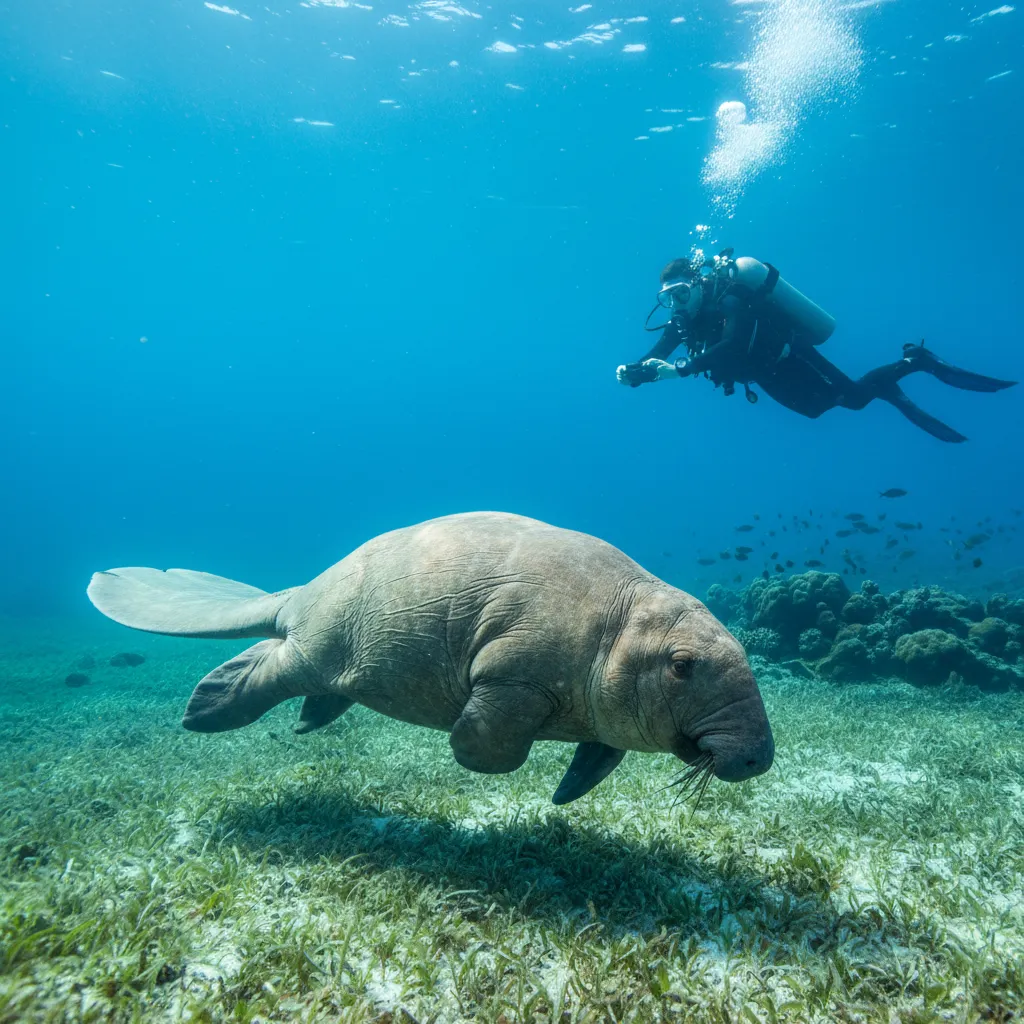
The dugong is the ocean's only herbivorous marine mammal - a gentle, rotund 'sea cow' that spends its days grazing on seagrass beds in the warm shallows of the Indo-Pacific. Closely related to elephants rather than whales, dugongs have a quiet, unassuming presence that belies their remarkable evolutionary history stretching back 50 million years. Encountering one underwater is a meditative experience: they move slowly and deliberately, their broad, flat tails sweeping gently as they vacuum up seagrass with their downturned snouts, occasionally surfacing for a breath with an audible sigh. In an ocean full of charismatic megafauna that dazzle with speed and power, the dugong offers something rarer - a moment of profound calm.
Where to Dive with Dugongs
Found across 9 countries, based on 2,523 verified observation records.

Australia
2 areas

Vanuatu
2 areas
New Caledonia
4 areas

Mayotte
1 area

India
2 areas

Singapore
1 area

Djibouti
1 area

Comoros
2 areas
+ 1 more country
Best Time to See Dugongs
Dugong encounters are available year-round at most locations, as these animals do not undertake long migrations. Marsa Alam (Egypt): year-round, with best visibility from March to November and warmest water from June to October. Coron (Philippines): year-round, though the best diving conditions are from November to May during the dry season. Shark Bay (Australia): year-round, with guided boat tours and kayak encounters. Vanuatu: year-round in select locations. Water temperatures across the dugong's range are consistently warm (24-30°C), as dugongs are restricted to tropical and subtropical waters. Sightings can vary day to day depending on feeding patterns and tidal conditions.
How to Dive with Dugongs
Dugong encounters are done by both snorkelling and scuba diving, depending on the location. Marsa Alam on Egypt's Red Sea coast is the world's most reliable destination - a resident dugong (or small group) has frequented the seagrass beds at Abu Dabbab Bay and Marsa Mubarak for years, and dive operators run daily trips. Encounters happen in 3-8 metres of water over sandy seagrass flats, making them accessible to both snorkellers and Open Water divers. In the Philippines, Coron's Dugong Dive Site offers scuba encounters. Australia's Shark Bay has the world's largest dugong population, though in-water encounters are less structured. The key is patience and gentleness - approach slowly, stay low to the seabed if diving, and let the dugong continue feeding undisturbed. Avoid blocking its path or surfacing route.
Is it Safe to Swim with Dugongs?
Dugongs are completely harmless to humans. They are slow-moving herbivores with no defensive behaviour beyond fleeing. The main consideration is not disturbing their feeding - dugongs need to consume large quantities of seagrass daily (up to 40kg), and repeated disturbance from divers can drive them away from essential feeding grounds. Never chase a dugong, and if it begins to move away, do not follow. Maintain a distance of at least 3 metres. In shallow water, be mindful of boat traffic overhead. At Abu Dabbab in Egypt, site-specific regulations limit the number of swimmers and establish approach zones. Some dugongs have become habituated to divers, but this should not be mistaken for an invitation to touch - always observe without contact.
Conservation Status
Dugongs are classified as Vulnerable by the IUCN, with populations declining across much of their range. They are critically dependent on seagrass beds, which are among the most threatened marine habitats globally - coastal development, pollution, dredging, and climate change are all destroying seagrass meadows at alarming rates. Dugongs also face threats from boat strikes, entanglement in fishing nets and shark nets, and hunting in some regions. Their slow reproductive rate - a single calf every 3-7 years, with a gestation period of 13 months - means populations recover extremely slowly from declines. Australia holds the largest remaining population (around 80,000), while populations in East Africa, the Persian Gulf, and Southeast Asia are fragmented and declining. Responsible diving tourism at sites like Marsa Alam provides local economic incentive to protect dugong habitats.
Species Profile

Recommended Equipment
For snorkelling encounters, a mask, snorkel, and fins are sufficient. Short fins work well in the shallow seagrass flats where dugongs feed. For scuba encounters, standard warm-water gear is appropriate - a 3mm wetsuit or shorty, BCD, and standard regulators. A camera with a wide-angle lens is ideal; dugongs are large (up to 3 metres) and encounters happen at close range in shallow, well-lit water. Avoid wearing bright, contrasting colours or making sudden movements. A rash guard provides sun protection during long surface swims over shallow flats. Reef-safe sunscreen is essential, as these encounters take place directly over sensitive seagrass habitats.
Browse dive equipmentFrequently Asked Questions
Where can you swim with dugongs?
The most reliable destination is Marsa Alam, Egypt, where resident dugongs graze on seagrass at Abu Dabbab Bay and Marsa Mubarak. Coron in the Philippines offers scuba encounters. Australia's Shark Bay has the world's largest population, and Vanuatu has accessible sightings.
What is the difference between a dugong and a manatee?
Dugongs and manatees are both sirenians but differ in several ways. Dugongs have a fluked, dolphin-like tail while manatees have a paddle-shaped tail. Dugongs are exclusively marine and found in the Indo-Pacific, while manatees inhabit freshwater, brackish, and coastal waters in the Americas and West Africa. Dugongs are generally slimmer with a more streamlined shape.
Are dugongs endangered?
Dugongs are classified as Vulnerable by the IUCN. Their dependence on declining seagrass habitats, slow reproduction rate (one calf every 3-7 years), and threats from boat strikes and fishing nets put many populations at risk. Australia holds the largest remaining population.
What do dugongs eat?
Dugongs are herbivores that feed almost exclusively on seagrass. They can consume up to 40kg of seagrass per day, grazing along the seabed with their broad, downturned snouts. They sometimes eat algae and invertebrates incidentally, but seagrass forms the vast majority of their diet.
How close can you get to a dugong while diving?
Maintain a minimum distance of 3 metres and never chase or corner a dugong. Let the animal control the interaction - some habituated individuals at sites like Abu Dabbab may approach closer on their own. Never touch a dugong, block its path, or prevent it from surfacing to breathe.
More Encounter Guides
Humpback Whales
Encountering a humpback whale underwater is one of the most profound experiences available to ocean ...
Orcas (Killer Whales)
Orcas are the ocean's apex predators - intelligent, social, and devastatingly effective hunters that...
Dolphins
Dolphins are the ocean's most joyful inhabitants, and swimming with them in the wild is an experienc...
Sperm Whales
The sperm whale is the largest toothed predator on Earth, a deep-ocean titan that routinely dives be...
Blue Whales
The blue whale is the largest animal ever to have lived on Earth - larger than any dinosaur, reachin...
Southern Right Whales
Southern right whales earned their grim name from whalers who considered them the 'right' whale to h...