Swimming in Jellyfish Lake
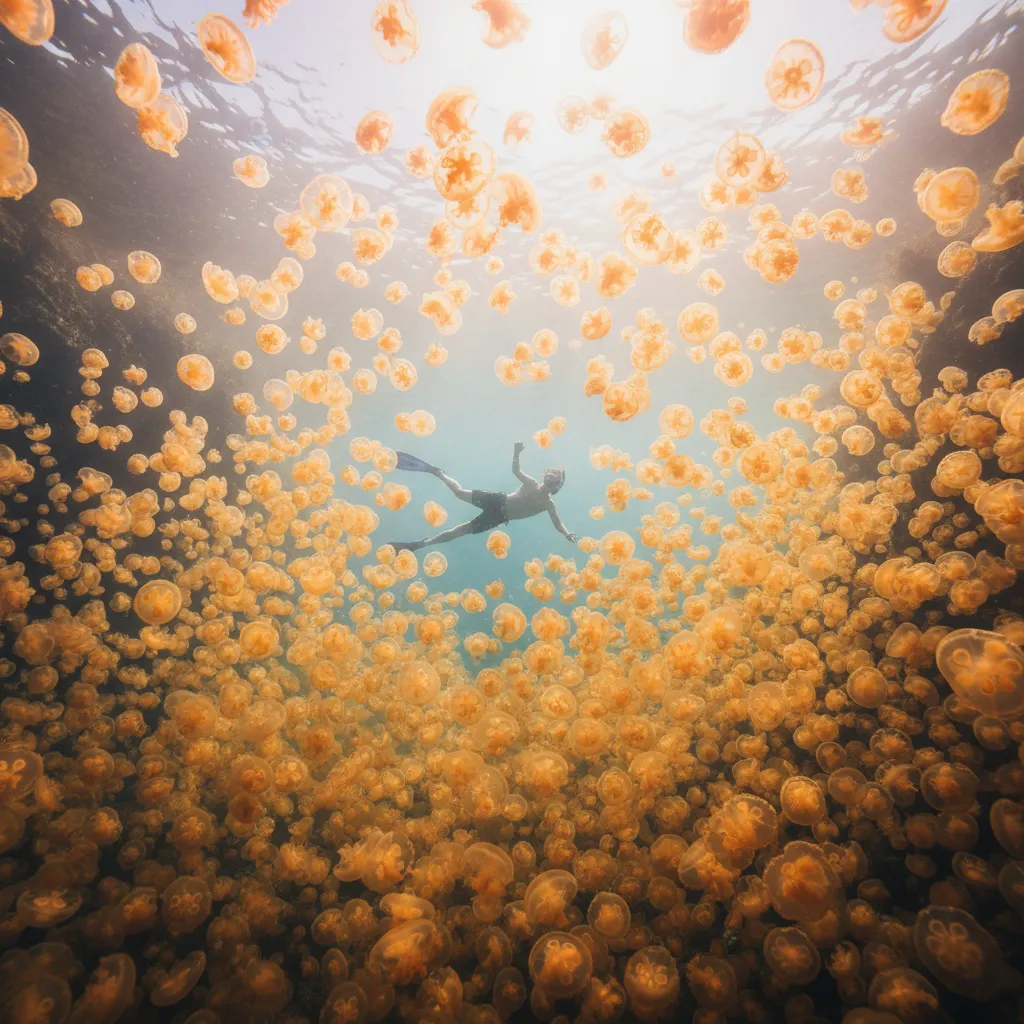
Imagine floating in warm, still water surrounded by millions of golden jellyfish - pulsing gently past you in every direction, bumping softly against your skin without the slightest sting. Jellyfish Lake (Ongeim'l Tketau) in Palau is one of the most surreal natural experiences on Earth. This isolated marine lake became separated from the ocean roughly 12,000 years ago, and its population of golden jellyfish (Mastigias papua etpisoni) evolved in the absence of predators, gradually losing their stinging ability over millennia. Twice daily, millions of these jellyfish migrate across the lake following the sun, which sustains the symbiotic algae living in their tissues. Similar stingless jellyfish lakes exist in Indonesia and the Philippines, each a unique evolutionary laboratory. The experience of drifting among millions of harmless jellyfish is profoundly peaceful and utterly unlike anything else in the underwater world.
Where to Dive with Jellyfish Lake
Found across 10 countries, based on 1,252 verified observation records.

Ireland
2 areas

United Kingdom
5 areas

Sweden
2 areas

Denmark
2 areas

Canada
3 areas

United States
1 area

Colombia
1 area

Japan
1 area
+ 2 more countries
Best Time to See Jellyfish Lake
Palau (Jellyfish Lake): accessible year-round, though the lake is occasionally closed for conservation or after population declines. The dry season (November to April) offers the best weather and calmest conditions. Jellyfish numbers fluctuate naturally - some months produce denser concentrations than others. Check current status before planning your visit. Kakaban Island, Indonesia: best visited from March to November during calmer seas. Tojoman Lagoon, Philippines: accessible year-round, with the best conditions from March to June. For general jellyfish encounters (moon jellies, etc.), temperate waters in late summer and autumn typically produce the largest blooms.
How to Dive with Jellyfish Lake
Jellyfish Lake in Palau is a snorkelling-only experience - scuba diving is prohibited because bubbles could harm the jellyfish and the lake's deeper layers contain toxic hydrogen sulphide. Access requires a Rock Islands/Jellyfish Lake permit, which can be purchased through dive shops and tour operators in Koror. The lake is reached by a short boat ride followed by a jungle trail over a rocky ridge. Once in the water, simply float and drift with the jellyfish. The densest concentrations are typically in the eastern part of the lake in the morning and the western part in the afternoon, as the jellyfish follow the sun. Do not dive below about 15 metres - the anoxic layer begins around this depth and is dangerous. In Indonesia, Kakaban Island in the Derawan archipelago has its own jellyfish lake with four species of stingless jellyfish. Tojoman Lagoon (Bucas Grande) in the Philippines offers a similar experience. For more conventional jellyfish encounters, moon jellies (Aurelia aurita) can be encountered in harbours, bays, and open water worldwide.
Is it Safe to Swim with Jellyfish Lake?
The golden jellyfish in Palau's Jellyfish Lake have vestigial stinging cells that cannot penetrate human skin - they are genuinely harmless. However, individuals with extreme jellyfish allergies should exercise caution. The primary safety hazard in Jellyfish Lake is the hydrogen sulphide layer that begins at approximately 15 metres depth. This toxic layer is absolutely lethal and is the reason scuba diving is prohibited. Snorkellers should not free-dive deep. Sun protection is important - the lake has no shade and the water surface reflects strongly. Apply reef-safe sunscreen before entering. At other jellyfish lake locations, stinging ability varies - confirm with local operators before entering. For open-water jellyfish encounters (moon jellies, etc.), a full-length rashguard or thin wetsuit provides protection against mild stings.
Conservation Status
Jellyfish Lake is ecologically fragile. The jellyfish population crashed during the 1998 El Nino event when rising water temperatures killed the symbiotic algae in their tissues, reducing the population from millions to near zero. The lake was closed to tourists until the population recovered. A similar crash occurred in 2016. Palau charges permit fees that fund conservation of the Rock Islands Southern Lagoon, a UNESCO World Heritage Site. Visitor numbers are managed to limit impact. The jellyfish are sensitive to physical disturbance - avoid kicking them with fins, wearing sunscreen that is not reef-safe, or creating strong currents. Kakaban Island's jellyfish lake faces threats from development and unregulated tourism. Climate change poses the greatest long-term threat, as these isolated lake ecosystems are extremely sensitive to temperature shifts.
Species Profile

Recommended Equipment
Snorkelling gear is all you need: mask, snorkel, and fins. Fins should be used gently - aggressive kicking can injure jellyfish and reduce visibility. A rashguard provides sun protection. An underwater camera is essential - this is one of the most photogenic experiences in the ocean. A wide-angle lens or action camera captures the immersive sensation of being surrounded by millions of jellyfish. A dome port for split-level (half-underwater, half-above) shots creates stunning images. Natural light photography works beautifully in the shallow, clear water of the lake. No strobes are needed in the bright surface conditions. Do not bring dive fins with hard edges - soft snorkelling fins are gentler on the jellyfish. Reef-safe sunscreen is mandatory.
Browse dive equipmentFrequently Asked Questions
Can you really swim with jellyfish without getting stung?
Yes, the golden jellyfish in Palau's Jellyfish Lake have evolved without predators for roughly 12,000 years and have lost their ability to sting humans. Their stinging cells are vestigial and cannot penetrate human skin. Similar stingless jellyfish lakes exist in Indonesia (Kakaban Island) and the Philippines (Tojoman Lagoon).
Why is scuba diving banned in Jellyfish Lake?
Scuba diving is prohibited for two reasons: bubbles can become trapped under the jellyfish bells and cause tissue damage, and the lake has a toxic hydrogen sulphide layer starting at approximately 15 metres depth that is lethal to breathe. The lake is strictly snorkelling only.
How do you get to Jellyfish Lake in Palau?
Jellyfish Lake is located on Eil Malk island in Palau's Rock Islands. You reach it by a short boat ride from Koror followed by a 10-15 minute jungle trail over a rocky ridge. A Jellyfish Lake/Rock Islands permit is required and can be purchased through local dive operators and tour agencies.
How many jellyfish are in Jellyfish Lake?
At peak populations, Jellyfish Lake contains an estimated 5-10 million golden jellyfish. Numbers fluctuate significantly - the population crashed to near zero during the 1998 and 2016 El Nino events when elevated water temperatures killed the symbiotic algae the jellyfish depend on. The population has recovered each time.
Are there other jellyfish lakes in the world?
Yes, Kakaban Island in Indonesia's Derawan archipelago has a jellyfish lake with four species of stingless jellyfish. Tojoman Lagoon in Bucas Grande, Philippines offers a similar experience. Several other marine lakes in Palau also contain jellyfish, though Ongeim'l Tketau (Jellyfish Lake) is the most famous and accessible.