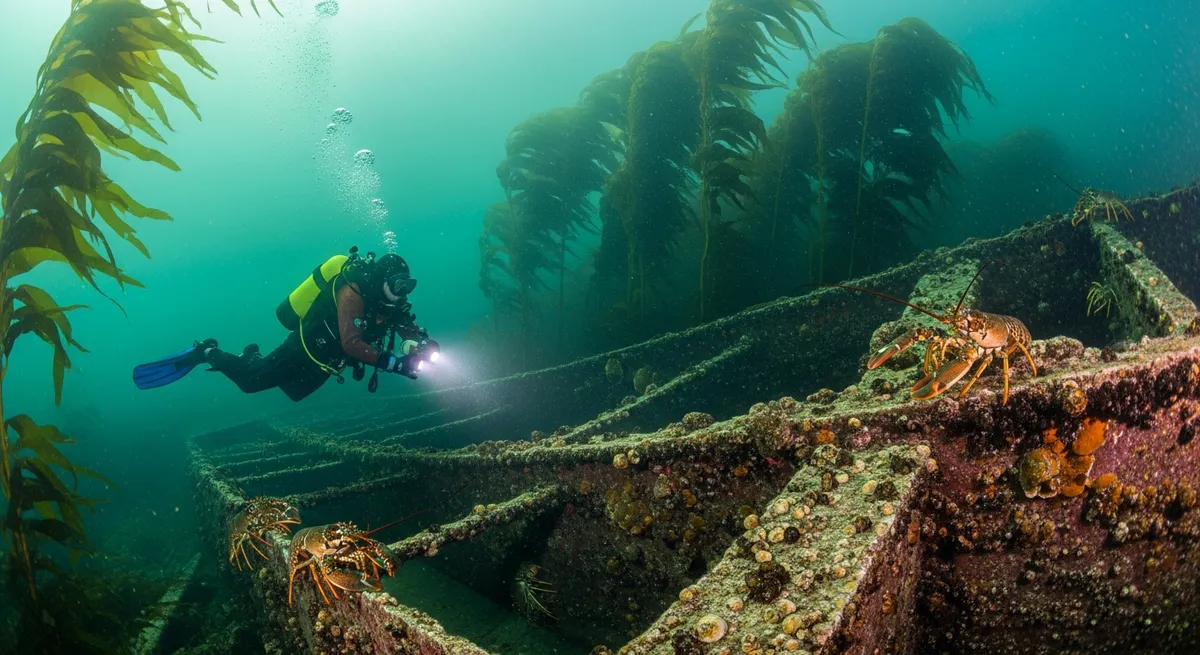
Diving in Nova Scotia
Why dive here
Nova Scotia offers some of Canada's richest diving, with 77+ marine species recorded in the area - including blue sharks, dwarf minke whales, humpback whales, ocean sunfish (mola mola) and jellyfish lake. Water ranges 1-17°C, warmest August, September, October.
Nova Scotia. The name itself conjures images of rugged coastlines and maritime history, and for us, it means some of the best wreck diving in Atlantic Canada. We've spent countless hours exploring the HMCS Saguenay, a destroyer purpose-sunk as an artificial reef, and every dive offers something new. The current can be brisk, but that's often what makes for excellent drift dives over those older wooden wrecks, scattering schools of Atlantic cod and moonfish. Forget your tropical fish; here, it’s about the sheer scale of the wrecks and the hardy, fascinating creatures that call them home. Look out for Atlantic rock crabs scuttling over corroded steel and the occasional wolf-fish peeking from a dark crevice - they’re surprisingly curious. Our favourite time to visit is late summer when the water is at its "warmest," usually around 12-15°C, and visibility can stretch to a decent 15-20 metres on a good day. It's a proper drysuit destination, obviously, but the rewards are massive. The sheer number of historic shipwrecks means you could spend a lifetime here and still find new things.
Nova Scotia Dive Site Map
Dive sites and dive centres in Nova Scotia
Nova Scotia Dive Sites
126 dive sites in Nova Scotia
Africville Park
Africville Park offers a straightforward shore dive, popular with local divers looking for an easy entry. The site is mostly sandy, with some rock formations that provide cover for crabs and small fish. It’s a decent spot for a casual exploration or for practicing skills, particularly suiting newer divers due to its generally calm conditions.
Anemones Alley
Anemones Alley in Nova Scotia lives up to its name, offering a wall covered in white-plumed anemones. It’s a pretty sight, with thousands of them swaying gently, particularly in the slight current often present. This site is a good pick for macro photographers or divers looking for a relaxing, shallower dive with plenty of stationary subjects. Just be prepared for colder water and the typical low-light conditions of the region.
Arctic Trader shipwreck
The Arctic Trader is a proper cold-water wreck, perfect if you’re into exploration over pretty colours. We love how much of the vessel is still there to poke around. You can trace the deck, drop into the holds, and even get a peek into the engine room, though things are silting up more each year. It’s got a real story to tell, even if you’re just imagining the crew on deck when she went down. This isn’t a warm-water drift over coral. Expect a chill, sometimes limited visibility, and the kind of rugged beauty only the Atlantic can deliver. We’ve found wolf eels tucked into cargo holds and schools of cod hovering in the superstructure. The best diving here is often on a calm morning, before any wind picks up and stirs the sediment. Our favourite part is navigating the internal spaces, keeping an eye out for those big Atlantic lobsters that call the wreck home. It's a dive that rewards careful buoyancy and a sense of adventure.
Avondale Reef
Avondale Reef, off the coast of Nova Scotia, is a surprising find for divers keen on exploring Canada's cooler waters. Here, you’ll encounter a resilient coral habitat thriving despite the northern temperatures. It's a site for those who appreciate the unique beauty of cold-water corals, offering a different kind of dive experience from the tropical norm. We'd suggest it for divers looking to tick off a distinctive Canadian reef.
BALEINE
The Baleine wreck, just off Nova Scotia's rugged coast, isn't your typical tropical jaunt, and that's exactly why we love it. This isn't about blinding sun and warm water, but rather the stark beauty of a historical trawler, swallowed by the cold Atlantic. We've spent a fair few hours nosing around her 18-meter depth, often finding ourselves alone with the resident wolfish and their grumpy stares. She’s a dangerous wreck, for sure, but that means a lot of her character remains intact. You'll find yourself gliding past collapsing deck structures, the ghostly shape of the bridge still discernible. The thrill here is in the exploration, in piecing together her past as you navigate around twisted metal and the occasional lost trawl net. Inside, the light filters down, playing tricks on your eyes, and that’s where the larger critters often hide. Look for the lobsters tucked into every available crevice, their antennae waving slowly in the gentle surge. Visibility can swing dramatically, from a murky ten feet to a respectable twenty, so pick a calm, sunny day if you can. It makes a world of difference. This isn’t a site for beginners; some solid cold-water experience and good buoyancy are a must to truly appreciate the Baleine.
Bayswater
Bayswater is a shore dive in Nova Scotia, a good spot for new divers to get comfortable. You’ll find a gradual slope, easy entry, and usually calm conditions. Expect to see some kelp, small fish, and maybe a crab or two scuttling on the bottom. It’s not a thrill-a-minute dive, but it's a solid training ground.
Big Duck Island
Big Duck Island, off Nova Scotia, offers cool-water diving with a good chance of seeing seals. The rocky seabed has plenty of nooks for crustaceans and smaller fish. It’s a good spot for divers looking for a quieter experience and a glimpse of Canadian Atlantic marine life.
Birchy Head
Birchy Head offers an easy shore entry in a sheltered cove. Down around 10 to 15 metres, you'll find boulders and kelp, usually with lobster and sculpins tucked amongst them. It’s a solid spot for local divers looking for a relaxed afternoon dive, particularly if you’re new to cold water or want to test out new gear. Visibility can be hit-or-miss, so pick a calm day.
Black Reef
Black Reef, off the coast of Nova Scotia, really stands out for its cold-water corals. It’s not the colourful, tropical kind, but a deep, somewhat eerie beauty that feels ancient. We've often found ourselves drifting along, mesmerised by the white and orange soft corals swaying in the current. It’s a site for those who appreciate the subtle drama of the North Atlantic. Visibility can be a mixed bag; we’ve had days where it stretched out to a good 15 metres, and others where it felt like diving in a cup of tea. Our tip is to check local reports for recent conditions. When it’s good, you’ll spot things like Atlantic Wolffish tucked into crevices, their grumpy faces peering out. We’ve also seen a surprising number of Lined seahorses clinging to kelp fronds, which is always a treat. Keep an eye out for various rocklings too, often camouflaged against the rocks. The water is consistently chilly, so a drysuit is non-negotiable here. Black Reef is best suited for experienced divers comfortable with cold water and variable conditions, offering a unique glimpse into a truly wild underwater ecosystem.
Black Rock Beach
Black Rock Beach offers a straightforward shore dive, handy for shaking off the rust or testing new gear. You'll navigate a rocky bottom, home to various small critters tucked into crevices. It's a solid choice for local divers looking for an easy, no-frills dive when the weather cooperates.
Blueberry Bay Reef
Blueberry Bay Reef gives you a taste of Nova Scotia’s cooler waters. It's a site that often surprises people with its quiet charm, even if it won't rival tropical destinations. We’ve found the best diving here happens on a calm day, when you can really settle in and search for the smaller stuff. Look out for American lobsters tucked into crevices and Atlantic cod patrolling the deeper sections. It’s a good spot for divers who enjoy a more relaxed pace, happy to explore the nooks and crannies.
Boutiliers Point
Boutiliers Point offers a straightforward shore dive in Nova Scotia. You'll find a rocky bottom sloping gently, with kelp beds providing shelter for sculpins and small crabs. It's a good spot for a relaxed shallow dive or for refreshing skills, with decent visibility on calm days.
Show all 126 dive sites in Nova Scotia
- Boyds Reef
- Broad Bank
- Bull Reef
- Bush Island
- Caribou Reef
- Charlos Reef
- CHRISTMAS SEAL
- Costa Rican Trader Shipwreck
- Cranberry cove
- Crazy Kate
- Cronie Reef
- Cross Island
- Cunningham Reef
- Doctor Reef
- Doctor Reef
- Downies Reef
- Duncan Reef
- Dunn Reef
- East End Reef
- East Point Reef
- Englishtown
- Featherings Reef
- Fergusons Cove
- Ferry Reef
- Fox Point Anglican Church
- Fox Point Beach
- Goillon Reef
- Grannies Brunt
- HALHAWK
- Hape Reef
- Hawkin Reef
- Hayes Gardens
- Hell Rackets
- Hell Rackets
- Hell Reef
- Herring Cove - Hebridean Park
- HMS Saguenay
- Hospital Reef
- Hubbards Shrimp Cannery Beach
- Hunters Reef
- Huskins Reef
- Indian Point
- Inman Reef
- Iona - Grand Narrows
- Isabells Beach
- Jackson Reef
- Jollimore Reef
- Kitts Reef
- Lewis Reef
- Little Duck Reef
- Lloyds Rock Reef
- Long Cove
- Long Reef
- Long Reef
- Long Reef
- Long Reef
- Lower Prospect Community Wharf
- Lucys Bar
- Macdonald Reef
- MacLeans Reef
- MacLeans Reef
- Marys Point Reef
- McAulays Reef
- Mill Cove
- Murray Point
- Nanny Island Reef
- Narrows Reef
- New Bear Cove
- New Harbour
- Nixons Mate
- Nixons Mate
- Northwest Reef
- O'Brien Reef
- ODYSSEUS (POSSIBLY)
- Old Cow Reef
- Ovens point - Rose Bay
- Paddys Head
- Parliament Rock
- Peach Passage
- Peggys Cove
- Prim Reefs
- Princess Lodge
- Prospect Community Wharf
- Prospect - Indian Pt Rd Cove
- Pugwash Reef
- Sambro Bridge
- Sand Reef
- Sandy Cove
- Sandy Cove Sambro Area
- Seal Rock
- Second Penninsula
- Shad Bay Breakers
- Shag Reef
- Skinners Reef
- Snipe Reef
- SOURIS TRADER
- Southeast Prong
- Southeast Reef
- Southern Head Reef
- Southwest Beach Reef
- Southwest Prong
- Steering Reef
- The Bluff
- The fish shack
- The Muff
- The Reef
- VONJO
- Walton Gypsum Quarry
- Warrior Reef
- Washball Reef
- Western Reef
- Western Reef
- Williams Reef
- Zealandia Wreck Grand Narrows
Nova Scotia Dive Centres
42 dive shops and operators in Nova Scotia
Action Scuba, Inc.
Aqua Dive & Watersports
Aqua Plein Air, Inc.
Aqua Sub Scuba Diving Centre
Benthic Scuba Center
Centre de découverte du milieu marin
Centre de Plongée du Bas St-Laurent
Centre de Plongee Nepteau
Show all 42 dive centres in Nova Scotia
- Cross Current Divers
- Dan's Dive Shop, Inc.
- Dive Kawartha
- Dive Life Tobermory
- Diver City Scuba Inc.
- Dive Source Scuba
- Dive World Inc.
- Diving Dynamics
- East Coast Scuba and Watersports
- Generation Wave Scuba Services
- IDC Diving Centre, Ltd.
- Kanata Diving Supply
- Kocher's Diving Locker, Ltd.
- La Boutique Du Plongeur (Triton) Ltee
- La Scubatheque
- La Scubathèque
- Nautilus
- Neptune & Salacia Diving
- Northwest Scuba, Ltd.
- Pavillon des grandes marées
- Plongé
- Plongé
- Plongee Aqua-Mundo Inc.
- Plongée Capitale
- Plongee Capitale 2000
- Plongee CPAS
- Plongée Forillon
- Plongee Sous-Marine Nautilus
- Plongee Sous-Marine Summum
- Plongee XL
- Sub Aqua Tech 2022
- The Dive Shack
- Torpedo Rays Scuba Adventures
- YRVA
Ocean Wildlife in Nova Scotia
77 species recorded in Nova Scotia
Nova Scotia Daylight & Sunrise/Sunset
Sunrise and sunset times for Nova Scotia, calculated from coordinates
Today - Sunday 11 October
Sunrise
06:24
Sunset
17:40
Daylight
11h 16m
Golden Hour
17:01
First light (dawn) at 05:54 · Last light (dusk) at 18:09
Monthly Averages
| Month | Sunrise | Sunset | Daylight |
|---|---|---|---|
| Jan | 07:49 | 16:58 | 9h 9m |
| Feb | 07:17 | 17:41 | 10h 24m |
| Mar | 06:30 | 18:19 | 11h 49m |
| Apr | 05:32 | 18:58 | 13h 26m |
| May | 04:48 | 19:35 | 14h 47m |
| JunLongest | 04:28 | 20:02 | 15h 34m |
| Jul | 04:42 | 19:59 | 15h 17m |
| Aug | 05:16 | 19:24 | 14h 8m |
| Sep | 05:52 | 18:29 | 12h 37m |
| OctNow | 06:29 | 17:33 | 11h 4m |
| Nov | 07:11 | 16:48 | 9h 38m |
| DecShortest | 07:45 | 16:34 | 8h 49m |
Times are approximate local times based on longitude. Actual times may vary slightly depending on the exact timezone observed in Nova Scotia.
Where to Stay near Nova Scotia
Prices from Booking.com. We may earn a commission at no extra cost to you.
Marine Protected Areas near Nova Scotia
39 protected areas near Nova Scotia - please respect local regulations when diving
Western and Emerald Banks Marine Refuge
Scallop Buffer Zone (SFA 22)
Scallop Buffer Zone (SFA 24)
Emerald Basin and Sambro Bank Marine Refuge
Maqpa’q Mi’kmac name
Southern Bight-Minas Basin
Shepody Bay
Musquodoboit Harbour
Mary’s Point
Falaises fossilifères de Joggins
Ellens Creek Estuary Natural Area and Wildlife Management Area
Cape Jourimain National Wildlife Area
Showing 12 largest of 39
Getting to Nova Scotia
Halifax
Greenwood
Charlottetown
Plan & book
Ways to dive Nova Scotia, from day trips to liveaboards.
Day trips & courses
via GetYourGuideGuided dives, courses and snorkel trips with instant booking.
Find dive trips in Nova ScotiaPlaces to stay
via Booking.comHotels and dive resorts near Nova Scotia.
Search stays in Nova ScotiaDive insurance
Most travel insurance excludes or limits scuba. Check what you need before you go.
Dive insurance explainedPartner links: we may earn a commission if you book, at no extra cost to you. How we make money