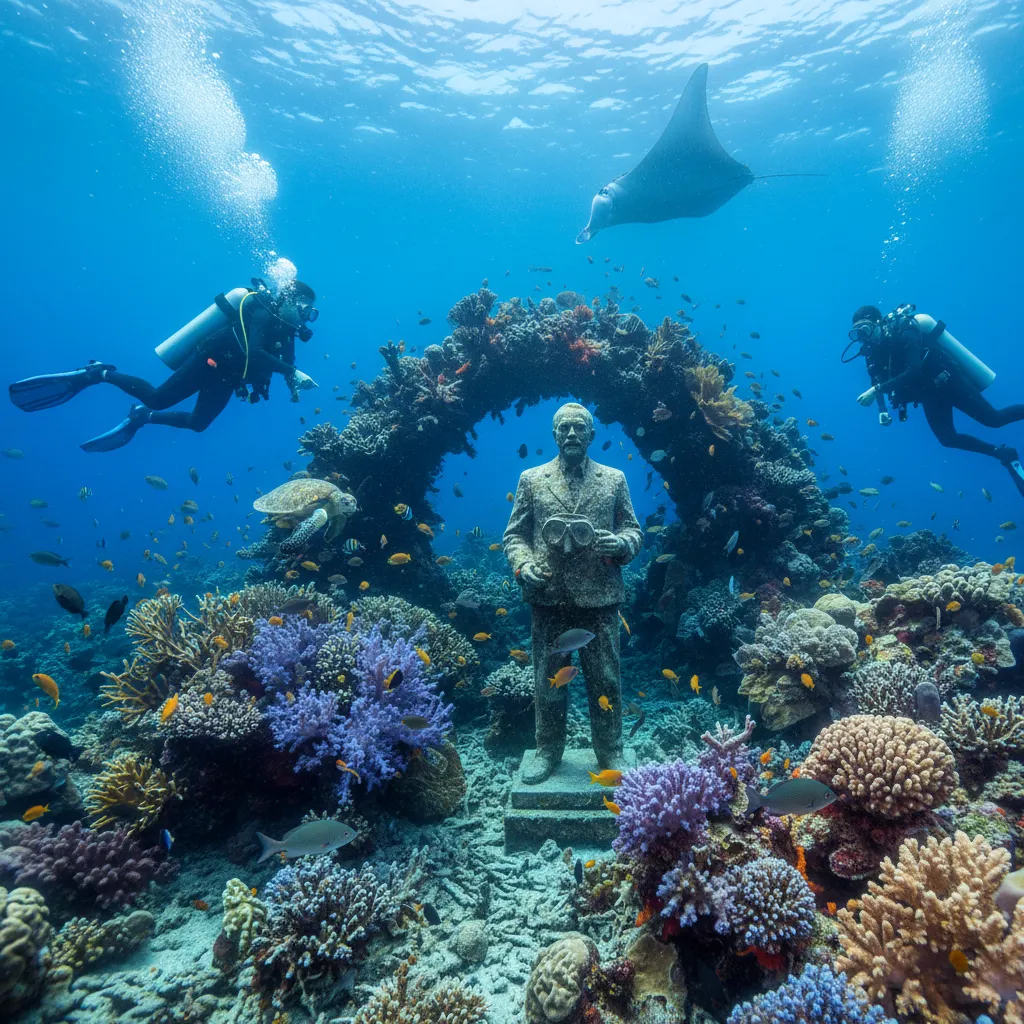
Diving in Cousteau Reserve
Why dive here
Cousteau Reserve offers some of Guadeloupe's richest diving, with 331+ marine species recorded in the area - including barracuda, dolphins, dwarf minke whales, humpback whales and manta rays. Water ranges 27-30°C, warmest August, September, October.
Cousteau Reserve, off Pigeon Island, isn’t just famous because the man himself loved it; it’s genuinely great diving. We’ve spent weeks here, and it still pulls us back. Dropping onto the reef, you often find yourself swimming through schools of horse-eye jacks, a silver curtain parting around you. We’ve seen batfish gliding lazily over the sponges and, if you keep your eyes peeled in the sandy patches, the peculiar Longarm Brotula peeking out. Our favourite dive here is the wreck of the Franjack, a small cargo ship lying on its side. It’s an easy penetration for those with the right training, but even from the outside, it’s alive with bicolor damselfish flitting among the coral growth. Current can pick up a bit around the pinnacles, so keep an eye on the dive flag, but mostly it’s a gentle drift. Visibility generally hovers around 20-25 metres, and the water stays warm, usually 26-29°C. If you’re lucky enough to be there between January and May, you might even hear the haunting calls of humpback whales, a real thrill underwater. It’s accessible for all levels, and the sheer number of sites means you won't get bored quickly.
Cousteau Reserve Dive Site Map
Dive sites and dive centres in Cousteau Reserve
Cousteau Reserve Dive Sites
63 dive sites in Cousteau Reserve
Anse à La Barque
Anse à La Barque is a decent spot in the Cousteau Reserve, especially if you’re new to diving or just want a relaxed afternoon. The reef here is pretty gentle, a gradual slope down to about 20 metres. You’ll find plenty of small reef fish flitting about and we often spot southern stingrays tucked into the sandy patches. It's calm, usually, making it a good confidence builder before tackling some of the reserve’s more exposed sites.
Anse Caraïbe plongée
Anse Caraïbe is a good spot for a relaxed dive in the Cousteau Reserve. We often find it a pleasant drift, with visibility usually staying around the 15-20 meter mark on a good day. Keep an eye out for the smaller stuff here, particularly the different brittle stars clinging to sponges, and we’ve seen Atlantic Yellow Cowries tucked into crevices. It’s a gentle introduction to the reserve’s diving, making it a comfortable option for divers looking for an easy afternoon out.
Anse Christophe
Anse Christophe is a pretty mellow dive in Cousteau Reserve, a solid choice for those just getting their fins wet or wanting a relaxed afternoon. The maximum depth here is 20 metres, making it comfortable for newer divers to cruise around. You'll find yourself drifting past scattered coral patches and sponges, often home to parrotfish grazing the reef and smaller schooling fish like grunts and snappers. We’ve spotted a few moray eels tucked into the rocks and sometimes a stingray gliding over the sandy bottom. It's a gentle introduction to Guadeloupe's underwater world, easy to navigate, and generally free of strong currents.
Anse des Tortues
Anse des Tortues, in Guadeloupe's Cousteau Reserve, is a really solid choice for new divers or anyone wanting a relaxed dive. We’re talking a gentle 16-meter maximum depth, so it's easy to control your buoyancy and just cruise. You’ll find a sandy bottom with patches of seagrass, which are prime feeding grounds for green sea turtles. Keep an eye out for them, often just munching away, totally unfazed. It’s a good spot to practice your photography without fighting current or deep profiles.
Anse Thomas
Anse Thomas is a shallow, relaxed dive within Cousteau Reserve, perfect for newer divers or those looking for an easy second dive. At 17 meters, you'll find a gently sloping reef with plenty of juvenile fish darting amongst the sponges and soft corals. We often spot schooling grunts and snapper here, along with the occasional moray eel peeking from a crevice. It’s a comfortable, unchallenging dive.
Aplysina
Aplysina. Even the name whispers “sponges,” and trust us, it delivers. We love how this site, shallow as it is at just 11 metres, just feels… *soft*. It’s not about dramatic drop-offs or roaring currents here. It’s a gentle wander through fields of those fantastic rope sponges, golden and purple, some as thick as your arm, others twisting upwards like corkscrews. You’ll also spot plenty of barrel sponges and pipe sponges, creating a maze of nooks and crannies. The light filters through the water beautifully, dappling the sand and making the sponges glow. We’ve found cowfish peeking out from behind a particularly chunky barrel sponge, and those red cushion sea stars just pop against the muted corals. Keep an eye out for brittle stars too, their tiny arms waving from every crevice; there are so many varieties here. This is a perfect site for photographers, especially macro fans, or anyone who enjoys a relaxed, detailed exploration. It’s also our pick for a really pleasant second dive, or for those days when you just want to take it slow and soak it all in.
Aplysina
Aplysina. Even the name whispers “sponges,” and trust us, it delivers. We love how this site, shallow as it is at just 11 metres, just feels… *soft*. It’s not about dramatic drop-offs or roaring currents here. It’s a gentle wander through fields of those fantastic rope sponges, golden and purple, some as thick as your arm, others twisting upwards like corkscrews. You’ll also spot plenty of barrel sponges and pipe sponges, creating a maze of nooks and crannies. The light filters through the water beautifully, dappling the sand and making the sponges glow. We’ve found cowfish peeking out from behind a particularly chunky barrel sponge, and those red cushion sea stars just pop against the muted corals. Keep an eye out for brittle stars too, their tiny arms waving from every crevice; there are so many varieties here. This is a perfect site for photographers, especially macro fans, or anyone who enjoys a relaxed, detailed exploration. It’s also our pick for a really pleasant second dive, or for those days when you just want to take it slow and soak it all in.
Aquarium
The Aquarium, perched on the northern edge of Pigeon Island, often gets overlooked for its deeper, flashier neighbours. Big mistake. This shallow coral garden, maxing out at a gentle 12 metres, is a personal favourite for a reason. It truly lives up to its name, a kaleidoscope of motion that feels like swimming inside a giant fish tank. We love dropping in here for a relaxed second dive, or for introducing new divers to the magic of the Reserve. The light is incredible, especially mid-morning, filtering through the water and illuminating every crevice. You’ll weave through small coral heads, spotting juvenile snapper darting for cover and schools of fusiliers swirling so thick they almost block your view. Keep an eye out for King Mullet sifting through the sand, their barbels twitching, and we’ve even seen a rather relaxed reef bass tucked into a coral overhang more than once. The calm conditions mean you can truly linger, watching the intricate dance of the reef unfold. It’s pure, unadulterated underwater chill.
Balise de Petit Canal
Balise de Petit Canal, right in the heart of Cousteau Reserve, is a shallow site we always bring new divers to, or anyone looking for a really relaxed afternoon dip. The red and white buoy itself is an absolute magnet for fish, a metal pillar completely encrusted and drawing in clouds of sergeant majors and chromis. We often see porkfish and the occasional school of snapper circling the structure, particularly in the later afternoon. But it's not just the buoy. Drift a little away from it and you'll find these surprisingly healthy patches of coral, home to some fascinating creatures if you take your time. We've spotted those delicate serpent brittle stars winding through the polyps, and once even saw a tiny darter goby darting into a crevice. The water here is usually that vivid turquoise, and at only 8 metres, the light penetration is fantastic. Visibility often pushes past 30 metres, which just makes everything feel wide open and inviting. It’s a gentle introduction to the Caribbean’s underwater world, perfect for building confidence or just enjoying a peaceful, easy dive.
Balise de Petit Canal
Balise de Petit Canal, right in the heart of Cousteau Reserve, is a shallow site we always bring new divers to, or anyone looking for a really relaxed afternoon dip. The red and white buoy itself is an absolute magnet for fish, a metal pillar completely encrusted and drawing in clouds of sergeant majors and chromis. We often see porkfish and the occasional school of snapper circling the structure, particularly in the later afternoon. But it's not just the buoy. Drift a little away from it and you'll find these surprisingly healthy patches of coral, home to some fascinating creatures if you take your time. We've spotted those delicate serpent brittle stars winding through the polyps, and once even saw a tiny darter goby darting into a crevice. The water here is usually that vivid turquoise, and at only 8 metres, the light penetration is fantastic. Visibility often pushes past 30 metres, which just makes everything feel wide open and inviting. It’s a gentle introduction to the Caribbean’s underwater world, perfect for building confidence or just enjoying a peaceful, easy dive.
BERTINA
Bertina isn't just a wreck; it's a testament to nature's power and its resilience. This dredger, driven ashore by Hurricane Hugo back in '89, now lies in the shallows, a skeletal outline against the blue. We love how accessible it is, literally starting at 0m, making it perfect for snorkelers and newer divers alike, but there's enough character for experienced folks too. What you'll find here is less about penetration and more about exploration around the edges. Her stern rises closest to the surface, and as you fin along the remaining hull plates, you’ll spot parrotfish grazing on algae, their beaks scraping audibly if you listen closely. Schools of juvenile snapper often shelter within the broken sections, darting in unison as you approach. It's a slow dive, a place to really take your time, looking for the tiny nudibranchs that cling to the rusting metal or watching the damselfish fiercely guard their patches of coral growth. The way the light plays through the gaps in the wreck, especially on a sunny afternoon, paints the sand in shifting patterns of gold and blue. It’s a gentle introduction to wreck diving, less about the deep mystery and more about the ongoing story of a ship reclaimed by the sea.
Bouée Anticyclonique
Bouée Anticyclonique in Cousteau Reserve is a solid drift dive, a really pleasant way to see some classic Caribbean reef. We’ve found the currents here are usually gentle, just enough to carry you along without much effort. The drop-off is particularly nice, sloping down to about 25 metres, and the visibility often hits 20 metres or more. We especially like the sandy patches in between the coral bommies; they’re often home to Heart Urchins and we’ve spotted Orangespotted Filefish flitting about. It’s not a dramatic wall, but the coral coverage is healthy, mostly brain corals and some big barrel sponges. Look closely in the nooks and crannies for juvenile snappers. We also often see schools of Blue Runners and Round Scad hanging in the blue, just off the reef. If you’re lucky, you might even catch a glimpse of a dolphin pod passing by – it’s rare, but we’ve had friends see both Bridled and Atlantic Spotted Dolphins here. This site is great for divers who enjoy a relaxed drift and appreciate the smaller details of a healthy reef. It’s perfect for photography or just an easy, enjoyable cruise.
Show all 63 dive sites in Cousteau Reserve
- Buste du Commandant Cousteau
- Crazy coral
- Eden plongée
- Epave Augustin Fresnel (Wreck)
- Epave du Gustavia (Wreck)
- Epave Le Franjack
- Epave Le Gustavia
- GROS MORNE INTERIEUR
- GROTTES DE FERRY
- Gwadive
- ISMINI
- Jardin de corail
- Jardin de Corail
- Jardin Japonais
- La Caye
- LA CHAISE
- La Piscine
- La Plongée Caribéenne
- La pointe à vache
- Le Canon
- Le Jardin de Corail
- Les Augustins
- Les Baillantes Tortues
- Le Sec Pâté
- Les sources d eau chaude
- LE STANIOR
- Le Tunnel de la Grande Vigie
- Machette
- Mambo
- Noa Plongée
- Note Bleue Plongée
- PAUL THOMAS
- PETIT MALENDURE
- Platax
- POINTE AUX FOUS
- Pointe Barque
- Pointe Barracuda
- POINTE BATTERIE
- Pointe Carangue
- POINTE FERRY
- Pointe Lézarde
- Pointe Mahaut
- Pointe Malendure
- POINTE MORPHY
- PPK Plongée Guadeloupe
- Quecy
- Rocroy
- Sec Delgrès
- Sec Pâté
- Snorkeling Park
- Source chaude
Cousteau Reserve Dive Centres
8 dive shops and operators in Cousteau Reserve
Ocean Wildlife in Cousteau Reserve
331 species recorded in Cousteau Reserve
Cousteau Reserve Daylight & Sunrise/Sunset
Sunrise and sunset times for Cousteau Reserve, calculated from coordinates
Today - Sunday 11 October
Sunrise
05:59
Sunset
17:50
Daylight
11h 51m
Golden Hour
17:21
First light (dawn) at 05:37 · Last light (dusk) at 18:12
Monthly Averages
| Month | Sunrise | Sunset | Daylight |
|---|---|---|---|
| Jan | 06:39 | 17:54 | 11h 15m |
| Feb | 06:34 | 18:10 | 11h 36m |
| Mar | 06:16 | 18:17 | 12h 1m |
| Apr | 05:53 | 18:22 | 12h 29m |
| May | 05:38 | 18:30 | 12h 52m |
| JunLongest | 05:35 | 18:40 | 13h 5m |
| Jul | 05:43 | 18:44 | 13h 1m |
| Aug | 05:52 | 18:33 | 12h 41m |
| Sep | 05:56 | 18:11 | 12h 15m |
| OctNow | 05:59 | 17:47 | 11h 48m |
| Nov | 06:10 | 17:34 | 11h 23m |
| DecShortest | 06:27 | 17:37 | 11h 10m |
Times are approximate local times based on longitude. Actual times may vary slightly depending on the exact timezone observed in Cousteau Reserve.
Where to Stay near Cousteau Reserve
Prices from Booking.com. We may earn a commission at no extra cost to you.
Marine Protected Areas near Cousteau Reserve
29 protected areas near Cousteau Reserve - please respect local regulations when diving
Agoa
Guadeloupe
Guadeloupe [Aire D\'Adhésion]
Grand Cul-de-Sac Marin de la Guadeloupe
Guadeloupe
Petite Terre
Iles De La Petite Terre
Terre-De-Haut
La Désirade
Ilots De Sainte Rose
Gros Morne - Grande Anse
Pointe Allegre
Showing 12 largest of 29
Getting to Cousteau Reserve
Pointe-à-Pitre
Gerald's Park
Osbourn
Plan & book
Ways to dive Cousteau Reserve, from day trips to liveaboards.
Day trips & courses
via GetYourGuideGuided dives, courses and snorkel trips with instant booking.
Find dive trips in Cousteau ReservePlaces to stay
via Booking.comHotels and dive resorts near Cousteau Reserve.
Search stays in Cousteau ReserveDive insurance
Most travel insurance excludes or limits scuba. Check what you need before you go.
Dive insurance explainedPartner links: we may earn a commission if you book, at no extra cost to you. How we make money