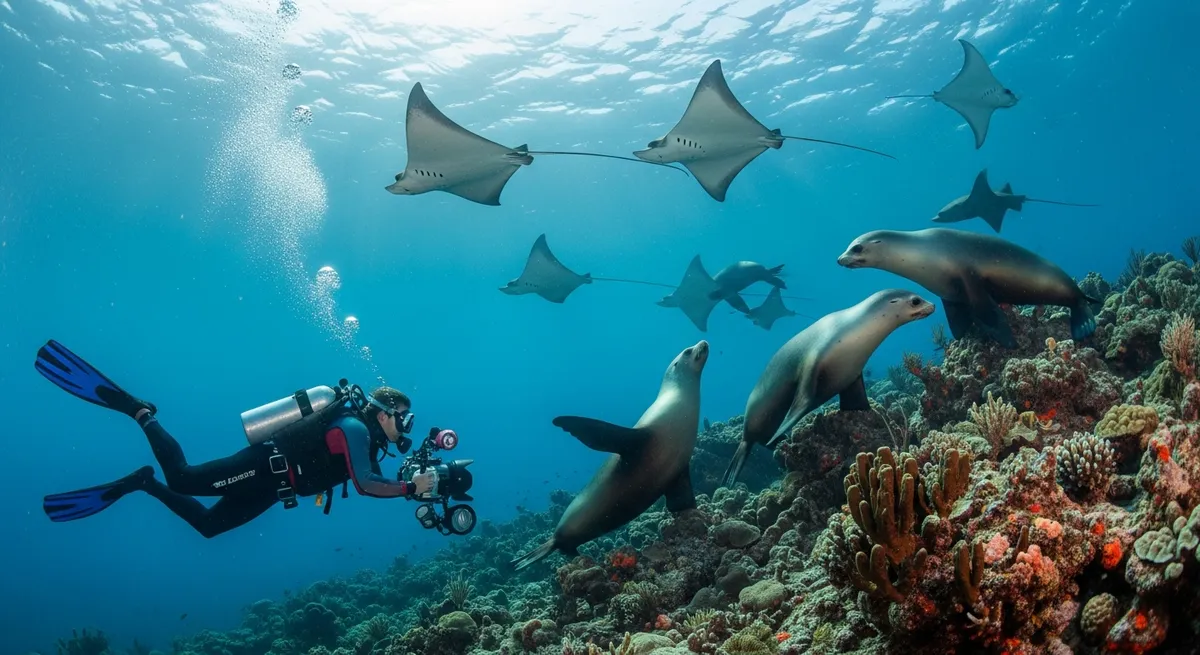
Diving in Sea of Cortez
Why dive here
Sea of Cortez offers some of Mexico's richest diving, with 195+ marine species recorded in the area - including blue whales, dolphins, humpback whales, nurse sharks and orcas. Water ranges 21-31°C, warmest August, September, October.
The Sea of Cortez, the *aquarium du monde* as Cousteau called it, truly lives up to its name. We love this stretch of water for its sheer unpredictability; one day it's a calm drift past schooling scissortail chromis, the next you're eye-to-eye with a playful sea lion pup. Dive sites here range from gentle pinnacles to dramatic walls, many of them home to huge aggregations of mobula rays, especially in the late summer and fall. Keep an eye out for the smaller stuff too, like the moonstruck stargazer peering from the sand, or a bold orangethroat pikeblenny flitting around a rock. Our favourite time to visit is October through December, when the water still holds some warmth and the chances of spotting whale sharks are at their peak. It’s also when the sea lion colonies are particularly active, with young pups zipping around, tugging fins and generally putting on a show. Just remember that currents can pick up, particularly around the exposed seamounts, so a bit of experience certainly helps. The visibility isn't always Caribbean-clear, sometimes dropping to 10-15 meters, but the sheer volume of life more than makes up for it. We always come back feeling a little more connected to the wild side of diving here.
Sea of Cortez Dive Site Map
Dive sites and dive centres in Sea of Cortez
Sea of Cortez Dive Sites
53 dive sites in Sea of Cortez
Anegada Rock
Anegada Rock offers a straightforward rocky dive, typical of the Sea of Cortez's coastline. You'll find a decent scattering of reef fish here, along with the occasional moray eel tucked into crevices. It's a solid choice for a second dive of the day, or for newer divers looking to get comfortable in the local conditions without too much current. We'd suggest it for an easy, pleasant dive rather than seeking out major pelagics.
Bait Boat
The Bait Boat wreck in the Sea of Cortez is one of our favourite dives when we’re in the area. We love a wreck with a story, and this fishing boat, purposefully sunk, has really settled into its new life as a reef. Descending, you’ll first notice the sheer number of schooling fish – often jacks and snapper swirling around the superstructure, so thick they almost obscure the bow. It’s an easy dive, sitting in comfortable depths, making it perfect for a relaxed exploration. Penetration is possible for trained wreck divers, but even if you just stick to the exterior, there’s plenty to see. Look closely at the deck plating and you’ll spot a surprising amount of macro life: nudibranchs, tiny crabs, and sometimes even an octopus tucked into a crevice. The wheelhouse is a particular highlight, now completely covered in soft corals, swaying gently with the surge. We’d suggest going in the morning; the light filtering through the water and reflecting off the sandy bottom really brings out the colours of the corals and the iridescent scales of the fish.
Barco Encayado
Barco Encayado, or "Stranded Ship", is one of our favourite wreck dives in the Sea of Cortez. It’s an old wooden fishing boat, probably from the 1940s, sitting upright in about 10 meters of water. We love the way the light filters through the shallow water, illuminating the hull and the schools of baitfish that swirl around it. You can swim right through the wheelhouse and peek into the hold, which is now home to green moray eels and grumpy-looking scorpionfish. The wreck itself is slowly disintegrating, but that’s part of its charm; it’s a living reef now, covered in colourful sponges and small hard corals. We’ve seen octopuses tucked into crevices, their eyes watching us as we fin past. This site is brilliant for photographers, especially macro shooters, and because it’s so shallow, you get a good long bottom time. It’s an easy, relaxed dive, perfect for a second dive of the day or for divers who want to take their time exploring.
C29
The C29 is an interesting wreck in the Sea of Cortez, definitely worth a dive if you're in the area. It sits upright, relatively intact, making for easy navigation around the main structures. We often find large schools of barracuda hanging off the bow, and a good look through the more open sections usually reveals a few green moray eels tucked away. This site is a great pick for divers who enjoy poking around a bit, exploring the nooks and crannies where groupers and snappers like to hide. It's not the deepest wreck, making for decent bottom time.
Cabo Pulmo
Cabo Pulmo, once a quiet fishing village, now stands as a testament to effective conservation. This national marine park in the Sea of Cortez, protected since 1995, offers a compelling look at a revitalized ecosystem. We've seen dense schools of jacks and fusiliers here, often swirling into those mesmerizing bait balls. Look out for bull sharks patrolling the deeper edges of the reef or turtles gracefully navigating the coral. It's a fantastic spot for divers keen on seeing marine life thrive, and a good reminder of what protection can achieve.
Cabo Pulmo Divers
Cabo Pulmo Divers, the namesake site, often gets overlooked for some of the flashier spots in the park, but we always make a point of dropping in here. It’s got a consistent vibe, a real steady performer. You'll find it shallower, generally 5 to 20 metres, and it’s a brilliant introduction to the park's buzz without the deeper commitment. What we love here is the sheer density of the smaller stuff that forms the foundation of the Cabo Pulmo food chain. We're talking about those massive shoals of Glasseye Snapper and Common Yellowtail Croaker. They often hang in shimmering clouds, catching the light just right, making the whole reef feel alive. It’s not just the big schools though. Take your time and you'll spot some gems like the Masked Moray peeking from a crevice or a well-camouflaged Player Scorpionfish. Keep an eye out for the Cortez Round Stingrays often resting on the sand patches, too. It’s a site that rewards a slow, observant dive, perfect for photographers or anyone who likes to really soak in the details rather than chase pelagics.
Cabo San Lucas
Diving Cabo San Lucas puts you among the famous arch formations. It’s a shallow dive, maxing out at 20m, which makes it a good spot for newer divers or those looking for an easy second dive. You'll often find sea lions cruising by, plus the usual schooling fish. It's an accessible entry point to the Sea of Cortez.
Chileno Reef
Chileno Reef offers a gentle introduction to the Sea of Cortez’s coral environments. You’ll drift past patches of hard coral, often spotting smaller reef fish like damselfish and wrasse flitting between them. It’s a good spot for newer divers or those looking for a relaxed dive, usually with mild currents. Keep an eye out for moray eels tucked into the crevices.
COLIMA
The *Colima* wreck, a historic motor vessel, lies upright in just 18 metres of water, making it a fantastic dive for a wide range of certifications. We love how accessible it is, and honestly, the story behind its sinking in 1939 – a storm on its way to Cabo to deliver supplies – adds a real layer of atmosphere. You can poke around the bow and stern, peer into the holds, and even get a sense of the old engine room, though penetration is definitely for experienced wreck divers only. What really stands out here is the marine life that's made this old ship home. Schools of grunts and snappers hang thick over the decks, shimmering in the shafts of sunlight. Look closely in the nooks and crannies for moray eels peering out, and we've seen some impressive octopus here too, masters of camouflage against the rusted hull. Our favourite spot is usually around the stern, where the prop is still visible and often hosts a particularly colourful collection of damselfish. Visibility can be decent, though sometimes a surge can kick up the silt, so we’d suggest timing your dive for calm mornings if you can. It’s a great site for photographers who appreciate the drama of a good wreck with plenty of fish life.
CONQUISTADOR
The Conquistador sits upright on a sandy bottom, a fishing vessel from a bygone era, sunk back in '85 after an engine room fire. We love a wreck with a story, and this Tacoma-built boat certainly has one. At 50 metres long, it's a decent size, and we usually find ourselves making at least two passes, often more. There’s a noticeable tilt to port as you descend, giving the whole structure a slightly disorienting, yet intriguing, feel. We've found the wheelhouse is a great spot to peer inside, often finding schools of glassy sweepers hanging in the shadows. Look for the engine room access, though we generally advise caution with overhead environments on older wrecks like this, especially when currents pick up. Moray eels are common residents, their heads poking from various nooks and crannies. The open cargo holds are fascinating, letting in shafts of sunlight that illuminate the metal structure, now softened by a vibrant tapestry of sponges and soft corals. It’s a photographer’s delight, especially when the light is right – usually mid-morning. We recommend checking the local current reports; while generally mild, a strong push can make navigating the exterior a bit more work. This wreck suits divers who appreciate history and the way the sea reclaims its own, offering plenty to explore without excessive depth.
El Bajo
El Bajo, near Cabo Pulmo, is a collection of three submerged peaks. We usually focus on the central one, since it’s the shallowest, topping out around 18-25 meters, giving you more bottom time. This is a site for advanced divers, primarily because you’re here for the scalloped hammerheads. They school around the pinnacles, sometimes in numbers that will genuinely surprise you – it’s a proper highlight of diving in the Sea of Cortez. Keep an eye on your depth and no-decompression limits, though; it’s easy to get absorbed watching them.
El Bajo - Cabo Pulmo
El Bajo is a real beauty for a pinnacle dive in Cabo Pulmo. It's not a deep one, topping out around 17 meters, which makes it perfect for newer divers or anyone wanting a relaxed dive with plenty to see. We’ve drifted over the top of this site many times, just watching the garden eels sway in the sand flats around the base, and we often spot green turtles resting on the rock formations. The big schools of snapper and grunts here can be incredible, sometimes so thick they form a shimmering wall. If you're looking for an easy, productive dive in the park, this is a solid choice.
Show all 53 dive sites in Sea of Cortez
- El Bajo de los Meros
- El Bajo Seamount
- El Bajo Sea Mounts
- El Cantil
- El Islote
- El Vencedor
- Fang Ming
- Fang Ming (Wreck)
- Isla De San Francisquito
- La Gaviota
- La Paz
- La Reina
- La Reinita
- Las Casitas
- La Tintorera
- Los Islotes
- Los Morros
- Los Viejitos
- Muertitos
- Neptunes Finger
- North Wall
- Outer Pulmo Coral Reef
- Pargo Via
- Pichilingue
- Punta Arenas
- Punta Perico
- Punta Pericos
- Punta Sur BCS
- Roca Montana
- Rofomex
- Salvatierra
- SALVATIERRA
- Sand Falls
- San Rafaelito
- Sea Lion Colony
- Sea of Cortez Diving: The Aquarium of the World
- Swanee Reef
- The Cortez Club
- The Point
- Tlacote
- Whale’s Head
Sea of Cortez Dive Centres
13 dive shops and operators in Sea of Cortez
Cabo Pulmo Divers
Cabo Pulmo Travel
CERRALVO DIVERS
Dive in la Paz
Divers Inn
Hipoxia Freediving
Nautilus Dive Tech
San Jose Divers
Show all 13 dive centres in Sea of Cortez
Ocean Wildlife in Sea of Cortez
195 species recorded in Sea of Cortez
Sea of Cortez Daylight & Sunrise/Sunset
Sunrise and sunset times for Sea of Cortez, calculated from coordinates
Today - Sunday 11 October
Sunrise
06:16
Sunset
17:59
Daylight
11h 44m
Golden Hour
17:29
First light (dawn) at 05:53 · Last light (dusk) at 18:22
Monthly Averages
| Month | Sunrise | Sunset | Daylight |
|---|---|---|---|
| Jan | 07:05 | 17:54 | 10h 49m |
| Feb | 06:55 | 18:15 | 11h 21m |
| Mar | 06:31 | 18:29 | 11h 59m |
| Apr | 06:00 | 18:41 | 12h 41m |
| May | 05:39 | 18:55 | 13h 17m |
| JunLongest | 05:33 | 19:09 | 13h 36m |
| Jul | 05:42 | 19:11 | 13h 29m |
| Aug | 05:56 | 18:55 | 12h 59m |
| Sep | 06:07 | 18:26 | 12h 19m |
| OctNow | 06:17 | 17:56 | 11h 38m |
| Nov | 06:35 | 17:35 | 11h 1m |
| DecShortest | 06:55 | 17:36 | 10h 41m |
Times are approximate local times based on longitude. Actual times may vary slightly depending on the exact timezone observed in Sea of Cortez.
Where to Stay near Sea of Cortez
Prices from Booking.com. We may earn a commission at no extra cost to you.
Marine Protected Areas near Sea of Cortez
8 protected areas near Sea of Cortez - please respect local regulations when diving
Ventilas Hidrotermales de la Cuenca de Guaymas y de la Dorsal del Pacífico Oriental
Zona marina del Archipiélago de Espíritu Santo
Cabo Pulmo
Parque Nacional Cabo Pulmo
Humedales Mogote - Ensenada de La Paz
Cabo San Lucas
Balandra
Balandra
Getting to Sea of Cortez
La Paz
San José del Cabo
Culiacán
Plan & book
Ways to dive Sea of Cortez, from day trips to liveaboards.
Day trips & courses
via GetYourGuideGuided dives, courses and snorkel trips with instant booking.
Find dive trips in Sea of CortezPlaces to stay
via Booking.comHotels and dive resorts near Sea of Cortez.
Search stays in Sea of CortezDive insurance
Most travel insurance excludes or limits scuba. Check what you need before you go.
Dive insurance explainedPartner links: we may earn a commission if you book, at no extra cost to you. How we make money