Diving with Blue-Spotted Stingrays
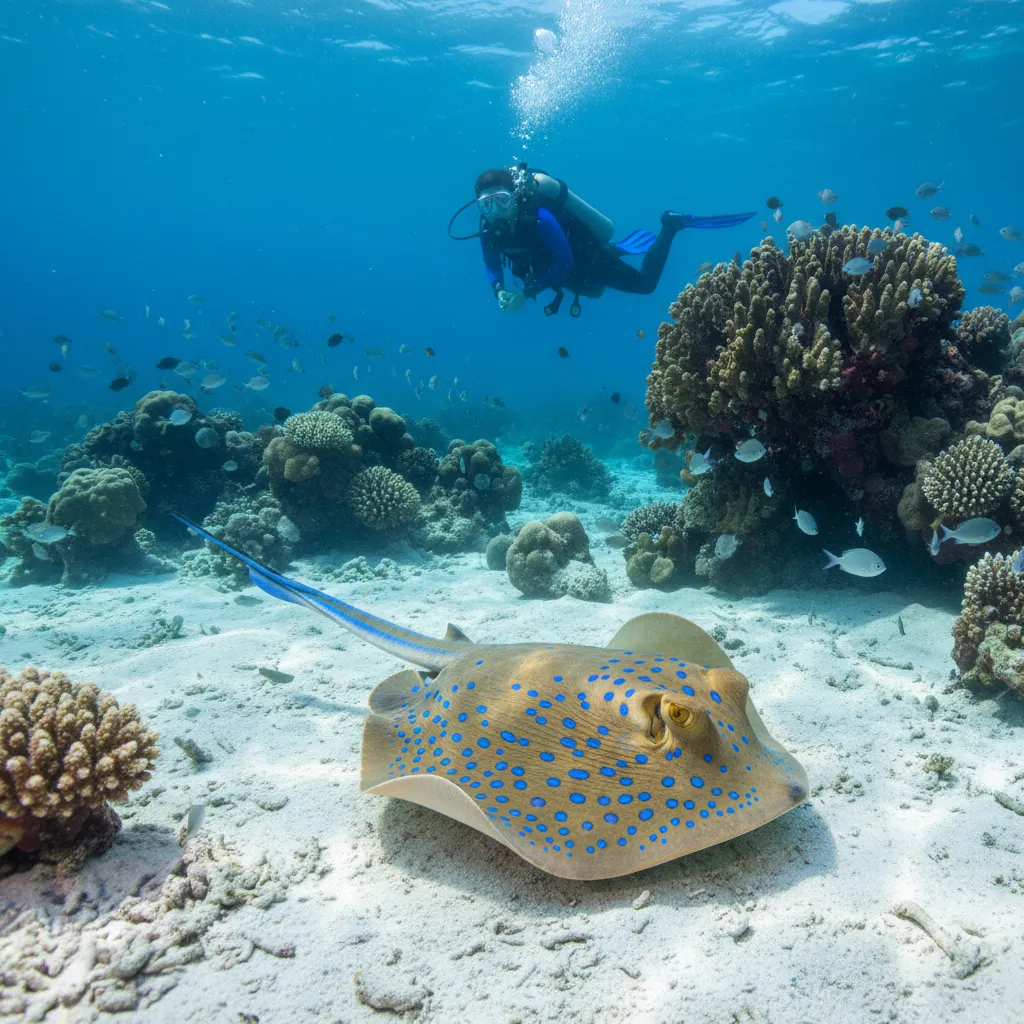
The blue-spotted ribbontail ray is one of the coral reef's most exquisite residents - a small, pancake-flat disc of sandy gold covered in electric blue spots that look as though they were painted by hand. Finding one tucked beneath a table coral or half-buried in sand on a reef flat is a moment of genuine delight, like discovering a living jewel hidden among the rubble. They are everywhere on healthy Indo-Pacific reefs, yet their beauty never becomes ordinary. Unlike many rays that burrow completely into the sand, blue-spotted stingrays often rest in the open, relying on their vivid markings to warn predators of their venomous tail spines. Watching one ripple across the sand on a sunny morning, its electric blue spots flashing against the white substrate, is one of those simple, perfect moments that makes reef diving endlessly rewarding.
Where to Dive with Blue-Spotted Stingrays
Found across 14 countries, based on 140 verified observation records.

South Africa
1 area

Indonesia
3 areas

Philippines
3 areas

Mozambique
1 area

Malaysia
2 areas

Tanzania
1 area

Timor-Leste
2 areas

Singapore
1 area
+ 6 more countries
Best Time to See Blue-Spotted Stingrays
Blue-spotted stingrays are resident year-round throughout their range. Red Sea (Egypt, particularly Dahab, Marsa Alam, and Ras Mohammed): year-round, with best conditions from March to November. Indonesia (Raja Ampat, Komodo, Bali): year-round, with Raja Ampat best from October to April and Komodo from April to November. Philippines (Anilao, Dumaguete, Moalboal): year-round, with dry season (December to May) offering calmer seas. Thailand (Similan Islands, Koh Lipe): November to April when dive sites are accessible. These rays are so common on healthy reefs that you are almost guaranteed to encounter them on any dive in their range.
How to Dive with Blue-Spotted Stingrays
Blue-spotted ribbontail rays are found on coral reefs, sandy reef flats, and rubble areas throughout the Indo-Pacific at depths from the intertidal zone to about 30 metres. No special certification is needed - Open Water divers and snorkellers encounter them regularly. They are most commonly seen resting beneath table corals, in small caves, or partially buried in sand. They become more active at dusk and dawn, emerging to hunt small crustaceans and worms on the sand. The best approach is slow and low: when you spot one, sink gently to the sand a couple of metres away and approach at their level rather than hovering above. They are more tolerant of lateral approaches than overhead shadows, which trigger a flight response. In the Red Sea, they are particularly abundant on shallow reef flats and within lagoons. In Indonesia and the Philippines, they are a common highlight on muck and reef dives alike.
Is it Safe to Swim with Blue-Spotted Stingrays?
Blue-spotted stingrays are timid and will flee rather than confront a diver. However, they do possess one or two venomous tail spines that can inflict a painful wound if the ray is stepped on or physically cornered. The simple rule is never to touch or attempt to handle one. When wading in shallow areas where they rest, shuffle your feet to give them warning vibrations so they can move away. During dives, avoid placing your hands on the sand near a resting ray. If you are photographing one and it begins to lift off the bottom, let it go rather than blocking its escape route. Sting injuries are rare among divers and almost exclusively involve accidental contact with a cornered animal.
Conservation Status
The blue-spotted ribbontail ray is classified as Least Concern by the IUCN, but faces localised pressure from collection for the aquarium trade (where they survive poorly in captivity), bycatch in bottom trawls, and coral reef degradation. Healthy coral reefs are essential for this species, as they rely on the structure of table corals and reef rubble for shelter. Regions with strong marine protection, such as the Red Sea marine parks and Indonesian MPAs like Raja Ampat, maintain healthy populations. As a diver, the most impactful thing you can do is support reef conservation efforts and avoid patronising aquarium shops that sell wild-caught marine rays.
Species Profile

Recommended Equipment
A standard reef diving kit is all that is required. A macro lens is the ideal camera setup for blue-spotted stingrays - their small size (typically 20–30 cm disc width) and intricate spot patterns reward close-up photography. A 60mm or 100mm macro lens produces stunning detail shots of their blue spots and eyes. A wide-angle lens works for environmental shots showing the ray in its reef habitat. A torch or video light helps bring out the vivid blue colours, especially in shaded areas beneath corals. Knee pads or a neoprene knee protector can be useful if you spend time lying on the sand for low-angle photographs.
Browse dive equipmentFrequently Asked Questions
Are blue-spotted stingrays dangerous?
Blue-spotted stingrays are not dangerous to divers under normal circumstances. They are timid and will swim away when approached. They do have venomous tail spines, but stings only occur through accidental contact - typically stepping on one in shallow water. Simply avoid touching them and give them an escape route.
Where can you see blue-spotted stingrays?
Blue-spotted ribbontail rays are common throughout the Indo-Pacific. The Red Sea (particularly Dahab and Marsa Alam) has exceptionally healthy populations. Raja Ampat and Komodo in Indonesia, Anilao in the Philippines, and the Similan Islands in Thailand are all excellent locations. They are found on almost any healthy coral reef in the region.
How big do blue-spotted stingrays get?
Blue-spotted ribbontail rays are relatively small, with a disc width of 20 to 35 centimetres and a total length (including tail) of about 70 centimetres. Their small size makes them easy to overlook, but their vivid blue spots against a golden-brown body make them unmistakable once spotted.
What do blue-spotted stingrays eat?
They feed on small crustaceans, molluscs, polychaete worms, and tiny fish. They forage by rippling across sandy areas and using their disc to pin prey against the substrate. They are most active at dawn and dusk, and divers on early morning or late afternoon dives are most likely to see feeding behaviour.
Can you keep blue-spotted stingrays in an aquarium?
While they are unfortunately sold in the aquarium trade, blue-spotted ribbontail rays fare very poorly in captivity and most die within weeks. They require large, sand-bottomed tanks and live foods that are difficult to provide. Purchasing wild-caught rays contributes to reef depletion. It is far better to enjoy them on the reef where they belong.
More Encounter Guides
Whale Sharks
Swimming alongside the world's largest fish is an experience that redefines your understanding of th...
Manta Rays
Manta rays are the ocean's most graceful giants. With wingspans reaching over 7 metres, these intell...
Great White Sharks
Coming face to face with a great white shark is the ultimate adrenaline rush for adventure divers. T...
Hammerhead Sharks
Seeing a school of hammerhead sharks is one of scuba diving's most iconic experiences. These prehist...
Sea Turtles
Sea turtles are among the most beloved creatures in the ocean, and for good reason. Watching a green...
Bull Sharks
Bull sharks are diving's most exhilarating close encounter. Known for their stocky build and bold te...