Diving with Hammerhead Sharks
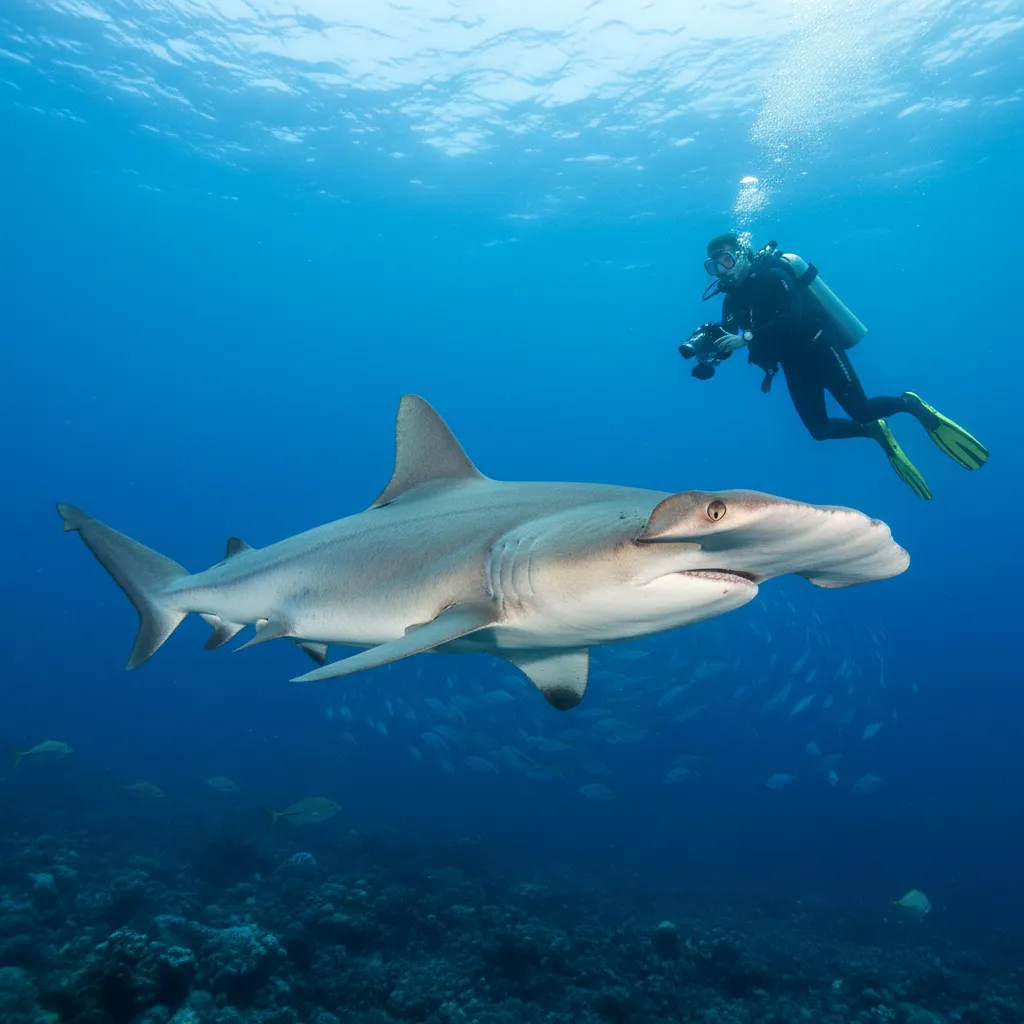
Seeing a school of hammerhead sharks is one of scuba diving's most iconic experiences. These prehistoric-looking sharks, with their distinctive flattened heads, often gather in vast schools at underwater seamounts and cleaning stations. Watching dozens - sometimes hundreds - of scalloped hammerheads silhouetted against the blue above you is a sight that defines a diving career. The great hammerhead, the largest species at over 6 metres, is usually encountered solo and is rarer but equally impressive, often seen at cleaning stations in the Bahamas.
Where to Dive with Hammerhead Sharks
Found across 25 countries, based on 7,902 verified observation records.

United States
1 area

New Zealand
3 areas

Australia
5 areas

South Africa
3 areas
Bahamas
1 area

Djibouti
1 area

Peru
2 areas

Réunion
1 area
+ 17 more countries
Best Time to See Hammerhead Sharks
Cocos Island (Costa Rica): June to November for the largest schools, during the rainy season when currents bring nutrients. Galapagos: January to May for large schools at Wolf and Darwin islands. Bimini, Bahamas: December to March for great hammerheads at the cleaning station. Sudan's Sha'ab Rumi: year-round but best June to September. Layang-Layang, Malaysia: March to May. South Africa (KwaZulu-Natal): December to March.
How to Dive with Hammerhead Sharks
Hammerhead encounters typically require Advanced Open Water certification and experience with currents and deep water. Schools gather at seamounts, pinnacles, and offshore cleaning stations, usually at 20-40 metres depth. The technique is to descend to the reef and find a sheltered position, staying low against the substrate while the hammerheads pass overhead. Avoid excessive movement and bubbles. Early morning dives tend to be most productive, as hammerheads come to shallow seamounts for cleaning before heading to deeper water during the day. Strong currents are common at hammerhead sites - a reef hook can be essential.
Is it Safe to Swim with Hammerhead Sharks?
Hammerhead sharks are generally shy around divers and not considered dangerous. However, great hammerheads are large, powerful predators and should be treated with appropriate respect. Scalloped hammerheads in schools are typically wary and will keep their distance. The main safety considerations at hammerhead sites are strong currents, depth, and cold thermoclines - the diving conditions are often more challenging than the sharks themselves. Always carry a safety sausage (SMB) and be prepared for drift dive scenarios.
Conservation Status
The great hammerhead is listed as Critically Endangered by the IUCN, and the scalloped hammerhead as Critically Endangered. Both species have declined by over 80% in many regions due to shark finning - hammerhead fins are among the most valued in the shark fin trade. Their schooling behaviour makes them particularly vulnerable to longline fishing. Marine protected areas around key aggregation sites (Cocos Island, Galapagos, Malpelo) are crucial for their survival. Dive tourism at these sites generates significant revenue that supports enforcement.
Species Profile


Recommended Equipment
Advanced diving equipment is needed for most hammerhead encounters. A 5-7mm wetsuit or semi-dry suit (thermoclines at depth can be cold), a reef hook for holding position in current, a safety sausage (SMB), and a dive computer rated for deep dives. A wide-angle camera setup is essential - schools are large and often distant. High ISO capability helps in the blue-water conditions typical of hammerhead sites. Nitrox certification is valuable, as many hammerhead dives push depth and bottom time limits.
Browse dive equipmentFrequently Asked Questions
Where can you see schools of hammerhead sharks?
The best locations for hammerhead shark schools are Cocos Island (Costa Rica), Wolf and Darwin Islands in the Galapagos, Layang-Layang (Malaysia), and the Red Sea. Great hammerheads are best seen solo in Bimini, Bahamas.
Are hammerhead sharks dangerous to divers?
Hammerhead sharks are generally shy around divers. Scalloped hammerheads in schools will typically keep their distance. Great hammerheads are large and should be respected, but unprovoked attacks on divers are virtually unheard of.
What certification do you need to dive with hammerheads?
Advanced Open Water is recommended, and many operators require it. Hammerhead sites typically involve deep water (25-40m), strong currents, and blue-water conditions that demand solid diving skills and experience.
Why are hammerhead sharks shaped like that?
The hammer-shaped head (cephalofoil) serves multiple purposes: it provides enhanced electroreception for detecting prey buried in sand, gives wider visual field (their eyes are at each end), and provides hydrodynamic lift and manoeuvrability.
More Encounter Guides
Whale Sharks
Swimming alongside the world's largest fish is an experience that redefines your understanding of th...
Manta Rays
Manta rays are the ocean's most graceful giants. With wingspans reaching over 7 metres, these intell...
Great White Sharks
Coming face to face with a great white shark is the ultimate adrenaline rush for adventure divers. T...
Sea Turtles
Sea turtles are among the most beloved creatures in the ocean, and for good reason. Watching a green...
Bull Sharks
Bull sharks are diving's most exhilarating close encounter. Known for their stocky build and bold te...
Tiger Sharks
Tiger sharks are the ocean's ultimate generalists - large, powerful, and supremely confident. Reachi...