Diving with Eagle Rays
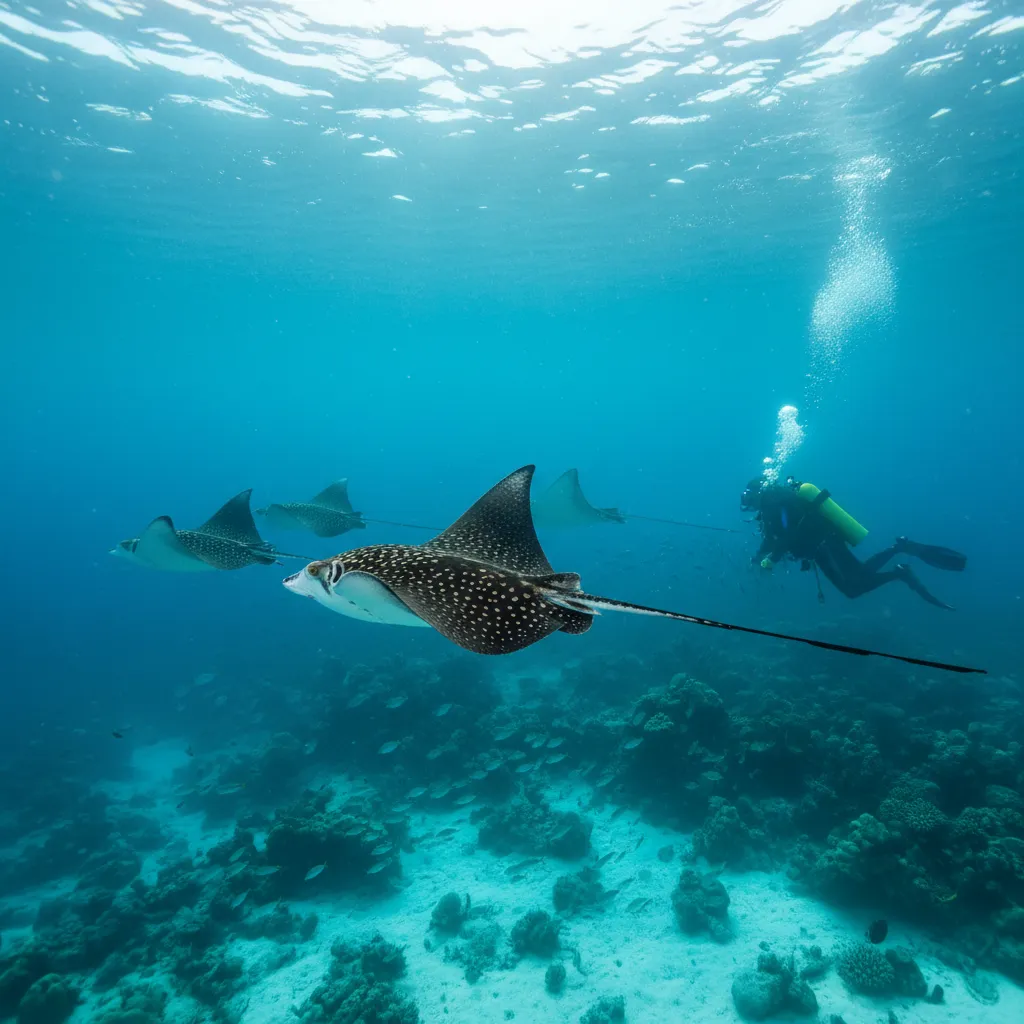
Spotted eagle rays are among the most beautiful creatures in the ocean, and watching one glide over a reef is like witnessing an underwater bird of prey in flight. Their dark dorsal surface is covered in a constellation of white spots and rings, each pattern as unique as a fingerprint, set against a body shaped like a perfectly engineered wing. They move with effortless grace, their pointed pectoral fins beating in slow, powerful strokes that propel them across vast stretches of reef in minutes. Sometimes a single ray will pass overhead like a living kite; at other times, a formation of a dozen or more will sweep past in a diamond pattern that takes your breath away. The long, whip-like tail streaming behind them completes a silhouette so elegant it barely seems real. Eagle ray encounters are fleeting - they rarely stop - but those brief moments of shared flight stay with divers forever.
Where to Dive with Eagle Rays
Found across 38 countries, based on 583 verified observation records.

Bahamas
1 area

South Africa
2 areas

New Caledonia
3 areas

Puerto Rico
3 areas

Seychelles
1 area

Mexico
2 areas

Belize
2 areas

Honduras
1 area
+ 30 more countries
Best Time to See Eagle Rays
Eagle rays are present year-round at most locations but with seasonal peaks. Galapagos: June to November (cool season) brings nutrient-rich waters and large aggregations, with December to May offering warmer water and good visibility. Maldives: year-round, with best sightings during the northeast monsoon (January to April) when channels are active. Hawaii (Molokini, Maui): year-round, with winter months (December to April) seeing more humpback whale activity as a bonus. Caribbean (Bonaire, Cozumel): year-round, with spotted eagle rays commonly seen on shallow reef dives. Florida (Palm Beach): year-round, with winter aggregations of up to 50 individuals in shallow coastal waters.
How to Dive with Eagle Rays
Spotted eagle rays are found over sandy flats, reef passes, and along outer reef walls from the surface down to 80 metres, though most encounters occur between 10 and 30 metres. Open Water certification is sufficient. They are strong, fast swimmers and rarely stop, so the best strategy is to position yourself in areas they are known to pass through rather than chasing them. Reef channels, sandy passages between reefs, and cleaning stations are prime spots. In the Galapagos, eagle rays regularly cruise past divers at sites like Cousin's Rock and Gordon Rocks. In the Maldives, channel dives during incoming tides produce fly-bys. In Hawaii, they frequent cleaning stations at Molokini Crater. When you spot one approaching, sink slowly to the reef and hold still - eagle rays are skittish and will change course if divers rise up toward them. If a formation passes overhead, resist the urge to swim after them; simply enjoy the moment.
Is it Safe to Swim with Eagle Rays?
Eagle rays are completely harmless to divers and will always move away from humans rather than toward them. Their tail contains one or more venomous barbs, but these are purely defensive and a ray would only sting if physically grabbed or stepped on - something that is virtually impossible during a diving encounter. The main safety consideration is the tendency for divers to chase eagle rays, which can lead to rapid, uncontrolled depth changes as the ray descends or crosses a drop-off. Maintain your depth awareness at all times and resist the urge to pursue. In channels with current, eagle rays may pass quickly - let them come to you rather than swimming into the current after them.
Conservation Status
The spotted eagle ray is listed as Endangered on the IUCN Red List. They are caught as bycatch in gillnets and trawls throughout their range and are sometimes targeted directly for their meat and gill plates. Their low reproductive rate - females produce only one to four pups per litter after a year-long gestation - makes populations slow to recover. Coastal development that degrades seagrass beds and sandy habitats reduces their foraging grounds. In the Galapagos, eagle rays benefit from the extensive marine reserve system. Florida has banned the harvest of eagle rays entirely. Supporting destinations with strong marine protection helps ensure these magnificent rays continue to grace the world's reefs.
Species Profile

Recommended Equipment
Standard reef diving equipment is all that is needed: wetsuit appropriate for the destination (3mm tropical, 5mm temperate), mask, fins, and BCD. A wide-angle lens is essential for photography - eagle rays are large (up to 3 metres wingspan) and move quickly, so you need a lens that can capture the whole animal in a single frame during a close pass. Fast shutter speeds (1/250s or higher) help freeze the motion of their beating wings. A medium zoom (24-70mm equivalent) can be useful for more distant fly-bys. Reef hooks are not typically needed but can help at current-swept channel sites in the Maldives where eagle rays pass predictably.
Browse dive equipmentFrequently Asked Questions
Are eagle rays dangerous to divers?
Eagle rays are not dangerous to divers. They are shy and will always move away from approaching humans. While they have venomous tail barbs, these are purely defensive and a sting during a diving encounter is virtually impossible. The only risk is divers chasing rays into unsafe depth changes.
Where is the best place to see eagle rays while diving?
The Galapagos Islands offer some of the most spectacular eagle ray encounters, with formations of a dozen or more at sites like Gordon Rocks. The Maldives channel dives produce regular fly-bys. Hawaii's Molokini Crater and the Caribbean (Bonaire, Cozumel) also offer reliable sightings.
Why do eagle rays swim in formation?
Spotted eagle rays sometimes travel in groups of up to several dozen, swimming in loose diamond or V-shaped formations. This behaviour may reduce hydrodynamic drag (similar to birds flying in formation), provide protection from predators, or be related to mating behaviour. The sight of a large formation is one of diving's most breathtaking experiences.
What do spotted eagle rays eat?
Spotted eagle rays feed primarily on hard-shelled molluscs, crabs, sea urchins, and shrimp. They use their flattened, duck-like snouts to root through sandy bottoms, crushing shells with powerful dental plates. You may see them hovering over sand patches, using their pectoral fins to fan away sediment and expose buried prey.
How big do spotted eagle rays get?
Spotted eagle rays can reach a wingspan of up to 3 metres (10 feet) and a total length, including the tail, of over 5 metres. They can weigh up to 230 kilograms. Despite their size, they are agile and fast swimmers, capable of spectacular leaps out of the water.
More Encounter Guides
Whale Sharks
Swimming alongside the world's largest fish is an experience that redefines your understanding of th...
Manta Rays
Manta rays are the ocean's most graceful giants. With wingspans reaching over 7 metres, these intell...
Great White Sharks
Coming face to face with a great white shark is the ultimate adrenaline rush for adventure divers. T...
Hammerhead Sharks
Seeing a school of hammerhead sharks is one of scuba diving's most iconic experiences. These prehist...
Sea Turtles
Sea turtles are among the most beloved creatures in the ocean, and for good reason. Watching a green...
Bull Sharks
Bull sharks are diving's most exhilarating close encounter. Known for their stocky build and bold te...