Diving in Inner Islands
Why dive here
Inner Islands offers some of Seychelles's richest diving, with 183+ marine species recorded in the area - including barracuda, dolphins, sea turtles, sperm whales and lionfish. Water ranges 27-30°C, warmest March, April, May.
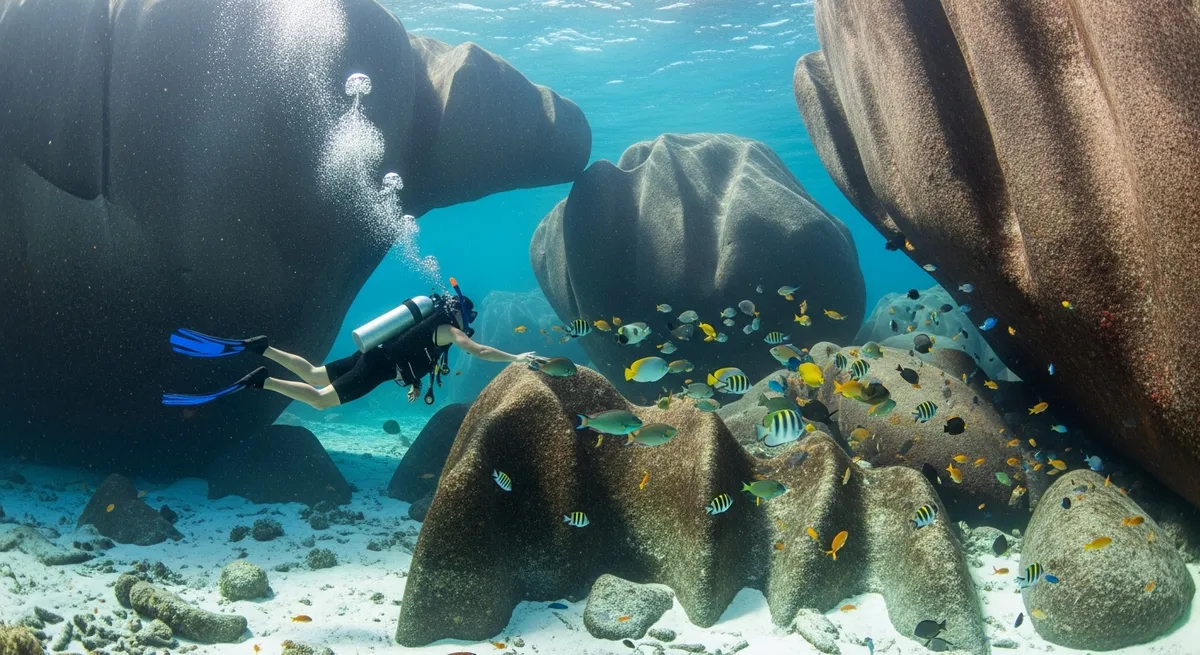
The Inner Islands of Seychelles, particularly around Mahé, Praslin, and La Digue, are where we send divers who want a bit of everything. We're talking dramatic granite boulder formations underwater, sculpting caves and swim-throughs you just have to fin through. We love the sheer variety here, from gentle reefs to exciting drift dives, and the pinnacles often hold surprises. Visibility can often hit 20-25 metres, giving you plenty of space to spot the resident honeycomb morays peeking from crevices or a school of ocean triggerfish shimmering by. Come October, our top tip is to keep an eye out for whale sharks; they cruise these waters with a serene presence that’s genuinely humbling. You might also catch a glimpse of Allison's Tuna darting past or the more elusive scalloped hammerheads if you're lucky. The wreck diving here is also solid, offering a different kind of exploration when you want a break from the reef. Just watch for currents on some of the deeper pinnacles, they can pick up quickly.
Inner Islands Dive Site Map
Dive sites and dive centres in Inner Islands
Inner Islands Dive Sites
86 dive sites in Inner Islands
Albatros
Albatros, near the Sister Islands, is one of those sites that just feels good. We’ve always found the visibility here to be reliably decent, often pushing past 20 meters, which makes the scattered coral heads and swim-throughs even more inviting. Descending onto the main rock, you’re often greeted by a shimmer of fusiliers, so thick they almost obscure the reef. We love drifting through the natural passages, keeping an eye out for the resident loggerhead turtle that often cruises by, or a sleepy stingray tucked under a ledge. It’s a relatively shallow dive, maxing out around 18m, making it super comfortable for an hour-long bottom time. We’ve often seen small schools of eagle rays here, sometimes as many as ten gliding past in formation – a truly graceful sight. Keep an eye on the sand patches for flatfish and garden eels. This site is a great pick for newer divers looking for beautiful reef scenery without strong currents, and a relaxing second dive after exploring deeper sites.
Albatros
Albatros, near the Sister Islands, is one of those sites that just feels good. We’ve always found the visibility here to be reliably decent, often pushing past 20 meters, which makes the scattered coral heads and swim-throughs even more inviting. Descending onto the main rock, you’re often greeted by a shimmer of fusiliers, so thick they almost obscure the reef. We love drifting through the natural passages, keeping an eye out for the resident loggerhead turtle that often cruises by, or a sleepy stingray tucked under a ledge. It’s a relatively shallow dive, maxing out around 18m, making it super comfortable for an hour-long bottom time. We’ve often seen small schools of eagle rays here, sometimes as many as ten gliding past in formation – a truly graceful sight. Keep an eye on the sand patches for flatfish and garden eels. This site is a great pick for newer divers looking for beautiful reef scenery without strong currents, and a relaxing second dive after exploring deeper sites.
ALDEBARAN
We’ve spent a fair bit of time exploring the Aldebaran and it’s become one of our favourite wreck dives in the Inner Islands. This ex-longliner fishing vessel sits upright at 26 metres, a proper, intact wreck you can actually get into. You’ll find the wheelhouse still mostly there, and for those comfortable with overhead environments, the engine room is a tight squeeze but worth the effort. What we really love about the Aldebaran is the way the marine life has completely embraced it. Schools of fusiliers are so thick around the mast and superstructure, they often block out the light, creating this flickering, silver curtain. Look closely among the nooks and crannies – you’ll often spot massive groupers lurking, and we’ve had some cracking encounters with giant trevally circling the bow. On one dive, a napoleon wrasse, bold as brass, came right up to us near the stern. It's a dive that really suits those who enjoy the character of a real wreck, not just a pile of rubble, and the sense of discovery that comes with poking around inside.
Aldebaran Wreck
The Aldebaran Wreck, a deliberately scuttled fishing boat from 2008, sits upright on a sandy bottom, its mast reaching up towards the light. We love how the hull has been completely claimed by life in such a short time. You’ll find Montipora corals forming textured carpets along the decks, and the wheelhouse is often home to some chunky Argus Grouper watching you pass. Our favourite time to drop in is early morning, before the thermocline settles too deep, as that’s when we’ve seen the most activity with Dorado flashing by in the blue. At around 30 metres, it's a dive for those comfortable with depth, but the calm conditions usually mean you can take your time circling the 28-meter long vessel. Look closely for the smaller residents: Sandfish darting from cover, and we’ve found some surprisingly bold Dragonfish tucked into crevices. It’s an absorbing wreck dive, not for penetration, but for appreciating how quickly the ocean reclaims and repurposes.
Aldebaran Wreck
The Aldebaran Wreck, a deliberately scuttled fishing boat from 2008, sits upright on a sandy bottom, its mast reaching up towards the light. We love how the hull has been completely claimed by life in such a short time. You’ll find Montipora corals forming textured carpets along the decks, and the wheelhouse is often home to some chunky Argus Grouper watching you pass. Our favourite time to drop in is early morning, before the thermocline settles too deep, as that’s when we’ve seen the most activity with Dorado flashing by in the blue. At around 30 metres, it's a dive for those comfortable with depth, but the calm conditions usually mean you can take your time circling the 28-meter long vessel. Look closely for the smaller residents: Sandfish darting from cover, and we’ve found some surprisingly bold Dragonfish tucked into crevices. It’s an absorbing wreck dive, not for penetration, but for appreciating how quickly the ocean reclaims and repurposes.
Amoujie Maman
Amoujie Maman in the Inner Islands tends to be a straightforward drift. We usually see schools of snapper and fusiliers moving along the reef, with the occasional eagle ray cruising by. It’s a good spot for an easy current dive, especially if you’re looking to cover some ground without much effort.
Anse Petit Cour
Anse Petit Cour is our pick for a genuinely relaxing dive. It’s a five-minute boat ride from the dive centre, and the bay is almost always flat calm, making for an easy entry and exit. We’d suggest this one for anyone feeling a little rusty, or if you’re introducing someone to diving for the first time. The reef here starts shallow, with much of the dive spent around 5 meters, though it drops down to 14 meters if you want to explore deeper. You’ll weave through a mix of hard and soft corals, keeping an eye out for the smaller stuff. We’ve had great luck spotting Belted wrasse darting between the coral heads, and there are always plenty of curious Parrotfish nibbling away. Look closely and you might even find a Crested Sabretooth Blenny peeking out from its hole. The visibility averages around 11 meters, which is perfectly adequate for this kind of macro-focused exploration. It’s a gentle place, a perfect site to slow down and enjoy the details.
Anse Petit Cour
Anse Petit Cour is our pick for a genuinely relaxing dive. It’s a five-minute boat ride from the dive centre, and the bay is almost always flat calm, making for an easy entry and exit. We’d suggest this one for anyone feeling a little rusty, or if you’re introducing someone to diving for the first time. The reef here starts shallow, with much of the dive spent around 5 meters, though it drops down to 14 meters if you want to explore deeper. You’ll weave through a mix of hard and soft corals, keeping an eye out for the smaller stuff. We’ve had great luck spotting Belted wrasse darting between the coral heads, and there are always plenty of curious Parrotfish nibbling away. Look closely and you might even find a Crested Sabretooth Blenny peeking out from its hole. The visibility averages around 11 meters, which is perfectly adequate for this kind of macro-focused exploration. It’s a gentle place, a perfect site to slow down and enjoy the details.
Aquarium
Aquarium, near Beau Vallon, earns its name honestly. We love this site for its chilled-out vibe and the sheer density of fish life in such a compact area. It's a shallow dive, maxing out at 14m, perfect for an afternoon potter or a long, leisurely second dive. You'll spend most of your time around the three main bommies, which are packed with activity. Look for the massive schools of Blue Surgeonfish that swirl around the coral heads, almost like a living curtain. We often spot Flathead Sleepers and Reticulate Sandgobies burrowing in the sandy patches between the bommies. Keep an eye out for the shy Bloodspot Pipefish too, they blend in beautifully with the Montipora and Staghorn corals. The visibility averages around 13m, which is good enough to take it all in without feeling overwhelmed. It’s ideal for photographers who want to get up close with reef fish and those who appreciate a slower pace. The site is pretty sheltered, so currents are usually light, though you might feel a gentle tug at the surface occasionally.
Aquarium
Aquarium, near Beau Vallon, earns its name honestly. We love this site for its chilled-out vibe and the sheer density of fish life in such a compact area. It's a shallow dive, maxing out at 14m, perfect for an afternoon potter or a long, leisurely second dive. You'll spend most of your time around the three main bommies, which are packed with activity. Look for the massive schools of Blue Surgeonfish that swirl around the coral heads, almost like a living curtain. We often spot Flathead Sleepers and Reticulate Sandgobies burrowing in the sandy patches between the bommies. Keep an eye out for the shy Bloodspot Pipefish too, they blend in beautifully with the Montipora and Staghorn corals. The visibility averages around 13m, which is good enough to take it all in without feeling overwhelmed. It’s ideal for photographers who want to get up close with reef fish and those who appreciate a slower pace. The site is pretty sheltered, so currents are usually light, though you might feel a gentle tug at the surface occasionally.
Aride Bank
Aride Bank, a solid 30-minute boat ride north of Praslin, delivers a different flavour of Seychelles diving. It's not about dramatic drop-offs; here, the granite boulders are the stars, creating a maze of channels and overhangs from 12m down to 19m. We love how the light plays through the gaps, highlighting the smaller, more intricate reef life. Look close for the Freckled Anglerfish or a shy Brown-banded Pipefish tucked amongst the corals. Visibility here averages 10m, so it’s a site where you need to slow down and appreciate the details. We've seen schools of Blackstriped Cardinalfish pulsing around the rocks, and the flash of an Orange-lined Triggerfish zipping past. It’s also one of our picks for spotting Nurse sharks napping under ledges, and we’ve had good luck with Whitetips patrolling the deeper edges. This site truly suits divers who enjoy exploring the nooks and crannies, rather than chasing big pelagics in the blue. Keep an eye out for the Arc-eye Hawkfish perched on the coral heads – they’re always a favourite.
Aride Bank
Aride Bank, a solid 30-minute boat ride north of Praslin, delivers a different flavour of Seychelles diving. It's not about dramatic drop-offs; here, the granite boulders are the stars, creating a maze of channels and overhangs from 12m down to 19m. We love how the light plays through the gaps, highlighting the smaller, more intricate reef life. Look close for the Freckled Anglerfish or a shy Brown-banded Pipefish tucked amongst the corals. Visibility here averages 10m, so it’s a site where you need to slow down and appreciate the details. We've seen schools of Blackstriped Cardinalfish pulsing around the rocks, and the flash of an Orange-lined Triggerfish zipping past. It’s also one of our picks for spotting Nurse sharks napping under ledges, and we’ve had good luck with Whitetips patrolling the deeper edges. This site truly suits divers who enjoy exploring the nooks and crannies, rather than chasing big pelagics in the blue. Keep an eye out for the Arc-eye Hawkfish perched on the coral heads – they’re always a favourite.
Show all 86 dive sites in Inner Islands
- ATERPE-ALAI
- Auberge Reef
- Auberge Reef
- Ave Maria
- Ave Maria
- Ave Maria
- Baie Ternay Marine Park
- Baie Ternay Marine Park
- Beau Vallon Beach
- Beau Vallon Beach
- Beau Vallon Reef
- Big Mama
- Booby Island
- Booby Island
- Brissaire Rocks
- Brizare Rock, Mahé
- Brizare Rock, Mahé
- Cap Matoopa
- Casualina
- Channel Rock
- Channel Rock
- Cheminey Rock
- Chuckles
- Conception Arena
- Conception Rocks
- Conny s Wall
- Coral Garden
- Coral Garden
- Coral Gardens
- Corsair Reef
- Criminal Rock
- Dragon Teeth
- Dredger Rock, Mahé
- Dredger Wreck
- Ennerdale Wreck
- Fisherman's Cove Reef
- Grand Bazar
- Ile au Vache
- ILE DENIS
- Jocker Reef
- Joker Reef
- LAVANN
- Light House
- L’Ilot
- L ilot Island
- Lost City
- Mannes Bank
- Marianne
- Monkey rock
- Paradise Rock
- Ray's point
- Red Point
- RFA ENNERDALE
- Roche Grand Maman
- Roche Grand Maman
- Scorpion Rock Praslin
- Shark Bank
- Shark Bank
- Shark rock
- Sister Bank
- South Mariane Island
- St. Pierre
- Sunset Rocks
- Therese Rocks
- Turtle Rock
- Turtle Rock
- Twin Barges
- Twin Barges Wreck
- Whale Rock
- Whale Rock, Seychelles
- White Bank
- White Bank
- Whitetip Divers
- Willy‘s Rock
Inner Islands Dive Centres
21 dive shops and operators in Inner Islands
Ocean Wildlife in Inner Islands
183 species recorded in Inner Islands
Inner Islands Daylight & Sunrise/Sunset
Sunrise and sunset times for Inner Islands, calculated from coordinates
Today - Sunday 11 October
Sunrise
06:00
Sunset
18:11
Daylight
12h 11m
Golden Hour
17:43
First light (dawn) at 05:39 · Last light (dusk) at 18:32
Monthly Averages
| Month | Sunrise | Sunset | Daylight |
|---|---|---|---|
| Jan | 06:17 | 18:38 | 12h 21m |
| Feb | 06:25 | 18:40 | 12h 15m |
| Mar | 06:24 | 18:32 | 12h 8m |
| Apr | 06:18 | 18:19 | 12h 1m |
| May | 06:18 | 18:12 | 11h 55m |
| JunShortest | 06:23 | 18:15 | 11h 52m |
| Jul | 06:28 | 18:21 | 11h 53m |
| Aug | 06:24 | 18:22 | 11h 58m |
| Sep | 06:12 | 18:17 | 12h 5m |
| OctNow | 05:58 | 18:10 | 12h 12m |
| Nov | 05:54 | 18:13 | 12h 19m |
| DecLongest | 06:02 | 18:25 | 12h 23m |
Times are approximate local times based on longitude. Actual times may vary slightly depending on the exact timezone observed in Inner Islands.
Where to Stay near Inner Islands
Prices from Booking.com. We may earn a commission at no extra cost to you.
Marine Protected Areas near Inner Islands
25 protected areas near Inner Islands - please respect local regulations when diving
Amirantes (Marine) to Fortune Bank (Marine) Area of Outstanding Natural Beauty
Bird Island (Ile aux Vaches) (Marine) National Park
Denis Island (Marine) Area of Outstanding Natural Beauty
Silhouette Marine National Park
Curieuse Marine National Park
Ste. Anne Marine National Park
Aride Special Reserve
Anse Aux Pins Shell Reserve
Port Launay Marine National Park
Praslin Shell Reserve
Cousin Special Reserve
La Digue Shell Reserve
Showing 12 largest of 25
Getting to Inner Islands
Victoria
Praslin Island
Plan & book
Ways to dive Inner Islands, from day trips to liveaboards.
Day trips & courses
via GetYourGuideGuided dives, courses and snorkel trips with instant booking.
Find dive trips in Inner IslandsPlaces to stay
via Booking.comHotels and dive resorts near Inner Islands.
Search stays in Inner IslandsDive insurance
Most travel insurance excludes or limits scuba. Check what you need before you go.
Dive insurance explainedPartner links: we may earn a commission if you book, at no extra cost to you. How we make money