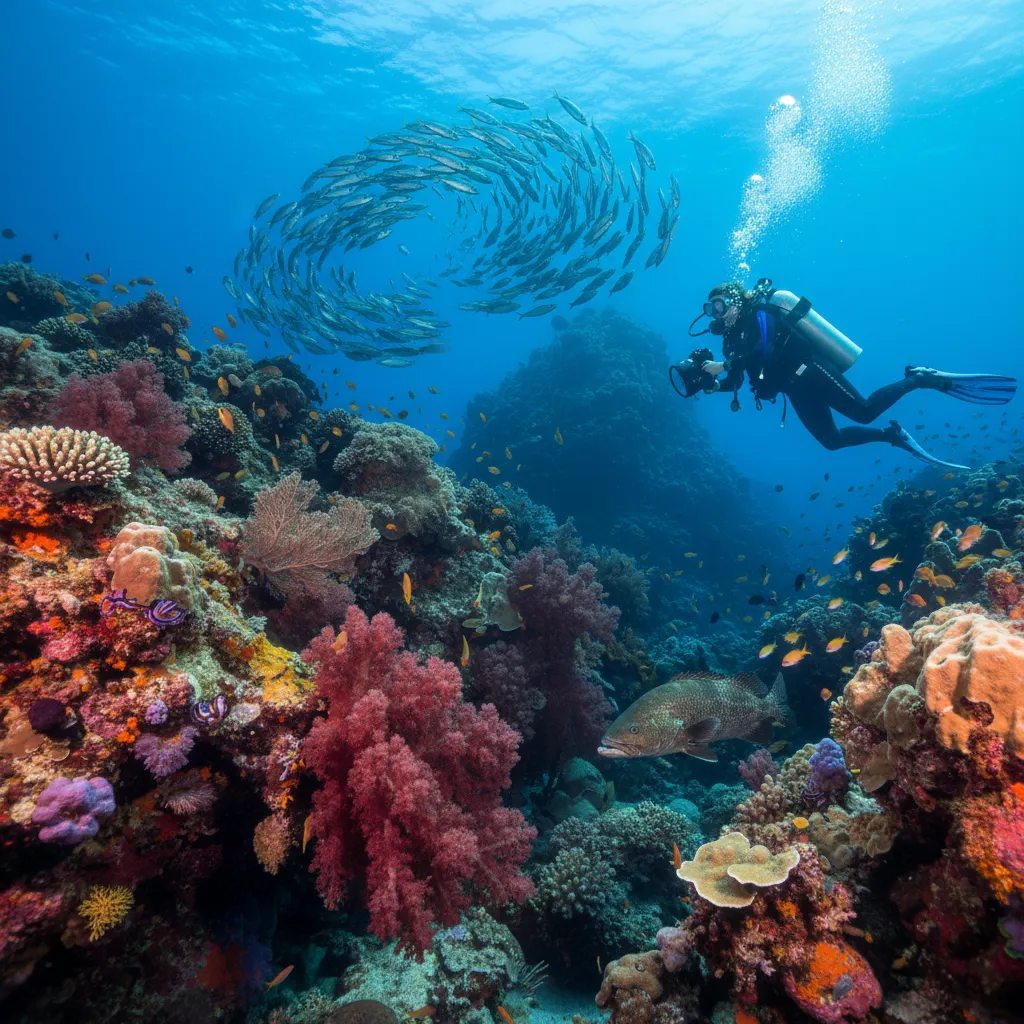
Diving in Sardinia
Why dive here
Sardinia offers some of Italy's richest diving, with 74+ marine species recorded in the area - including blue sharks, dolphins, mobula rays (devil rays), oceanic whitetip sharks and ocean sunfish (mola mola). Water ranges 14-27°C, warmest July, August, September.
Sardinia is a firm favourite of ours in the Mediterranean. We particularly love the island's west coast around Alghero, where the limestone cliffs drop dramatically into the sea, hiding a maze of grottoes and caverns just begging to be explored. Drop into Neptune's Grotto for a surface interval - it’s touristy, sure, but incredible - then head out for a dive in the Cala del Lazzaretto. We’ve finned through schools of salema here so thick they genuinely blot out the sun, a shimmering wall of silver. The marine reserves, like Tavolara Punta Coda Cavallo, offer some of the healthiest reefs we’ve seen in the Med. Look closely in the seagrass beds for broadnosed pipefish, and keep an eye out for flashes of black coral on deeper walls. Wrecks are scattered around too, often draped in fishing nets, home to resident pandora and pearl-sides. Visibility is usually superb, often pushing 30 metres, especially in late spring when the water starts to warm up but the summer crowds haven’t fully arrived. Currents can pick up, particularly around the capes, so it’s worth checking the local conditions.
Sardinia Dive Site Map
Dive sites and dive centres in Sardinia
Sardinia Dive Sites
108 dive sites in Sardinia
ACHAIKA HOPE
The Achaika Hope holds a proper place in our list of favourite Mediterranean wrecks. She’s a big old steamship, all 100 metres of her, sitting upright at 25 metres off Razzoli Island. She ran aground in a storm back in ’69, and you can still feel that drama when the surge picks up a bit. We love how intact she is – you can trace the whole deck, peer into cargo holds that now shelter schools of silvery juvenile barracuda, and even see the distinctive shape of her boilers in the engine room area. Exploring the Achaika Hope feels like stepping back in time. The bow points seaward, almost defiantly, while the stern is closer to the rocks where she met her end. Swarms of damselfish flicker around the mast, which still reaches up towards the surface, and we often find large groupers lurking in the deeper, darker sections of the holds. Visibility here is usually excellent, giving you a real sense of her scale as you drift along the length of her hull. For wreck divers who appreciate history and an accessible, impressive structure, this one’s a real treat. Just be mindful of local conditions; that same surge that brought her down can make for a more lively dive.
ADELCONCITA
Adelconcita, off Sardinia’s Capo Testa, isn’t just another sunken ship. This motor vessel went down in 1981, and we’ve seen how decades underwater transform metal into a thriving habitat. Dropping down, the first thing you notice is the sheer scale – it’s a big wreck, sitting upright on the seabed at 35 metres. We love how the stern section is still largely intact, allowing for some great swim-throughs if you’re comfortable with overhead environments. Exploring the Adelconcita, you’ll find schools of barracuda often circling the superstructure, their silver bodies flashing in the shafts of sunlight. The deck is carpeted with colourful gorgonians and sponges, and we’ve spent ages just watching moray eels peek out from every crevice. Our favourite spot is usually the bow, where the mast lies across the seabed, creating a kind of artificial reef that’s always busy with damselfish and small wrasse. It’s a dive that really benefits from good light, so we’d suggest an early morning dip if the weather looks calm. Strong currents can pick up here, so pick your day carefully; a smooth surface means a much more enjoyable descent. This site is perfect for experienced wreck divers looking for a substantial, explorable structure with plenty of character.
AGELIKA
The AGELIKA in Sardinia is one of those wrecks that really gets under your skin. We love it because it’s a proper piece of history, grounded off Punta Marmorata back in ‘82. For a shallow wreck, only five metres deep, it’s surprisingly atmospheric. You descend into the blue and the sheer scale of the ship spreads out beneath you – 109 metres of hull, broken but still imposing. The AGELIKA is an easy dive, perfect for just about anyone, and it’s a brilliant spot for photographers who want to play with light and shadow. We’d suggest going early in the morning before the day boats arrive, or late afternoon for that golden hour glow. You can spend a good chunk of time exploring the deck structures, seeing how the ocean has slowly reclaimed the metal. Moray eels peer out from nooks and crannies, and barracuda often cruise overhead, silhouetted against the surface shimmer. It’s not about huge pelagics here, it’s about the intimacy of a wreck taken by the sea, and the smaller marine life that calls it home.
ALI REIS V
The Ali Reis V isn't one of those deep, technical wrecks we usually chase, but it’s a site we genuinely love for its sheer accessibility and unique character. This cargo carrier, built in '76 and sunk just two years later, lies practically on the surface, with a maximum depth of two metres. That makes it perfect for a leisurely snorkel or even just wading out from the beach. You’ll find its remains broken into several large sections, scattered across a sandy bottom. We particularly enjoy the way the Mediterranean light filters through the shallow water, illuminating the rusted metal. It’s not a site for big pelagics, but look closely and you’ll spot small schooling fish darting in and out of the twisted frames. Damselfish and blennies are everywhere, and we've even seen the occasional octopus tucked away in a crevice. It’s a site that tells a story, even if it's a short one, and it's our pick for a relaxing afternoon exploring history without the need for tanks. Go on a sunny day for the best visibility; the colours are more vibrant then.
Allume
Allume, off Sardinia, offers a Mediterranean dive that’s fairly straightforward. The real draw here is the chance to see nudibranchs and octopuses tucked into the rocks. It’s a good spot for a relaxed dive, appealing to those who prefer macro life over big pelagics, and suitable for most experience levels looking for a chilled-out afternoon.
Ancore Spagnole
Ancore Spagnole, or Spanish Anchors, offers a straightforward dive to 23m in Sardinia. We found several large anchors scattered across the seabed, giving the site its name and a bit of historical intrigue. It’s a gentle spot, good for newer divers or those looking for a relaxed bottom time without strong currents. Expect to see some typical Mediterranean reef fish flitting around the sandy patches.
Angelika MS
The Angelika MS, off Sardinia, is one of our favourite Mediterranean wreck dives. It's not a deep dive, sitting comfortably around 18-22 metres, making it accessible for most PADI Advanced Open Water divers. What we love about the Angelika is how much of it remains intact, and the way light plays through the holds on a sunny day. We'd suggest aiming for a morning dive to catch those light beams. You can really spend some time exploring here. The cargo holds are open, revealing the ship's structure, and we’ve often found schools of barracuda hanging around the superstructure, their silver scales flashing. Look closer at the deck and bulkheads; scorpionfish are masters of camouflage here, blending into the rust-coloured metal. It’s a genuinely atmospheric dive, especially when a slight current gives the whole scene a gentle sway, and the sponges on the rails filter the light. Just keep an eye on your buddy; the wreck is big enough to lose track of each other for a moment if you’re not careful.
Anna Bianca Wreck
The Anna Bianca. Now there’s a proper dive. We love a good wreck with a bit of history, and this one delivers. Lying at around 20-22 metres, it’s a relatively easy dive, open to most certified divers. What makes it special isn’t just the intact bow, still recognisable, or the engine room you can safely peek into, but the sheer volume of life that’s colonised every surface. We’ve seen immense schools of barracuda circling the stern on more than one occasion, their silver scales flashing in the shafts of light filtering down. Inside the superstructure, you’ll often find large groupers hunkered down, just watching you pass, and the deck is thick with yellow gorgonians and vibrant sponges. It’s got that slightly spooky, almost ghostly feel as you swim through the cargo holds, but it’s entirely safe and quite open. Our favourite time to dive it is late afternoon; the light really brings out the colours of the corals and the rust. If you're looking for a wreck that feels alive, not just a pile of metal, this is your spot.
Archeo Diving
Archeo Diving in Sardinia offers a different kind of Mediterranean dive, one that blends history with marine life. We’ve found the real draw here isn’t just the occasional amphora fragment, but how these ancient pieces have become integrated into the reef structure. You'll often spot scorpionfish perched on an old ceramic shard, or a corb darting amongst the broken pottery. It's a great spot for photographers who appreciate the contrast of human history and natural beauty, best explored on a calm morning when the light penetrates just right.
Balena
Balena offers a straightforward dive to a maximum of 20 metres, making it a good choice for newer divers or those looking for an easy afternoon. The site features rock formations and sandy patches, providing habitat for common Mediterranean species like moray eels, octopus, and occasional bream. We find it’s a solid option for shaking off the rust or enjoying a relaxed exploration.
Biancas Garden
Bianca’s Garden in Sardinia offers a relaxed dive through a coral reef. We’ve seen a good variety of Mediterranean fish species here, moving among the soft corals. It’s a pleasant site, especially for those looking for a gentle dive rather than anything too dramatic.
BUCADOR (PROBABLY)
Alright, let's talk about the *Bucador*, or as we affectionately call it, "Probably the Bucador." We love this site not just for the wreck itself, but for the story. This isn't some deep, dark behemoth. She sits in a modest 10 metres of water, a bulk carrier that tried to beach herself on Cavallo Island back in '76 but eventually just slid under. What you get is a wonderfully accessible wreck, broken in places but with enough structure to feel like a proper exploration. The stern is the deeper part, listing dramatically, and that's where we often find the best fish action – schools of damselfish that scatter as you approach, and often a grumpy moray eel peeking from a dark crevice. The bow lies shallower, spread across the rocks, an inviting jumble of twisted metal and rusted plating. Sunlight streams through the gaps, illuminating the sponges and sea squirts that have claimed every surface. We'd suggest going on a calm morning; the visibility can be stellar, making the whole wreck feel almost ethereal. It's an easy dive, perfect for photographers or anyone wanting to spend a relaxed hour just soaking it all in.
Show all 108 dive sites in Sardinia
- Cala Cupa
- Cala dell Oro
- Cala di Trana
- Cala d'Oliva
- Cala Inglese
- Cala Mariolu
- Capo Caccia
- Capo Carbonara
- CHRISSO
- COMTE DE FIANDEE
- CONEGLIANO
- Corallo Rosso
- COSTAZZURA
- Coticcio
- Crique électrique
- CROUX
- Diving Archimete
- DST Sardegna - Diving & Snorkeling Team
- Galera
- Gli Archetti
- Grotta di Nettuno
- Grotta di San Francesco
- Grotta Fantasmi
- Grotta Maurizio Sarra
- Grottes de Beccu
- Grottoni
- HMS Shakespeare
- Ile de Forana - Nord
- Ile de Forana - Nord Ouest
- INDUSTRIA
- I Picchi
- ISABEL
- Isolotto
- JOSEPHINE
- JOYCE
- KT12 Wreck
- KT Wreck
- L’Anse de la Chiappa
- La pointe de la Chiappa
- Le danger de la Vacca
- Le danger du Toro
- Le Grottace
- Le phare de la Chiappa
- Le rocher de la Vacca Nord
- Les aiguilles de la Vacca
- Les arches
- Les cloches
- Les prêtres
- Le vieux port
- MARIA DEL SOCCORSO
- MARIE DI MONTE ALLEGRO
- MATER NOSTRA (PROBABLY)
- Mérouville
- MONTE STELLO
- Mortoriotto
- Motore dei Monaci
- MuMart (museo sommerso)
- Munichedda
- Nasello
- Nasim
- NECCHIA
- Nereo Cave
- OMBRIA (POSSIBLY)
- OMEGA
- PALESTINIA
- Petit Canyon
- Plage Saint Antoine
- Punta Agnadda
- Punta Avoltore
- Punta Battistoni
- Punta Guardiano
- Punta li Francesi
- Punta Nera di Osala
- Punta Sabina
- Punta Salippi
- Punta Secca
- Punta Tegge
- Punta Zanetto - Plane engine
- RODOSTO
- SABLAIS
- SANTA CATERINA
- Scoglio del Bottiglione
- Scoglio del Corvo
- Secca dei Monaci
- Secca Del Papa
- Secca di Mezzo Canale
- Secca di Punta Nera di Osala
- Secca di Santa Caterina
- Secche dei Monaci
- Sec des Cormorans
- Spalmatore
- Spargiotto Island
- Tête d’Homme et Tête de Cheval
- Vignola Mare Beach
- Washington rock
- Wreck of Costa Concordia
Sardinia Dive Centres
24 dive shops and operators in Sardinia
ALGHERO DIVERS
ALIKE DIVING
Archeo Diving
AREA11 DIVING CENTER
ASD FOCUS
Bosa Diving Center
Capo Galera Diving Center
ESEA FREEDIVING
Show all 24 dive centres in Sardinia
Ocean Wildlife in Sardinia
74 species recorded in Sardinia
Sardinia Daylight & Sunrise/Sunset
Sunrise and sunset times for Sardinia, calculated from coordinates
Today - Sunday 11 October
Sunrise
06:30
Sunset
17:50
Daylight
11h 20m
Golden Hour
17:13
First light (dawn) at 06:02 · Last light (dusk) at 18:17
Monthly Averages
| Month | Sunrise | Sunset | Daylight |
|---|---|---|---|
| Jan | 07:46 | 17:17 | 9h 31m |
| Feb | 07:20 | 17:55 | 10h 36m |
| Mar | 06:37 | 18:28 | 11h 51m |
| Apr | 05:46 | 19:01 | 13h 15m |
| May | 05:06 | 19:33 | 14h 26m |
| JunLongest | 04:50 | 19:57 | 15h 6m |
| Jul | 05:02 | 19:55 | 14h 53m |
| Aug | 05:31 | 19:24 | 13h 53m |
| Sep | 06:02 | 18:36 | 12h 33m |
| OctNow | 06:33 | 17:45 | 11h 12m |
| Nov | 07:09 | 17:06 | 9h 57m |
| DecShortest | 07:40 | 16:55 | 9h 15m |
Times are approximate local times based on longitude. Actual times may vary slightly depending on the exact timezone observed in Sardinia.
Where to Stay near Sardinia
Prices from Booking.com. We may earn a commission at no extra cost to you.
Marine Protected Areas near Sardinia
71 protected areas near Sardinia - please respect local regulations when diving
Santuario per i Mammiferi Marini
Da Tavolara a Capo Comino
Da Tavolara a Capo Comino
Da Capo Testa all'Isola Rossa
Da Capo Testa all'Isola Rossa
Parco nazionale dell' Arcipelago Toscano
Dall'Isola dell'Asinara all'Argentiera
Arcipelago La Maddalena
Arcipelago La Maddalena
Isola di Mal di Ventre e Catalano
Isola di Mal di Ventre e Catalano
Penisola Del Sinis - Isola Mal Di Ventre
Showing 12 largest of 71
Getting to Sardinia
Olbia (SS)
Figari
Bastia
Plan & book
Ways to dive Sardinia, from day trips to liveaboards.
Day trips & courses
via GetYourGuideGuided dives, courses and snorkel trips with instant booking.
Find dive trips in SardiniaPlaces to stay
via Booking.comHotels and dive resorts near Sardinia.
Search stays in SardiniaDive insurance
Most travel insurance excludes or limits scuba. Check what you need before you go.
Dive insurance explainedPartner links: we may earn a commission if you book, at no extra cost to you. How we make money