Diving in North Carolina
Why dive here
North Carolina offers some of United States's richest diving, with 42+ marine species recorded in the area - including sea turtles.
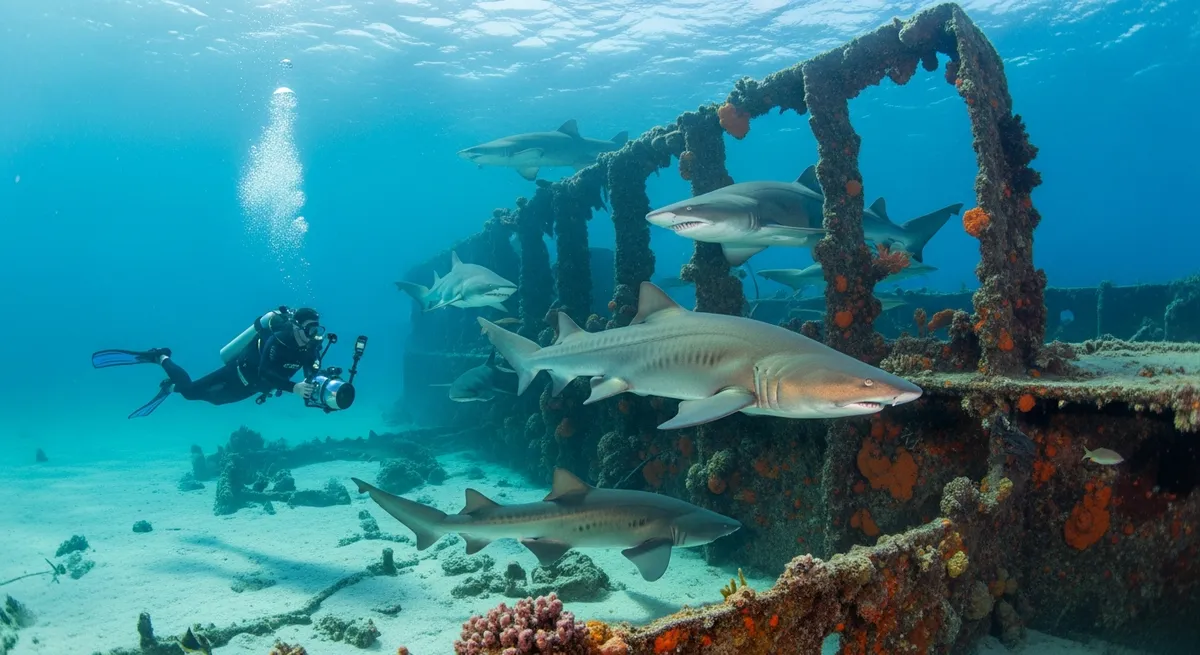
North Carolina diving, for us, means one thing: sharks and wrecks. The 'Graveyard of the Atlantic' isn't just a catchy name; it’s a living museum of WWII U-boats and other maritime history. We’re talking about metal skeletons draped in soft corals, big enough to swim through, attracting schools of baitfish that shimmer like liquid silver. The real stars here are the sand tiger sharks, often seen in aggregations so dense it feels like you're diving in a shark traffic jam, especially from late spring through early autumn. We love the sheer scale of the wrecks, like the U-352 or the Papoose, which provide amazing swim-throughs and shelter for colossal schools of amberjack. Visibility can vary, but on a good day, watching those sand tigers cruise lazily past, their jagged teeth on full display, is just magic. It’s mostly intermediate diving due to the currents that feed all that life, but the rewards are massive. Our favourite time to visit is September, after the summer crowds thin out a bit, but the water is still warm and the sharks are still around in numbers. Don't forget your bigger torch; some of those interior passages are properly dark.
North Carolina Dive Site Map
Dive sites and dive centres in North Carolina
North Carolina Dive Sites
165 dive sites in North Carolina
184 menhaden vessel CAPT GREG MICKEY AR-400
The Capt. Greg Mickey, an old menhaden fishing boat, sits upright in the sand, a proper wreck dive off the North Carolina coast. We love a wreck that still holds its shape, and this one does, with the bow and stern mostly intact. You can swim into the wheelhouse and down into the engine room if you’ve got the right training and a good guide. It’s dark in there, properly atmospheric. Schools of baitfish usually swirl around the superstructure, and we often see sand tiger sharks cruising the perimeter, especially in late summer. It's a solid intermediate dive, nothing too crazy, but the currents can pick up. We’d suggest going with a local charter who knows the best slack tide windows. Our favourite spot is the stern, where the prop shaft usually hosts some big sheepshead.
Aeolus (Wreck)
North Carolina’s wreck alley is packed with sunken history, but the *Aeolus* always stands out for us. It’s a destroyer escort, purpose-sunk in 1988, and it’s taken on a whole new life. Dropping down, you’ll see the bow first, often surrounded by sand tiger sharks cruising the thermocline. We love exploring the bridge area; the swim-throughs here are easy and the light often shafts through, illuminating schools of baitfish that pulse with the current. The *Aeolus* sits upright, which makes navigating it surprisingly intuitive, even at 31 meters. Keep an eye out for Goliath groupers tucked into the deeper sections of the hull, and we’ve often spotted massive loggerhead sea turtles resting on the deck. Our favourite time to dive it is late summer when the water is warmest and visibility can push past 20 meters, letting you appreciate the sheer scale of the wreck as you descend. Just remember, currents can pick up here, so good buoyancy control is a must. It’s a fantastic intermediate dive, offering penetration options without being overly challenging.
AR-220 - Buoy
The AR-220 Buoy site in North Carolina is an interesting spot for those who enjoy open water navigation. While there's no fixed reef, the buoy itself acts as a marker for pelagic sightings and baitfish schools. It's a dive that suits more experienced divers comfortable without a direct bottom reference, focused on the blue water experience. Expect to encounter whatever marine life happens to be passing through the area.
AR-225 - Buoy
The AR-225 Buoy site in North Carolina is an advanced dive, best suited for experienced divers comfortable with deeper wrecks and potential currents. It’s an old fishing trawler, settled on its side, attracting sand tiger sharks and schooling baitfish. Visibility varies, but on a good day, you’ll get a clear view of the wreck’s structure, which holds a surprising amount of detail. The depth means careful bottom time management is key.
AR-255 - Buoy
The AR-255 Buoy site in North Carolina is exactly what it sounds like – a buoy. It’s a good spot for a drift dive, often with pelagic fish passing through and barracuda hanging around. We've seen a few turtles here too. It’s a straightforward dive, best for those wanting to practice navigation or just enjoy an easy current ride.
AR-302 - 459 Assault Transport Ship YANCEY
The Yancey, now there's a wreck with some serious history. She was an assault transport, saw action in WWII and Korea, and finished her career as an artificial reef off North Carolina. We love a wreck with a story, and the Yancey tells hers with every bent plate and open cargo hold. Descending onto her immense structure, you feel the sheer scale of the ship – she’s over 450 feet long. Penetration opportunities are everywhere, particularly through the large cargo holds, where sunlight filters down, illuminating schools of baitfish that swirl around the structure. We've seen some hefty sand tiger sharks cruising the deeper sections here, and the swim-throughs around the superstructure are usually home to big gag groupers and sheepshead. Visibility can be hit or miss, typical of North Carolina, but when it’s good, the Yancey truly shines, revealing intricate details of her past. It’s a dive for experienced wreck lovers, comfortable with depths and potentially strong currents, but the rewards are huge.
AR-366 - Buoy
The AR-366 Buoy site off North Carolina offers divers a chance to explore a concrete reef, originally placed for fishing enhancement. Expect to see typical Atlantic wreck inhabitants like amberjack, grouper, and various schooling fish. It’s a good choice for divers looking for a straightforward dive with solid fish action, rather than intricate reef structures.
AR-368 - 10 Railroad boxcars
We’ve got a soft spot for the AR-368 boxcars, a site that’s often overlooked in favor of North Carolina’s bigger wrecks. Ten hulking railroad cars, sunk deliberately as part of an artificial reef project, now sit upright in about 30 meters of water. There’s a beautiful desolation to them, like a ghost train at the bottom of the ocean. The boxcars are surprisingly intact, offering plenty of nooks and crannies to peer into. We particularly love the way light filters through the missing roofs, illuminating schools of baitfish that swirl inside. You’ll often find large amberjacks circling the entire structure, and sometimes, if you’re lucky, a sand tiger shark or two cruises by, using the boxcars as a resting spot. It’s a great dive for those who appreciate the slower pace of wreck exploration and don't mind a bit of a current, which can sometimes be strong out here. Our top tip: aim for slack tide if you want to explore the interiors comfortably. Bring a good light; the deeper sections can get quite dim, enhancing that eerie, cavernous feel we enjoy so much.
AR-368 - 241 barge LC-16
The AR-368, also known as the 241 barge or LC-16, is one of those North Carolina wrecks we just keep coming back to. We love it because it’s not some grand warship, but a working vessel that met its end, and that character still shines through. As you descend, the shape emerges from the green-blue, often with schools of baitfish shimmering around the superstructure, darting in and out of the holds. This barge offers some excellent penetration for appropriately trained divers, with open hatches leading into dark, silty interiors that always feel a bit like exploring an abandoned building. Look closely in the shadowed corners for oyster toadfish or the occasional sleepy nurse shark tucked away. The exterior is thoroughly encrusted with mussels and barnacles, providing homes for blennies and small crabs, and we often see spiny lobsters peeking out from under plates of steel. It’s a site that rewards slower diving, letting you really soak in the atmosphere of a working boat now repurposed as a thriving artificial reef.
AR-368 - Buoy
The AR-368 Buoy site in North Carolina is an artificial reef. You'll find a collection of concrete pipes and bridge rubble, creating structure for sand tiger sharks and the usual reef fish like sheepshead. It’s a good spot for divers looking for easy navigation and a reasonable chance of seeing larger pelagics passing through.
AR-372 - 10 Railroad boxcars
We've spent a fair bit of time on North Carolina's wreck alley, and the AR-372, or the "Boxcars" as everyone calls it, is a standout for us. It’s not about finding intact relics here; it’s about the sheer scale of the disruption and how life adapts. Ten freight cars, scattered and piled, make for some seriously interesting topography. We love dropping down and seeing the way the metal has buckled and twisted, creating all these nooks and crannies. You’ll find big schools of baitfish shimmering around the deeper sections, and if you peek into the shadows, you often spot a grumpy-looking gag grouper or a curious loggerhead turtle cruising past. Our favourite part is navigating through the gaps between the overturned cars; it feels like exploring a submerged industrial maze. It's a great dive for those who appreciate seeing nature reclaim man-made structures and prefer a more explorative, less current-driven wreck experience. Just keep an eye on your depth and bottom time, as it's easy to get absorbed in the twists and turns.
AR-372 - 2 220 barge
The AR-372 barge, sitting off North Carolina, isn't some ancient galleon, but it's a fantastic example of how nature reclaims things. We love dropping onto this site, finding it often a bit silty on the surface, but clearing up as you descend. It’s essentially a large, broken-up cargo barge, probably scuttled here deliberately. What you get is a spread of metal sections, some upright, some toppled, creating all these nooks and crannies. We often spot schools of baitfish shimmering over the larger plates, and if you look closely into the shadowed areas, you’ll likely find nurse sharks resting. Our favourite part is navigating the scattered framework, pushing through gaps where the plates have bent and twisted, revealing fat grouper lurking in the shadows. It’s a gentle wreck dive, perfect for those comfortable with navigating a spread-out site rather than a compact ship. Keep an eye out for lionfish; they’re pretty common here, unfortunately.
Show all 165 dive sites in North Carolina
- AR-376 - 10 Railroad boxcars
- AR-376 - Buoy
- Atlantic Beach Reef AR-315 - 104 US Navy tug TAKOS
- Atlantic Beach Reef AR-315 - 60 lash barge 1
- Atlantic Beach Reef AR-315 - Buoy
- Australia
- AWOIS 774
- Bill Perry Jr Reef
- Billy Murrell Reef AR-364 - 297 barge HT-290
- Billy Murrell Reef AR-364 - 52 tug CAPTAIN TOM
- Billy Murrell Reef AR-364 - 55 Landing Craft
- Billy Murrell Reef AR-364 - Buoy
- Billy Smith Reef AR-275 - 130 menhaden vessel GULF COAST
- Billy Smith Reef AR-275 - 65 crew boat MISS CLARA
- Billy Smith Reef AR-275 - Buoy
- Blackfish Bank Reef
- Bow Mariner Wreck
- Box Wreck
- Bp-25 Reef
- Bruce Rush Reef
- Brunswick County Fishing Club Reef AR-440 - 65 tug A T PINER
- Cabbage Patch Reef
- Caribsea Wreck
- Cassimer Wreck
- Catherine M Monohan Wreck
- Cherrystone Reef
- City of Richmond
- CLIFTON MOSS REEF AR-320 - 140 menhaden vessel NOVELTY
- Clifton Moss Reef AR-320 - Buoy
- Dale McDowell Reef AR-445 - ADMIRAL CHARLIE 55 Tug
- Dale McDowell Reef AR-445 - Buoy
- Dale McDowell Reef AR-445 - JELL II 174 vessel
- Dale Ward Reef AR-455 - 102 US Navy tug PAWTUCKET
- Dale Ward Reef AR-455 - Buoy
- Dixie Arrow
- Dredge Wreck Reef AR-382 - 105 tug POCAHONTAS
- Dredge Wreck Reef AR-382 - 86 tug R R STONE
- Dredge Wreck Reef AR-382 - Dredge PLAYA
- East Ocean View Reef
- Fantasy Lake Scuba Park
- Fenwick Island Wreck
- Fishermans Reef AR-460 - 330 barge
- Gary Ennis Reef AR-465 - 180 menhaden vessel MANCE LASSITER
- General Sherman Wreck
- George Summerlin Reef AR-285 - 130 steel hull fishing vessel NANCY LEE
- George Summerlin Reef AR-285 - Buoy
- Georgetown Nearshore Reef
- Georgetown Reef
- Gwynn Island Reef
- Gypsy Divers Aquatic Center
- Hanks Trawler
- Hardee s Reef AR-300 - 174 US Navy Yard Oiler FS-26
- Howard Chapin Reef AR-330 - 2 C-130 aircraft
- Howard Chapin Reef AR-330 - 55 steel sailboat NEPOMUK
- Howard Chapin Reef AR-330 - Buoy
- Indra
- Keshena Wreck
- Lake Rawlings
- Lennon-Hyde Reef AR-386 - 10 Railroad boxcars
- Lennon-Hyde Reef AR-386 - 150 YTT barge ALTON LENNON
- Lennon-Hyde Reef AR-386 - 215 USACOE dredge HYDE
- Lillian Luckenback Wreck
- Little River Offshore Reef
- Little River Reef
- Manuela Wreck
- Marine Electric Wreck
- Meares Harriss Reef AR-370 - 105 tug STONE BROTHERS
- Meares Harriss Reef AR-370 - 120 tug SOCONY 8
- Meares Harriss Reef AR-370 - 135 barge
- Meares Harriss Reef AR-370 - 2 90 barges
- Meares Harriss Reef AR-370 - 440 Liberty Ship ALEXANDER RAMSEY
- Mobjack Bay Reef
- Mr J C Reef AR-230 - 105 tug MR J C
- Mr J C Reef AR-230 - 130 yard freighter
- Mr J C Reef AR-230 - 75 landing craft
- MV Empire Gem Wreck
- Mystery Lake Scuba Park
- Nandua-Pungoteague Reef
- Nassawadox Reef
- Newport News Middle Ground
- New River Reef AR-355 - 60 ferro-cement vessel SEA MINT
- New River Reef AR-355 - Buoy
- Normannia Wreck
- Northern Neck Reef
- North Inlet Reef - Steel Pup Tents
- Occohannock Reef
- Onslow Bay Sport Fishing Club Reef AR-342 - Buoy
- Oregon Inlet Reef AR-160 - 441 US Navy Repair Ship DIONYSUS
- Oregon Inlet Reef AR-160 - 83 wooden trawler IRVING H
- Oregon Inlet Reef AR-160 - Buoy
- Papoose
- Papoose (Wreck)
- Paradise Reef
- Parramore Reef
- Penderbrook Swimming Pool (Diving)
- Phillip Wolfe Reef AR-378 - 195 barge
- Phillip Wolfe Reef AR-378 - 3 98 barges
- Poquoson Reef
- Porta Allegra Wreck
- Proteus Wreck
- Radio Island Rock Jetty
- Santore Wreck
- Schurz Wreck
- Springmaid Pier Reef
- SS Atlas
- St Cathan
- Swansboro Rotary Club Reef AR-345 - 116 tug TITAN
- Tamaulipas Wreck
- Tarpon Wreck
- Ten Mile Reef
- Ten Mile Reef - 200 Ship
- Ten Mile Reefe - Concrete Reef Balls
- Ten Mile Reef - Southern Buoy
- The Cell Reef
- Theodore Parker Wreck
- Tom Boyette Reef AR-362 - Buoy
- Tom McGlammery Reef AR-420 - 104 YSD barge
- Tom McGlammery Reef AR-420 - 110 water barge YC-794 Potter Barge
- Tom McGlammery Reef AR-420 - Bridge span 230
- Tom McGlammery Reef AR-420 - Buoy
- TopsailL Reef AR-360 - Buoy
- Tower Reef
- Tower Tug
- U-1105
- U-352 Wreck
- U-576 (Wrack)
- U-701 (Wrack)
- U-85 (Wrack)
- USCGC Cuyahoga Wreck
- USNS Clark Wreck
- USNS Garrison
- USNS Haviland Wreck
- USNS Morgan Wreck
- USNS Webster Wreck
- USS Aeolus
- USS Cyclops (Wrack)
- USS Naeco
- USS Philadelphia
- USS Schurz (Wreck)
- Veturia Wreck
- Wachapreague Reef
- Wayne Upchurch Reef
- W E Hutton Wreck
- Will Goldfinch Reef
- Windmill Point Reef
- Wreck of Bounty
- Wreck of Queen Anne's Revenge
- Wreck of U-352
- Wreck of U-701
- Wreck of U-85
- Yaupon Beach Reef AR-425 - Buoy
- Yaupon Beach Reef AR-425 - Floating Drydock
- Zane Gray
North Carolina Dive Centres
43 dive shops and operators in North Carolina
All About Diving
Aquatic Safaris
Bay Breeze Dive Center
Broadreach Adventures LLC
Bubbles or Not Scuba
Carolina Dive Center
Carolina Dive Locker
Coastal Scuba
Show all 43 dive centres in North Carolina
- Deep South Scuba
- Discovery Diving Co., Inc.
- Dive Below h2o Scuba
- Diventures Raleigh
- Divers Supply Marietta
- Down Under Dive Shop
- EXND Diving and Marine Services
- Fantasy Lake Adventure Park (Scuba Diving)
- Gigglin' Marlin Dive & Swim
- Harry's Dive Shop
- Holden Beach Scuba
- Horizons Dive Shop
- International Diving Institute
- MBT Divers
- Mermet Springs Office
- Olympus Dive Center
- Open Water Adventures (OWA)
- Pennyroyal Scuba Center
- Planet Ocean Scuba Center
- Roanoke Island Outfitters
- Round Island Divers
- Salisbury Scuba
- Scubaland Adventures North Austin
- Scuba Shack
- Scuba Shack
- Scuba Shop/Voyages
- Scuba Toys
- Scuba Ventures
- Seven Seas
- Southern Skin Divers Supply
- Sport Divers
- Sugar Land Dive Center
- The Dive Shop
- The Dive Shop
- Water World Marine
Ocean Wildlife in North Carolina
42 species recorded in North Carolina
North Carolina Daylight & Sunrise/Sunset
Sunrise and sunset times for North Carolina, calculated from coordinates
Today - Sunday 11 October
Sunrise
06:10
Sunset
17:41
Daylight
11h 31m
Golden Hour
17:07
First light (dawn) at 05:45 · Last light (dusk) at 18:06
Monthly Averages
| Month | Sunrise | Sunset | Daylight |
|---|---|---|---|
| Jan | 07:16 | 17:19 | 10h 3m |
| Feb | 06:56 | 17:50 | 10h 54m |
| Mar | 06:21 | 18:15 | 11h 54m |
| Apr | 05:38 | 18:39 | 13h 2m |
| May | 05:06 | 19:04 | 13h 58m |
| JunLongest | 04:54 | 19:23 | 14h 29m |
| Jul | 05:05 | 19:23 | 14h 18m |
| Aug | 05:28 | 18:59 | 13h 31m |
| Sep | 05:51 | 18:18 | 12h 27m |
| OctNow | 06:13 | 17:35 | 11h 22m |
| Nov | 06:42 | 17:04 | 10h 22m |
| DecShortest | 07:08 | 16:58 | 9h 50m |
Times are approximate local times based on longitude. Actual times may vary slightly depending on the exact timezone observed in North Carolina.
Where to Stay near North Carolina
Prices from Booking.com. We may earn a commission at no extra cost to you.
Marine Protected Areas near North Carolina
35 protected areas near North Carolina - please respect local regulations when diving
Cape Lookout National Seashore
Cape Hatteras National Seashore
North Carolina National Estuarine Research Reserve
Sea Turtle Sanctuary
Cape Hatteras
Currituck National Wildlife Refuge
Currituck
Masonboro Island
Masonboro Island Estuarine Reserve Dedicated Nature Preserve
Bald Head Island State Natural Area
Cape Lookout
Several Islands Audubon
Showing 12 largest of 35
Getting to North Carolina
New Bern
Raleigh/Durham
Norfolk
Plan & book
Ways to dive North Carolina, from day trips to liveaboards.
Day trips & courses
via GetYourGuideGuided dives, courses and snorkel trips with instant booking.
Find dive trips in North CarolinaPlaces to stay
via Booking.comHotels and dive resorts near North Carolina.
Search stays in North CarolinaDive insurance
Most travel insurance excludes or limits scuba. Check what you need before you go.
Dive insurance explainedPartner links: we may earn a commission if you book, at no extra cost to you. How we make money