Diving in Komodo
Why dive here
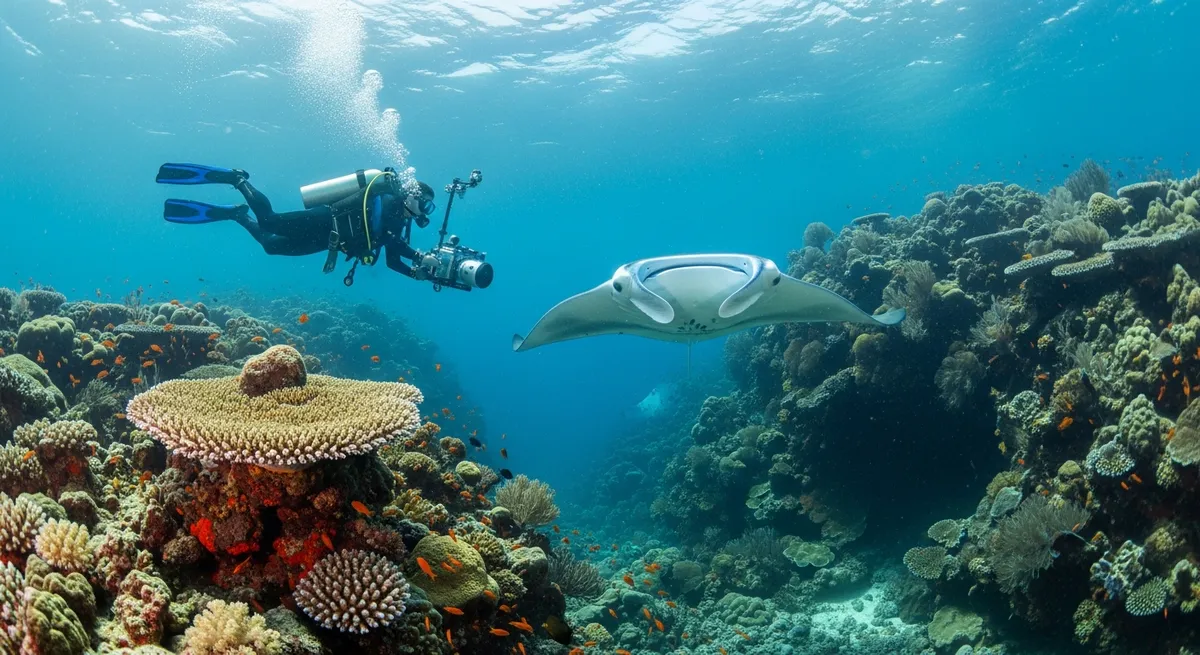
Komodo offers some of Indonesia's richest diving, with 203+ marine species recorded in the area - including manta rays, mobula rays (devil rays), pygmy seahorses, sea turtles and sperm whales. Water ranges 28-30°C, warmest April, May, November.
Komodo. Just the name conjures images of dragons and, for us, some truly electrifying diving. We’ve logged more bottom time here than almost anywhere else, and it never gets old. Picture yourself dropping into a dive at Batu Bolong, where the current parts around a pinnacle, revealing a wall absolutely plastered in corals. We’re talking Montipora and corrugated corals in shades you didn’t know existed, and then a cloud of yellowstriped cardinalfish just hangs there. It’s glorious. What we really love about Komodo is the sheer energy of the place. You’ll be soaring along a drift dive at Manta Alley, feeling the water push you, and then a train of mantas glides by, their mouths open wide. It’s often a bit chilly down there, a good 24°C, but that’s what brings in all the good stuff. We’ve seen black comb-tooth blennies peering from their holes and even spotted a fringe-eye flathead tucked into the sand. For a change of pace, we always make time for a muck dive. You might find an Indian seahare inching along or a tiny Kankra crab scuttling past. The currents can be fierce, especially around the full and new moons, so don’t underestimate them. Go with an experienced operator who knows the tides. We always recommend hitting the southern sites like Manta Alley in the dry season, roughly April to October, for the best chances with the big pelagics. The visibility is usually excellent then too, easily 20 meters plus.
Komodo Dive Site Map
Dive sites and dive centres in Komodo
Komodo Dive Sites
123 dive sites in Komodo
3 Sisters
The 3 Sisters site in Komodo is a personal favourite of ours, a collection of three pinnacles that rise up from the depths near Gili Lawa Laut. We love it because it’s a site that rewards slow diving, often overlooked by those chasing pelagics, but honestly, it’s where you find the really interesting stuff. Drop down and find a comfortable spot to watch the show. Look closely at the cracks and crevices. This place is macro heaven. We’ve spent entire dives here within a few square metres, just observing. You’ll spot Yellow-fin flasher-wrasses doing their display, Comettailed wrasse flitting about, and if you have the patience, a Threespot Righteye Flounder doing its camouflage act. Mushroom corals dot the landscape, and we always find something new tucked into the folds. Keep an eye out for Marshall Dottybacks and the vibrant Blue-head Combtooth-Blenny. We find the shallower sections, around 10-15 metres, are particularly fruitful. It’s not a site for screaming currents, but a gentle drift keeps things interesting. This spot suits divers who appreciate the smaller details, those who can settle in and truly observe the intricate behaviour of reef life. It's a photographer's dream, especially for macro lenses.
Amelia
Amelia sits in the Komodo National Park, a spot we often visit for a quick second dive. It's a nice drift along a coral reef, with schools of fusiliers and snapper hanging out. We generally find a good number of reef sharks patrolling the deeper sections. It's a solid, undemanding dive, perfect for warming up or winding down your day in Komodo.
ARDADELDALI
Ardaledali is one of those sites that just feels right, a genuinely atmospheric wreck dive in Komodo. We love how the historical context adds another layer to the experience; knowing it was a WWII Japanese motor vessel just before it was scuttled in 1944 gives you a moment of pause. The wreck itself sits upright, mostly intact, starting around 18 metres down. You can still make out the superstructure, and the bow and stern are pretty well-defined. What really gets us about Ardaledali is the way the marine life has completely taken over. Big schools of snapper swirl around the mast, and we’ve seen some hefty groupers lurking in the cargo holds. Keep an eye out for nudibranchs on the deck plating, they’re surprisingly plentiful here. Our favourite bit is exploring the engine room – it’s tight, but the light filtering through the hull creates some fantastic visuals. Visibility can be a bit variable, so we’d suggest going in the morning before any currents stir things up too much. It’s a comfortable dive for anyone with some wreck experience; no major penetrations needed, but plenty to poke around in.
Bahuluang Wall
Bahuluang Wall, on Komodo’s southern edge, feels like a secret handshake. It’s a proper drift dive when the current picks up, a gentle glide past a sheer limestone face that drops well beyond recreational limits. We love how the wall itself is textured, not just a flat expanse, with pockets and ledges holding delicate feather corals and the occasional bowl coral. Keep an eye out for the Peacock-tail Anemone Shrimp – a tiny flash of colour if you can spot it in the nooks. This is a site for those who appreciate the subtle drama of a well-preserved wall. We've seen reef sharks patrolling the deeper sections and often catch groups of fusiliers swirling like a silver tornado in the blue. Visibility can vary, but even on an average day, the sheer scale of the wall is impressive. Our top tip: go early. The morning light really brings out the subtle hues in the coral and the chances of seeing a leatherback turtle or an eagle ray cruising by seem to increase then. The entry is typically a backwards roll, straight onto the wall, which always gets the heart pumping just a little.
Batu Bolong
Batu Bolong, or 'Hollow Rock,' is a pinnacle that truly delivers on its reputation in Komodo. We drop in on the sheltered side, usually the south, where the rock offers a momentary break from the channels’ infamous currents. The walls are a tapestry of hard corals and sponges, surprisingly untouched, likely due to the sheer force of water that sweeps through here. What really gets us, though, is the fish: schools of fusiliers and snapper form shimmering curtains, and often we’ll spot reef sharks cruising the blue. It’s a lively, exhilarating dive, best suited for those comfortable with drift diving and keeping an eye on their buoyancy.
Batu Bolong Dive Site
Batu Bolong in Komodo. Now that's a site we always make time for. It’s this small, volcanic rock pinnacle, barely breaking the surface, and it drops straight down into a kaleidoscope. Seriously, the sheer density of soft corals here is something else. You descend into a wall draped in purples, pinks, and oranges, all swaying gently in the current. We love dropping in on the sheltered side, letting the gentle down current carry us along the wall. Look for the yellow-fin flasher-wrasses doing their mating dances near the coral heads; they’re spectacular. And the blennies! So many little blue-head combtooth-blennies peeking out from every crevice. Visibility is usually superb, 20-30 metres, so the scale of the place really hits you. You’ll see schools of fusiliers, bannerfish, and snapper, thick enough to momentarily block out the sun. Keep an eye out for greenfish darting amongst the staghorn corals and the colossal small giant clams tucked into the reef. Currents can be tricky on the exposed side, sometimes ripping, so it’s one for experienced divers, or at least those comfortable with a bit of drift. Our favourite time to dive it is mid-morning, just after the sun has warmed the water, bringing out the smaller reef fish. It’s an absolute showstopper.
Batu Bolong Komodo
Batu Bolong is a site we’ll always make time for in Komodo, despite its reputation for serious current. It's really two submerged pinnacles, a large one and a smaller one, with a deep channel between them. We’re talking about a site that demands respect and good briefing, but the payoff is huge. You’ll experience that exhilarating drop down the reef face, often tucked in close to the rock to avoid the main current. What we love here is the sheer density of fish. Schools of fusiliers are so thick they often block out the light, creating a shimmering wall of silver. Look into the blue for chances of reef manta rays gliding by, or perhaps a cruising reef shark. The coral health on the sheltered sides is spectacular too – vibrant Montipora and brain corals thriving in the nutrient-rich water. We’d suggest going in the morning if you can, before boat traffic picks up. This dive is best suited for experienced divers comfortable with drift diving and managing strong, sometimes unpredictable, currents. Trust us, it’s worth the effort.
Batu Bolong Komodo
Batu Bolong is a site we’ll always make time for in Komodo, despite its reputation for serious current. It's really two submerged pinnacles, a large one and a smaller one, with a deep channel between them. We’re talking about a site that demands respect and good briefing, but the payoff is huge. You’ll experience that exhilarating drop down the reef face, often tucked in close to the rock to avoid the main current. What we love here is the sheer density of fish. Schools of fusiliers are so thick they often block out the light, creating a shimmering wall of silver. Look into the blue for chances of reef manta rays gliding by, or perhaps a cruising reef shark. The coral health on the sheltered sides is spectacular too – vibrant Montipora and brain corals thriving in the nutrient-rich water. We’d suggest going in the morning if you can, before boat traffic picks up. This dive is best suited for experienced divers comfortable with drift diving and managing strong, sometimes unpredictable, currents. Trust us, it’s worth the effort.
Batu Tiga
Batu Tiga is one of those Komodo sites where you just hold on and enjoy the ride. It’s a proper drift, often with a ripping current, making it an advanced dive for those comfortable moving with the water. We usually drop in, descend quickly, and watch the reef fly by. The sheer volume of fish here is what keeps us coming back – we've seen schools of giant trevally so thick they momentarily block out the sun, and barracuda walls that stretch into the blue. Mantas are a frequent sight, gliding in the current, sometimes just cruising past, sometimes stopping for a clean. We’ve also had fantastic encounters with Napoleon wrasse and bumphead parrotfish cruising the deeper sections. Our pick for timing? Mid-morning, if the tides are right. The light penetration really makes the corals pop, though honestly, with the speed you’re often moving, it's more about the pelagics. Visibility averages around 15 metres, which is plenty when you're watching the big stuff. It’s not a site for macro, it’s all about the wide-angle thrills and the rush of being part of the ocean's flow.
Batu Tiga
Batu Tiga is one of those Komodo sites where you just hold on and enjoy the ride. It’s a proper drift, often with a ripping current, making it an advanced dive for those comfortable moving with the water. We usually drop in, descend quickly, and watch the reef fly by. The sheer volume of fish here is what keeps us coming back – we've seen schools of giant trevally so thick they momentarily block out the sun, and barracuda walls that stretch into the blue. Mantas are a frequent sight, gliding in the current, sometimes just cruising past, sometimes stopping for a clean. We’ve also had fantastic encounters with Napoleon wrasse and bumphead parrotfish cruising the deeper sections. Our pick for timing? Mid-morning, if the tides are right. The light penetration really makes the corals pop, though honestly, with the speed you’re often moving, it's more about the pelagics. Visibility averages around 15 metres, which is plenty when you're watching the big stuff. It’s not a site for macro, it’s all about the wide-angle thrills and the rush of being part of the ocean's flow.
Batu Tiga Dive Site
Batu Tiga, for us, is all about the little things. You won’t get the roaring current here that defines some of Komodo’s more famous drift dives, and that's precisely why we love it. Instead, we’d suggest taking your time, really slowing down your fin kicks, and getting properly acquainted with the reef. It’s a gentler experience, perfect for macro lovers or anyone who just wants to soak it all in without being swept away. We’ve spent whole dives just watching the intricate dance of Black-headed Leatherjackets, or trying to spot the elusive Alligator Pipefish tucked into the seagrass. Keep an eye out for Bennett’s Pufferfish, they’re surprisingly endearing. And those Black-spotted Garden Eels? Absolutely mesmerising, swaying in unison, then vanishing in a blink. The diversity of Blennies, from the bright Sapphire Demoiselle to the more reclusive Black Blenny, makes it a spot we return to again and again.
Bhayangkara
Bhayangkara, a quick 20-minute run from Benteng Harbour, offers a mellow dive perfect for an easy afternoon. The site gently slopes to about 15 metres, a nice mix of white sand and coral patches. We often spot green and hawksbill turtles gliding past, and the blue-spotted stingrays usually hang out on the sandy bottom. Keep an eye out for pink anemonefish in their homes and the occasional leaf scorpionfish camouflaged amongst the reef. It's a relaxed dive, good for beginners or anyone looking for a chill underwater cruise, though we’ve seen the surface get a bit choppy in certain seasons.
Show all 123 dive sites in Komodo
- Bhayangkara
- Bidadari
- Bidadari
- blue fish
- blue fish
- Bone Malea
- Bone Malea
- Bonsai dive site
- Buginang
- Bylandt Reef
- Cannibal Rock
- Cannibal Rock Komodo
- Castle Rock Komodo
- China Shop
- Crystal Bay Dive Site
- Crystal Bay Komodo
- Crystal Rock Komodo
- Cystal Rock Dive Site
- Diving Beach
- Gaja Rock dive site
- Gili Lawa
- Gindang
- Gindang
- Golden Passage Komodo
- GPS Point
- Gusung Melambiri
- HMS Sturdy
- House Reef Selayar Dive Resort
- Indihiang
- Karang Kassi
- Karang Lambelamberi
- Karang Limpogeh
- Karang Manrantusang
- Karang Pamalu
- Karang Patawasang
- Karang Puaraba
- Karang Tintingan
- KM. Canci Ladjoni
- KMP Kencana XIII
- Kolo-Kolo
- Komodo National Park
- Liang Tarrusu Spot
- Lighthouse Komodo
- Lighthouse Reef Dive Site
- Little Wall
- Loh Namu
- Loh Sera dive site
- Magic Wall, Selayar
- Makassar Reef (Manta Point)
- Manta Alley
- Manta Point
- Manta Point dive site
- Manta Point , Makassar Reef
- Mawan
- Mawan Komodo
- Mini Wall
- Mini Wall
- Netz
- North Komodo
- Outside
- Pantai Merah
- pantai pinang
- Payong
- Pengah Kecil
- Pengah Kecil
- Pillarsteen
- Pink Beach
- Pink Beach Komodo
- Plataran
- Police Corner
- Pulau Khayangan
- RADEN SALEH
- Sabayor Kecil
- Sabolan Besar
- Sabolon besar dive site
- Sabolon kecil dive site
- Sangeang Island
- Sebayor Kecil Dive Site
- Sebayur dive site
- Sebayur Kecil Komodo
- Secret Garden
- Seraya kecil dive site
- Shark Point, Selayar
- Siaba Besar dive site
- Siaba Besar dive site
- Siaba Kecil
- Siaba Kecil Dive Site
- Snorkeling
- Taka Dange
- Taka Garlarang
- Taka Lambaena
- Taka Lamungan
- Taka Rangkap
- Takat Lanco
- Tanjung Loh Sera dive site
- Tatawa Besar dive site
- Tatawa Besar Dive Site
- Tatawa Island
- Tatawa Kecil
- Tatawa Kecil dive site
- The Cauldron
- The Cauldron Dive Site
- Three Sisters Komodo
- Tinabo Island
- Torpedo Alley
- Turtle Point
- Twin Island Dive
- Waecicu
- Wainilu
- White Angels
- Yellow Wall Komodo
Komodo Dive Centres
30 dive shops and operators in Komodo
Akuatica
Aqura Dive Center
ARCHIPELAGO DIVE RESERVE
Batara Baruna
Bira Dive Camp
Blue Marlin Dive
Blue Planet Dive Resort
Blue Planet Dive Resort
Show all 30 dive centres in Komodo
- Blue Planet Dive Resort
- CNDive
- Compass
- Dive Komodo
- Dive Shop
- Dragon Dive Komodo Dive
- Dugong Scuba
- iDIVE Komodo
- KALIMAYA DIVE RESORT
- Komodo Aggressor
- Manta Dive Komodo
- Manta Rhei
- Neptune Scuba Diving Komodo
- Santai Divers Maumere
- Scuba Junkie Komodo
- SELAYAR DIVE & ADVENTURE
- SELAYAR MARINE DIVE
- Signature Scuba Flores
- Somer Dive
- Ta'a Dive Resort
- Wet Frog Divers
- Wicked Diving Komodo
Ocean Wildlife in Komodo
203 species recorded in Komodo
Komodo Daylight & Sunrise/Sunset
Sunrise and sunset times for Komodo, calculated from coordinates
Today - Sunday 11 October
Sunrise
05:41
Sunset
17:55
Daylight
12h 14m
Golden Hour
17:28
First light (dawn) at 05:20 · Last light (dusk) at 18:16
Monthly Averages
| Month | Sunrise | Sunset | Daylight |
|---|---|---|---|
| Jan | 05:55 | 18:26 | 12h 31m |
| Feb | 06:05 | 18:26 | 12h 21m |
| Mar | 06:06 | 18:15 | 12h 9m |
| Apr | 06:03 | 18:00 | 11h 56m |
| May | 06:05 | 17:51 | 11h 46m |
| JunShortest | 06:12 | 17:52 | 11h 41m |
| Jul | 06:16 | 17:59 | 11h 43m |
| Aug | 06:11 | 18:02 | 11h 51m |
| Sep | 05:56 | 17:59 | 12h 3m |
| OctNow | 05:39 | 17:55 | 12h 16m |
| Nov | 05:32 | 18:00 | 12h 28m |
| DecLongest | 05:40 | 18:13 | 12h 34m |
Times are approximate local times based on longitude. Actual times may vary slightly depending on the exact timezone observed in Komodo.
Where to Stay near Komodo
Prices from Booking.com. We may earn a commission at no extra cost to you.
Marine Protected Areas near Komodo
13 protected areas near Komodo - please respect local regulations when diving
Take Bone Rate
KK Liukang Tangaya
Komodo
Parc national de Komodo
Komodo
KK Gili Banta
KK Teluk Cempi
KK Labuhan Bajo Timur Laut
KK Pulau Kelapa
KK di Perairan di Wilayah Kayuadi
Tujuh Belas Pulau
KAWASAN KONSERVASI PERAIRAN DAERAH PULO PASI GUSUNG KABUPATEN SELAYAR
Showing 12 largest of 13
Getting to Komodo
Bima
Makassar
Mataram (Pujut, Lombok Tengah)
Plan & book
Ways to dive Komodo, from day trips to liveaboards.
Day trips & courses
via GetYourGuideGuided dives, courses and snorkel trips with instant booking.
Find dive trips in KomodoPlaces to stay
via Booking.comHotels and dive resorts near Komodo.
Search stays in KomodoDive insurance
Most travel insurance excludes or limits scuba. Check what you need before you go.
Dive insurance explainedPartner links: we may earn a commission if you book, at no extra cost to you. How we make money