Diving in Klein Bonaire
Why dive here
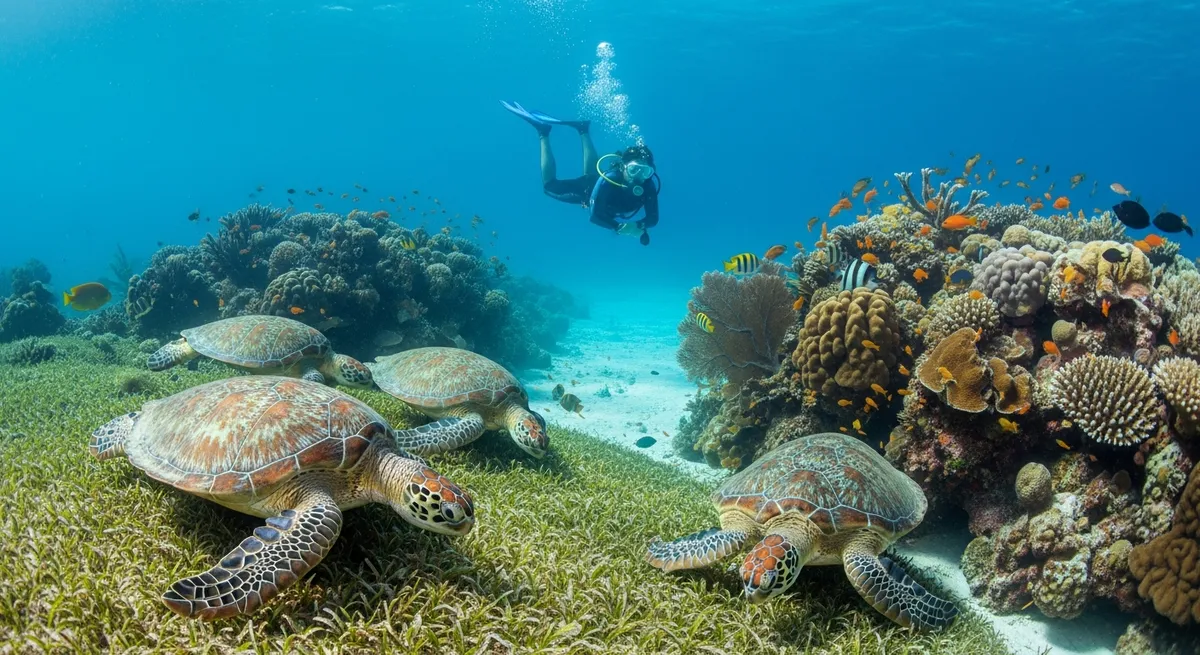
Klein Bonaire offers some of Bonaire's richest diving, with 192+ marine species recorded in the area - including barracuda, blue sharks, orcas, sea turtles and sperm whales. Water ranges 27-30°C, warmest September, October, November.
Klein Bonaire is our happy place when we’re looking for a truly relaxed dive. That short boat ride across from the main island always feels like leaving the crowds behind, even if you’re sharing the water with a few other boats. We especially love the sites along the west side, like Sampler and Jerry’s Reef. Drop in there and you're instantly among some seriously healthy elkhorn and staghorn corals, which isn't always a given these days. Visibility here is usually fantastic, often pushing past 30 metres, which lets you really appreciate the scale of the reef. We’ve had some memorable encounters with Dark Green Parrotfish here, just chugging along, oblivious to us, and the Sharpnose Pufferfish always make us smile. Keep an eye out for manatee grass beds in the shallower areas, a great place to spot the unusual Antilles Glass-slug if you’ve got a keen eye. While it's all generally pretty calm, we find the late morning often offers the best light, with the sun hitting the corals just right. It’s a perfect spot for beginners, or frankly, anyone who wants an easy, beautiful dive without much fuss.
Klein Bonaire Dive Site Map
Dive sites and dive centres in Klein Bonaire
Klein Bonaire Dive Sites
178 dive sites in Klein Bonaire
1000 Steps
Okay, let’s be real, the 1000 Steps name is a bit of a fib, but it sets the tone for a dive that delivers. You’re definitely not walking down a thousand steps, more like sixty-odd limestone stairs, but you’ll feel every single one of them on the way back up when you’re lugging your gear. That’s the Bonaire shore diving life, though, and it’s always worth the effort here. Once you hit the water, the slight exertion is forgotten. We love the immediate drop-off into deep blue, a wall blanketed in huge formations of grooved brain coral and mustard hill coral. It’s an easy swim out, past schools of bluestriped grunts and schoolmasters hanging around the shallows. Keep an eye out for loggerhead and hawksbill turtles munching away; they’re regular fixtures. Our favourite part has to be the sheer density of reef fish – we’ve seen everything from banded basslets darting through crevices to the occasional orbicular batfish gliding by. The fire coral patches are impressive, but obviously, watch your buoyancy. This site suits divers who appreciate a classic Caribbean wall dive with abundant, healthy reef life and don’t mind a bit of a workout for the entry and exit. We’d suggest going early to beat any crowds, especially cruise ship day-trippers.
18th Palm
We’ve probably drifted past 18th Palm a dozen times, and it’s always a good call for an easy afternoon dive. It’s one of those sites on Klein Bonaire that just delivers consistent, relaxed diving. Drop in, and you’re immediately greeted by the soft sway of turtle grass beds in the shallows, a haven for the smaller stuff. We love spending some time here, searching for tiny Spinyhead Blennies peeking out of old coral rubble – they’re surprisingly entertaining. The reef itself is a gentle slope, mostly finger coral and some impressive sheets of Lamarck's coral, stretching down to about 25 metres. Keep an eye out for Blackfish zipping between the coral heads, and we’ve often spotted Tiger Groupers lurking in the shadows. We once watched a pair of Hourglass Basslets darting in and out of a small crevice for a good five minutes. The current here is usually mild, a mellow drift that lets you take your time. It’s a great spot for photographers keen on macro, and for anyone who just wants a peaceful dive without too much effort.
Alice in Wonderland
Alice in Wonderland, on Klein Bonaire, is one of those sites that always leaves us smiling. It's a gentle drift, perfect for just letting the current carry you along, taking everything in. The name comes from the huge, sprawling mustard hill coral formations that genuinely look like oversized mushrooms on the reef slope, dropping down to about 25 metres. We love gliding through them, spotting the tiny yellowline arrow crabs that often hide in the crevices. While the big stuff, like a hawksbill turtle cruising past, is always a treat, we think Alice truly shines in its macro life. Keep an eye out for banded basslets tucked into overhangs and we’ve often found glass gobies perched delicately on sponges. Dive it in the late morning, the light filtering through the water really makes the colours pop on the finger and boulder brain corals. It’s a great second dive of the day, relaxed and rewarding.
Andrea I
Andrea I, off Klein Bonaire, is one of those sites we always try to hit, especially if we’ve got newer divers in the group. The reef here just slopes so gently, starting shallow and easing down to a sandy bottom around 20 meters. It’s perfect for long, relaxed drifts where you can really take your time. We love dropping in and just letting the gentle current push us along. Look closely at the sand patches; we’ve spotted Nodulose Miters and Lightning Pitars kicking up little puffs of sand. The coral formations, a good mix of Staghorn and big stands of Grooved Brain Coral, create plenty of little hideouts. You’ll definitely see lots of Bluegold Gobies darting into their burrows and Apricot Bass hovering above the reef. Keep an eye out for Green Turtles, they seem to appreciate the calmer conditions here too. Sometimes, we’ll even spot a big Angelfish just cruising past, almost ignoring us. It’s a site that rewards slow exploration rather than a fast fin kick. Head there mid-morning for the best light, when the sun really makes the corals pop.
Andrea II
Andrea II isn't your typical Caribbean wreck dive. We’re talking about a tugboat, sunk deliberately in 1989, and what a transformation it’s undergone. The wreck sits upright, remarkably intact, at about 27 meters. It’s got an almost ghost-like quality, especially on an overcast day, with the light filtering through the water and bouncing off the structure. We love swimming through the wheelhouse; it’s open enough not to feel confining, but you still get that thrill of penetration. The big draw for us here, beyond the wreck itself, is the sheer density of life that has claimed it. Finger Coral grows in thick clumps on the deck, and you’ll spot Apricot Bass darting in and out of the crevices. Look closer and you’ll find colonies of Common Wiry Feather Hydroids swaying gently, and we’ve had some cracking encounters with Cherub Pygmy Angelfish here, tucked into shadowy corners. Keep an eye on the sandy patches nearby too; we’ve seen Blackberry Drupes and Night Dove Snails slowly making their way across the substrate. It’s a dive that rewards slow exploration rather than rushing through, perfect for those who appreciate history and the way the ocean reclaims its own.
Angel City
Angel City, off Klein Bonaire, is a site we return to again and again. It’s one of those spots that just keeps giving, dive after dive. The reef starts fairly shallow, maybe 8 metres, and slopes gently down. We usually drop in and head right, letting the subtle current guide us past the huge beds of lettuce coral and ten-ray star coral. You’ll see plenty of parrotfish here, chomping away, leaving their little plumes of sand. The magic really happens when you slow down and look closely. We’ve had incredible luck spotting pearl blennies peeking from their holes and tiny red clingfish almost invisible on the coral. Keep an eye out for spinythroat scorpionfish, masters of disguise, and those elegant hogfish cruising by. The beds of manatee grass are a good place to spot a bluegold goby or a Keeltail needlefish. We always take our time here, maybe 60 minutes or more, just drifting and observing. It’s a truly relaxing dive, perfect for photographers or anyone who just wants to unwind and watch the reef’s quiet drama unfold.
Aquarius
Aquarius on Klein Bonaire is a site we keep coming back to. We love how the reef here just rolls gently down, no dramatic drop-offs, just a calm slope perfect for really slowing down and observing. It’s a great spot for macro enthusiasts, and we often spend a good portion of our dive just hovering, looking for the tiny things. Keep an eye out for Pearl Blennies popping out of the sand, and the Yellowline Arrow Crabs are usually tucked away in crevices. The coral formations are healthy, particularly the Maze Coral and Ten-ray Star Coral, providing lots of nooks for small fish. We’ve had fantastic luck spotting Bigtooth Cardinalfish hovering in the shadier spots. The visibility here is usually excellent, so you can really appreciate the detail. It’s an easy drift, making it perfect for a relaxed dive where the current does most of the work. If you’re looking to tick off some of the smaller, harder-to-spot species, Aquarius is definitely a strong contender.
Aquarius (46)
Aquarius is one of those Klein Bonaire spots that just keeps giving, especially if you’ve got a good guide who knows the nuances. We love how it starts with that shallow, sun-drenched swim over the first reef, giving you time to spot those blushing star corals before the main event. It’s a gentle introduction to a seriously healthy wall. What really sets Aquarius apart for us isn't just the sheer number of fish – though we did spot plenty of angelfish and parrotfish – it's the smaller, more unusual finds. Keep an eye out for those tricky banded basslets darting into crevices, and if you’re lucky, a cherub pygmy angelfish will flash its colours. We’ve even seen the odd orbicular batfish here, a true Caribbean treat. The current can be mild, making it a relaxed drift along the wall, but we always suggest keeping an eye on your air if you plan to venture deeper towards that second, often overlooked reef. That’s where the bigger critters sometimes cruise, though it’s a fair swim. This site suits divers who appreciate a mix of macro life and classic Caribbean reef scenes without feeling rushed.
Aquarius (46)
Aquarius is one of those Klein Bonaire spots that just keeps giving, especially if you’ve got a good guide who knows the nuances. We love how it starts with that shallow, sun-drenched swim over the first reef, giving you time to spot those blushing star corals before the main event. It’s a gentle introduction to a seriously healthy wall. What really sets Aquarius apart for us isn't just the sheer number of fish – though we did spot plenty of angelfish and parrotfish – it's the smaller, more unusual finds. Keep an eye out for those tricky banded basslets darting into crevices, and if you’re lucky, a cherub pygmy angelfish will flash its colours. We’ve even seen the odd orbicular batfish here, a true Caribbean treat. The current can be mild, making it a relaxed drift along the wall, but we always suggest keeping an eye on your air if you plan to venture deeper towards that second, often overlooked reef. That’s where the bigger critters sometimes cruise, though it’s a fair swim. This site suits divers who appreciate a mix of macro life and classic Caribbean reef scenes without feeling rushed.
Atlantis
Atlantis, off Klein Bonaire, is a gently sloping reef, a nice drift dive when the current is running, which it often is. We typically drop in and let the water carry us past wide fields of turtlegrass and manatee grass. It’s a great spot for spotting the smaller, shyer stuff like Cherub Pygmy Angelfish or the various gobies – Sharknose, Bluegold, Yellowline, Rusty – tucked into crevices. Keep an eye out for foraging green and loggerhead turtles, a fairly common sight here. It's not the most dramatic reef, but for a relaxed drift and some good macro photography, Atlantis does the trick.
Atlantis
Atlantis, on Klein Bonaire, is one of those sites where we almost always spot something unusual. You follow the channel, a sandy path between sprawling coral heads, and it quickly drops to 22 metres. We love the drift here; it’s usually a gentle push that lets you really soak in the smaller things. Look closely for Spinythroat Scorpionfish tucked into crevices and the tiny Puffcheek Blennies darting among the corals. On a good day, the light plays beautifully through the water, illuminating the crinoids that fan out from the reef. It’s an ideal spot for macro enthusiasts, but the eagle rays and tarpon cruising by keep wide-angle shooters happy too. Just remember, this area is popular with kite surfers. Always, always send up an SMB well before you ascend. It’s a small price to pay for such a rewarding dive.
Atlantis
Atlantis, on Klein Bonaire, is one of those sites where we almost always spot something unusual. You follow the channel, a sandy path between sprawling coral heads, and it quickly drops to 22 metres. We love the drift here; it’s usually a gentle push that lets you really soak in the smaller things. Look closely for Spinythroat Scorpionfish tucked into crevices and the tiny Puffcheek Blennies darting among the corals. On a good day, the light plays beautifully through the water, illuminating the crinoids that fan out from the reef. It’s an ideal spot for macro enthusiasts, but the eagle rays and tarpon cruising by keep wide-angle shooters happy too. Just remember, this area is popular with kite surfers. Always, always send up an SMB well before you ascend. It’s a small price to pay for such a rewarding dive.
Show all 178 dive sites in Klein Bonaire
- Bachelor's Beach
- Bakadera
- Barcadera
- Barcadera (21)
- Barcadera (21)
- Bari Reef
- Bari’s Reef (30)
- Bari’s Reef (30)
- Belleveu
- Belleveu
- Bise Morto
- Bisé Morto
- Bisé Morto (4)
- Bisé Morto (4)
- Bloodlet (12)
- Bloodlet (12)
- Boca Bartol North
- Boka Bartol
- Boka Bartol (1)
- Boka di Tolo
- Boka Katuna
- Boka Slagbaai
- Bonaire
- Bonaire
- Bonaventura (G)
- Bonaventura (G)
- Bonaventure
- Bon Bini Na Cas
- Bon Bini na Kas (15)
- Bon Bini na Kas (15)
- Boy Scout
- Bruce's Rappel
- Buddy's Reef
- Cai
- Calabas Reef
- Candyland
- Captain Don’s Habitat
- Captain Don's Reef
- Captain Don’s Reef (K)
- Carel's Vision
- Carl's Hill
- Carl’s Hill (V)
- Chachacha Beach
- C.H. Annex/ Yellowman
- Chez Hines (39)
- Cliff
- Corporal Meiss
- Country Garden (14)
- CUMAREBO I
- Delfin Beach Resort Reef
- Delphins Reef
- Ebo's Reef
- Ebo’s Reef (B)
- Ebo's Special
- Éden Beach Point
- Eden Resort
- English Garden
- Forest (N)
- Front Porch
- Hamlet
- Hands Off
- Hands Off (M)
- Harbor Village Bonaire
- Hidden Beach (unmarked site)
- Hilma Hooker
- Invisibles
- Invisibles
- Jeannie's Glory
- Jeff Davis Memorial
- Jeff Davis Memorial
- Jerry s Jam
- Jerry s reef
- Jerry's Reef
- Joanne's Sunchi
- Joanne’s Sunchi (J)
- Just A Nice Dive
- Kalli's Reef
- Kalli’s Reef (19)
- Karapata
- Karpata
- Keepsake
- Keepsake (F)
- Knife
- Knife (Y)
- Lac Bay
- La Dania's Leap
- La Denia's Leap
- La Machaca
- Larry's Lair
- Larry’s Lair (47)
- Leonora's Reef
- Leonora’s Reef (X)
- Lighthouse Point
- MAK H-1
- Margate Bay
- Mi Dushi
- Mi Dushi (T)
- Monte's Divi
- Monte’s Divi Tree (H)
- Munk’s Haven
- No Name
- No Name (A)
- Nukove
- Oil Slick Leap
- Ol Blue
- Petries Pillar
- Petrie’s Pillar (24)
- Pink Beach
- Pink Beach (53)
- Playa Benge
- Playa Frans
- Playa Funchi
- Punt Vierkant
- Punt Wekua
- Rappel (11)
- Red Beryl
- Red Slave
- Reef Scientifico
- Rock Pile (I)
- Salt City
- Salt Pier
- Sampler
- Sampler (Z)
- Sara’s Smile
- Sebastian Reef
- Sharon's Serenity
- Sharon’s Serenity (R)
- Small Wall (25)
- Soft Coral Garden (unmarked site)
- Something Special
- South Bay
- South Bay
- Southwest Corner
- Sweet Dreams
- Sweet Dreams (59)
- Taylor Made
- Te Amo Beach
- The Double Reef
- The Lake
- The Point
- The Rock
- Thousand Steps (16)
- TILISA DEL MAR
- Tolo (13)
- Tori's Reef
- Tori s reef Bonaire
- Town Pier
- Town Pier Dive
- Turtle City
- Vista Blue
- Vista Blue (58)
- Wajacá
- Wayaca II
- Wayaka
- Wayaka 2
- Webber s Joey
- Weber's Joy
- Weber's Joy / Witch's Hut
- White Hole
- White Slave
- Willemstoren Lighthouse
- Windjammer
- Windjammer wreck
- Windsock
- Yellow Hut (unmarked site)
- Yellow Submarine
Klein Bonaire Dive Centres
20 dive shops and operators in Klein Bonaire
Ocean Wildlife in Klein Bonaire
192 species recorded in Klein Bonaire
Klein Bonaire Daylight & Sunrise/Sunset
Sunrise and sunset times for Klein Bonaire, calculated from coordinates
Today - Sunday 11 October
Sunrise
05:23
Sunset
17:19
Daylight
11h 55m
Golden Hour
16:50
First light (dawn) at 05:02 · Last light (dusk) at 17:40
Monthly Averages
| Month | Sunrise | Sunset | Daylight |
|---|---|---|---|
| Jan | 05:58 | 17:27 | 11h 29m |
| Feb | 05:56 | 17:40 | 11h 44m |
| Mar | 05:42 | 17:45 | 12h 2m |
| Apr | 05:22 | 17:46 | 12h 23m |
| May | 05:10 | 17:51 | 12h 41m |
| JunLongest | 05:09 | 17:59 | 12h 50m |
| Jul | 05:16 | 18:03 | 12h 47m |
| Aug | 05:23 | 17:55 | 12h 32m |
| Sep | 05:23 | 17:36 | 12h 13m |
| OctNow | 05:23 | 17:16 | 11h 53m |
| Nov | 05:31 | 17:06 | 11h 35m |
| DecShortest | 05:46 | 17:11 | 11h 25m |
Times are approximate local times based on longitude. Actual times may vary slightly depending on the exact timezone observed in Klein Bonaire.
Where to Stay near Klein Bonaire
Prices from Booking.com. We may earn a commission at no extra cost to you.
Marine Protected Areas near Klein Bonaire
4 protected areas near Klein Bonaire - please respect local regulations when diving
Bonaire
Het Pekelmeer
Het Lac
Flamingo (Bonaire) Sanctuary
Getting to Klein Bonaire
Kralendijk
Willemstad
Oranjestad
Plan & book
Ways to dive Klein Bonaire, from day trips to liveaboards.
Day trips & courses
via GetYourGuideGuided dives, courses and snorkel trips with instant booking.
Find dive trips in Klein BonairePlaces to stay
via Booking.comHotels and dive resorts near Klein Bonaire.
Search stays in Klein BonaireDive insurance
Most travel insurance excludes or limits scuba. Check what you need before you go.
Dive insurance explainedPartner links: we may earn a commission if you book, at no extra cost to you. How we make money