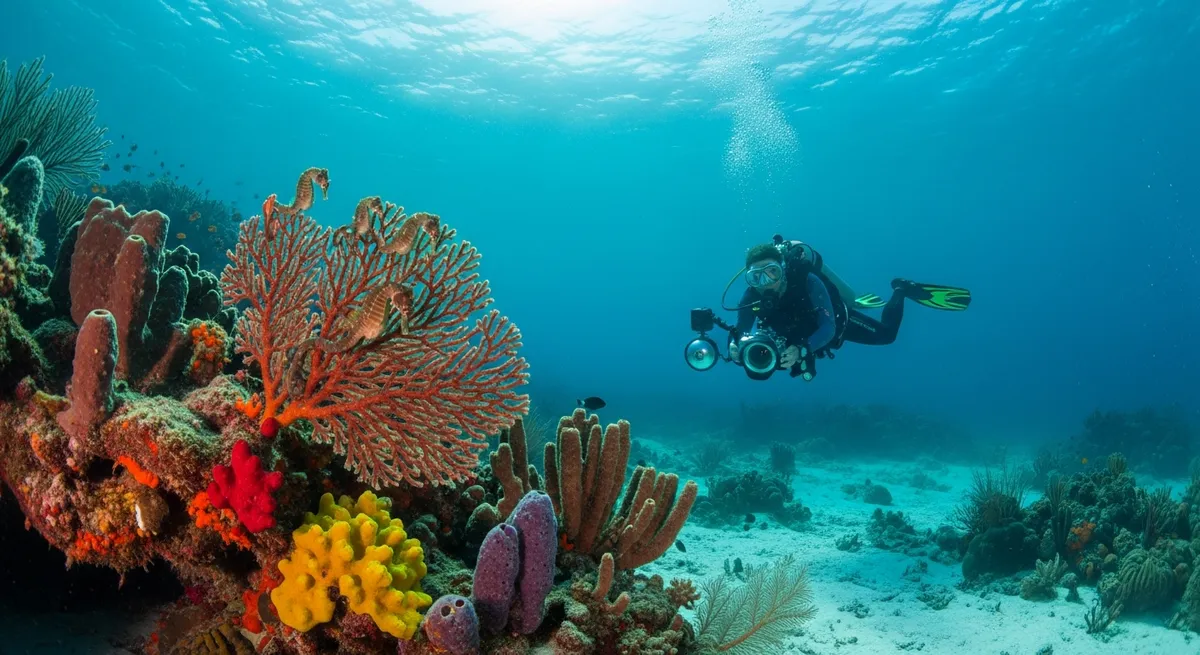
Diving in Roatán
Why dive here
Roatán offers some of Honduras's richest diving, with 168+ marine species recorded in the area - including barracuda, orcas, sea turtles, whale sharks and pufferfish. Water ranges 27-30°C, warmest August, September, October.
Roatán’s a special place, one we often find ourselves recommending for those looking for solid, affordable wall diving. It’s the kind of place where you can roll out of bed, grab a coffee, and be on a boat heading to a fantastic site within minutes. We love the sheer variety here, from gentle drift dives along the extensive Mesoamerican Barrier Reef to exhilarating drops over dramatic walls that plunge into the deep. You’re not just seeing the big stuff, though loggerheads do make an appearance. Keep an eye out for the smaller inhabitants like the White-eye Goby peeking from its hole, or the Atlantic Lookdown shimmering in the blue. The walls are often draped in sponges and soft corals, creating vibrant tapestries that shift with the surge. Our favourite dives often happen early morning when the light plays through the water just right, illuminating schools of Big-eye Anchovies. Current can pick up on some sites, so it’s worth checking conditions with your dive shop, but generally, it’s a calm affair, making it pretty accessible for most divers. If you’re a fan of exploring crevices, you’ll find plenty of spots for Yellow roughneck shrimp and Robertson's Blennies.
Roatán Dive Site Map
Dive sites and dive centres in Roatán
Roatán Dive Sites
192 dive sites in Roatán
Airplane Wreck
We’ve dived a few plane wrecks in our time, but the Roatán Airplane Wreck has a particular charm. It’s a single-engine passenger plane, a small Cessna that went down in 2021. Everyone on board made it out okay, which always helps with the mood. This isn't a massive warplane, so don't expect dramatic bomb bays, but its relatively shallow depth, maxing out at 22 metres, means plenty of bottom time. When you drop down, you find the plane lying flat on the sand, surprisingly intact. You can easily swim around the cockpit, peer into the passenger windows, and imagine the pilot’s last moments before the splash. Because it’s relatively new, it hasn't completely transformed into an artificial reef, but we’ve already spotted some excellent signs of colonisation. Look closely, and you'll see tiny blennies peeking from crevices, a few cardinalfish sheltering in the fuselage, and even a small school of blue parrotfish picking at algae that’s starting to grow on the wings. We’ve even seen the odd turtle cruising by, perhaps curious about the new addition to their neighbourhood. This is a relaxed dive, perfect for photographers wanting clean lines of a recognisable wreck, or anyone who enjoys the novelty of an accidental artificial reef. Our advice? Go in the morning; the light hitting the plane through the clear water is just stunning.
Airplane Wreck
We’ve dived a few plane wrecks in our time, but the Roatán Airplane Wreck has a particular charm. It’s a single-engine passenger plane, a small Cessna that went down in 2021. Everyone on board made it out okay, which always helps with the mood. This isn't a massive warplane, so don't expect dramatic bomb bays, but its relatively shallow depth, maxing out at 22 metres, means plenty of bottom time. When you drop down, you find the plane lying flat on the sand, surprisingly intact. You can easily swim around the cockpit, peer into the passenger windows, and imagine the pilot’s last moments before the splash. Because it’s relatively new, it hasn't completely transformed into an artificial reef, but we’ve already spotted some excellent signs of colonisation. Look closely, and you'll see tiny blennies peeking from crevices, a few cardinalfish sheltering in the fuselage, and even a small school of blue parrotfish picking at algae that’s starting to grow on the wings. We’ve even seen the odd turtle cruising by, perhaps curious about the new addition to their neighbourhood. This is a relaxed dive, perfect for photographers wanting clean lines of a recognisable wreck, or anyone who enjoys the novelty of an accidental artificial reef. Our advice? Go in the morning; the light hitting the plane through the clear water is just stunning.
Airport Caves
Airport Caves is exactly what it sounds like, a series of swim-throughs and small caverns not far from Roatán’s airport. We found it a nice, easy dive, usually calm and shallow enough for newer divers to practice buoyancy in confined spaces. You’ll see plenty of schooling fish darting in and out, and we often spot nurse sharks tucked away in the darker corners. It's a fun, relaxing alternative when the open reef is a bit choppy.
Airport Caves
Alright, let's talk about Airport Caves. First off, ignore the mention of Utila in some older descriptions; this one’s firmly in Roatán, sitting right off the old airstrip, which is a neat bit of trivia. We love a site with a little history. It’s not a true deep cave system, more a series of dramatic overhangs and swim-throughs carved into the reef at about 10-15 meters. Think of it as nature’s architecture, with light shafts piercing through openings, creating these incredible, shifting patterns on the sandy floor. It’s absolutely beautiful to just drift through, feeling the cool pockets where the sun doesn't quite reach. Our favourite time to dive here is early morning, when the sun is lower and the light effects are at their most striking. You’ll often find Longspine Squirrelfish tucked into the shadowed recesses and the occasional Doctorfish schooling along the reef edge. Keep an eye out for sleepy Milk Conchs on the sand patches between the coral. Visibility is generally solid, around 20 meters, which really lets you appreciate the scale of the formations. It’s a pretty relaxed dive, perfect for photographers or anyone who just wants to take their time soaking in the unique topography.
Airport Caves
Alright, let's talk about Airport Caves. First off, ignore the mention of Utila in some older descriptions; this one’s firmly in Roatán, sitting right off the old airstrip, which is a neat bit of trivia. We love a site with a little history. It’s not a true deep cave system, more a series of dramatic overhangs and swim-throughs carved into the reef at about 10-15 meters. Think of it as nature’s architecture, with light shafts piercing through openings, creating these incredible, shifting patterns on the sandy floor. It’s absolutely beautiful to just drift through, feeling the cool pockets where the sun doesn't quite reach. Our favourite time to dive here is early morning, when the sun is lower and the light effects are at their most striking. You’ll often find Longspine Squirrelfish tucked into the shadowed recesses and the occasional Doctorfish schooling along the reef edge. Keep an eye out for sleepy Milk Conchs on the sand patches between the coral. Visibility is generally solid, around 20 meters, which really lets you appreciate the scale of the formations. It’s a pretty relaxed dive, perfect for photographers or anyone who just wants to take their time soaking in the unique topography.
Alaina’s Sandy Bottom
Alaina’s Sandy Bottom. Don’t let the name fool you, this isn't just a patch of sand. We’re talking about a channel, yes, but one carved through a seriously impressive reef. You drop onto a buoy at around 7 or 8 metres, and then the real show begins. The channel itself eventually opens up to a wide sandy expanse, but it’s the walls you want to explore. There are swim-throughs here, not just little holes, but proper passages where you can glide through the reef. Our favourite bits are the massive fan corals that grow out from the overhangs, they’re just enormous, the kind that make you feel tiny. Keep your eyes peeled for the smaller stuff in the sand, particularly the darters and rusty gobies, they’re always busy. We’ve seen Caribbean reef squid here too, often in pairs, putting on their colour show. If you're lucky, and we mean really lucky, you might spot an Atlantic flashlightfish in one of the deeper, darker crevices. It’s a site that rewards slow exploration. Take your time, really poke around the coral formations, because there’s always something hiding. This is a perfect afternoon dive when the sun is a bit lower, bringing out the colours.
Alaina’s Sandy Bottom
Alaina’s Sandy Bottom. Don’t let the name fool you, this isn't just a patch of sand. We’re talking about a channel, yes, but one carved through a seriously impressive reef. You drop onto a buoy at around 7 or 8 metres, and then the real show begins. The channel itself eventually opens up to a wide sandy expanse, but it’s the walls you want to explore. There are swim-throughs here, not just little holes, but proper passages where you can glide through the reef. Our favourite bits are the massive fan corals that grow out from the overhangs, they’re just enormous, the kind that make you feel tiny. Keep your eyes peeled for the smaller stuff in the sand, particularly the darters and rusty gobies, they’re always busy. We’ve seen Caribbean reef squid here too, often in pairs, putting on their colour show. If you're lucky, and we mean really lucky, you might spot an Atlantic flashlightfish in one of the deeper, darker crevices. It’s a site that rewards slow exploration. Take your time, really poke around the coral formations, because there’s always something hiding. This is a perfect afternoon dive when the sun is a bit lower, bringing out the colours.
Anka s Place
Anka’s Place is a decent drift dive, often with a steady current pushing you along the wall. We typically see a good mix of Caribbean reef fish here, parrotfish grazing the corals and the occasional eagle ray gliding past in the blue. It’s a good choice for divers comfortable with current, offering a relaxed way to cover a lot of reef without much effort.
Anthony’s Key Resort House Reef
We know house reefs. Most are… fine. A convenient dip, maybe a sleepy turtle. Anthony’s Key’s Front Porch, though, is genuinely special. It’s right there, a short swim from the dock, yet you’re immediately immersed in proper Roatán reef. The wall drops gently, not dramatically, to around 22 meters, making it incredibly relaxed for multiple dives a day. We love slipping in for an early morning scout, watching the reef wake up. You’ll see plenty of the usual suspects, of course – parrotfish grazing, angelfish darting – but take your time with the sand patches near the wall. That’s where we’ve consistently spotted Mottled Jawfish peering out of their burrows and even the occasional Brown Garden Eel swaying in the gentle surge. Keep an eye out for larger Tarpon Snook cruising by, especially towards dusk. The coral here, mostly brain and star varieties, feels established, providing countless nooks for juvenile fish. It’s the kind of site where every dive feels like visiting an old friend, familiar but always offering a new small detail. Perfect for easy, repetitive dives, photographers wanting calm conditions, or anyone looking to truly unwind into the rhythm of the reef.
Anthony’s Key Resort House Reef
We know house reefs. Most are… fine. A convenient dip, maybe a sleepy turtle. Anthony’s Key’s Front Porch, though, is genuinely special. It’s right there, a short swim from the dock, yet you’re immediately immersed in proper Roatán reef. The wall drops gently, not dramatically, to around 22 meters, making it incredibly relaxed for multiple dives a day. We love slipping in for an early morning scout, watching the reef wake up. You’ll see plenty of the usual suspects, of course – parrotfish grazing, angelfish darting – but take your time with the sand patches near the wall. That’s where we’ve consistently spotted Mottled Jawfish peering out of their burrows and even the occasional Brown Garden Eel swaying in the gentle surge. Keep an eye out for larger Tarpon Snook cruising by, especially towards dusk. The coral here, mostly brain and star varieties, feels established, providing countless nooks for juvenile fish. It’s the kind of site where every dive feels like visiting an old friend, familiar but always offering a new small detail. Perfect for easy, repetitive dives, photographers wanting calm conditions, or anyone looking to truly unwind into the rhythm of the reef.
Aquarium
Aquarium, about 20 minutes east-northeast from Roatán’s main dive shops, is a site we keep coming back to. Forget what the name implies about captive animals, this is pure reef. We love how it unfolds across three distinct sections: the shoreline, a middle reef, and an outer reef running parallel. It’s the kind of place where you can spend a whole dive exploring overhangs and smaller caverns, feeling the subtle shift in light as you pass under. Our favourite part has to be the chance to spot the more unusual residents – we’ve seen everything from the tiny, intricate Sleeper and Kuna Gobies to the striking Blue Parrotfish. Keep an eye out for octopus tucked into crevices, moray eels peeking from their homes, and the occasional nurse shark resting in the sand. Visibility here is consistently good, usually around 19 meters, making it ideal for photographers or anyone who just wants to soak it all in. This site really suits divers who appreciate detailed exploration over dramatic depths, offering a relaxed but rewarding experience down to 19 meters.
Aquarium
Aquarium, about 20 minutes east-northeast from Roatán’s main dive shops, is a site we keep coming back to. Forget what the name implies about captive animals, this is pure reef. We love how it unfolds across three distinct sections: the shoreline, a middle reef, and an outer reef running parallel. It’s the kind of place where you can spend a whole dive exploring overhangs and smaller caverns, feeling the subtle shift in light as you pass under. Our favourite part has to be the chance to spot the more unusual residents – we’ve seen everything from the tiny, intricate Sleeper and Kuna Gobies to the striking Blue Parrotfish. Keep an eye out for octopus tucked into crevices, moray eels peeking from their homes, and the occasional nurse shark resting in the sand. Visibility here is consistently good, usually around 19 meters, making it ideal for photographers or anyone who just wants to soak it all in. This site really suits divers who appreciate detailed exploration over dramatic depths, offering a relaxed but rewarding experience down to 19 meters.
Show all 192 dive sites in Roatán
- Bando Beach
- Bando Beach
- Bayman Drop
- Bear s Den
- Bear’s Den
- Bear’s Den
- Big Bight
- Big Bight
- Big French Cay Cut
- Big Rock
- Big Rock
- Bikini Bottom
- Bikini Bottom
- Black Coral Wall
- Black Coral Wall
- Black Hills
- Black Hills
- Black Hills
- Blackish Point
- Blackish Point
- Blackish Point
- Black Rock
- Black Rock
- Black Rock Roatan Honduras
- Blue Bayou
- Blue Bayou
- Blue Cave
- Blue Cave
- Blue Channel
- Blue Channel
- Blue Moonshine
- Blue Moonshine
- BOSTON WASP
- Bucca Quay
- Bucca Quay
- Butcher’s Bank
- Butcher’s Bank
- Cabañas
- Cabañas
- Calvin s Crack
- Canyon Reef
- Cara a Cara
- Carib Point
- CARLOS A
- Cayos Cochinos
- Cayos Cochinos Seamount
- Chimneys
- Chloes Coral
- Christophers Coral
- Church Wall
- CJ s Dropoff
- CJ’s Dropoff
- Coco View Wall
- Deep - Ricardo Montans
- Deep Sea Quest
- Deja Vu
- Dennis’ Dropoff
- Diamond Cay
- Dolphin Den
- Dolphins Den
- Don Quickset
- Duppy Waters
- Eagle Ray Alley
- EL AGUILA
- El Aguila (Wreck)
- El Aquario
- Emma’s Plummet
- Fish Bowl
- Fish Den
- Forty-foot Point
- Four Sponges
- French Cay Bank
- Gibson Bight
- Gibson bites
- Grape Escape
- Great Wall
- Green house
- Green Outhouse
- Half Moon Bay Media Luna
- Half Moon Wall
- Happily Ever After
- HAWTHORNE TRADER
- HAWTHORN TRADER (PROBABLY)
- Helene Wall
- Hole In The Wall
- Hole In The Wallet
- Honduras Diving: Roatan and Utila Bay Islands
- Honeycomb Caves
- Infinity Bay House Reef
- Iron Bound
- Ironshore
- Jack Neil Bight
- Jack s Bight
- Joshua Swash
- Josie J Wreck
- Labyrinth/Kenny’s Reef
- Laguna Beach
- Land of the Giants
- Laras Rainbows
- Las Palmas
- LEWROSE
- Lighthouse
- Linda's Wall
- Little Bight
- Little Bight
- Maccallum Girls
- Madelines
- Malu’s Mermaid Retreat
- Mandy’s Eel Garden
- MARITISANT
- Mary s Place
- Mary’s Place
- Missing Link
- moon hole
- Moon Hole
- Moonlight
- Moratt Wall
- Mr. Bud Wreck
- Neverstain Bight
- Newman s Wall
- Octopus Acre
- Odyssey (Wreck)
- Old House
- Old Shrimp Boat Wall
- Over Heat
- Overheat Reef
- Pablo’s Place
- Palmetto Keyhole
- Pelican s Point
- Peters Place
- Pidgeon keys
- Pillar Coral
- Pirates Point
- Pretty Bush
- Prince Albert, wreck
- Pubudus Playground
- Puncher s Paradise
- Raggedy Cay
- Red Cliff
- Roatan
- Rocky Point
- Ron’s Wreck
- Seaquest Deep
- Seaquest Shallow
- SETECA
- Ships Stern
- Silver Garden
- Silver Gardens
- Single Divers
- Spooky Channel
- Spooky Channel
- Spotted Bay
- Stingray Point
- Sturges Bank
- Sunny Side B B
- Tabyanas
- Ted's Point
- Ted s Point West
- Temptation reef
- Texas (The Point)
- The Bight
- The Crucible Warfighter Scuba
- The Halliburton (Wreck)
- The Lighthouse Reef
- The Odyssey
- The Pinnacle
- The Underground Roatan
- The Wreck of the Mr Bud
- Tobri Divers
- Too Tall Too Small
- Treehouse
- Turtle Crossing Deep
- Turtle Crossing Shallow
- Utila
- Utila Open Water
- WENDY
- West End
- West End Wall
- White Hole
- Willy’s Hole
Roatán Dive Centres
40 dive shops and operators in Roatán
Alton's Dive Center
Barefoot Divers
Best Dive Roatan
Blue Island Divers
Blue Moon Scuba
Captain Morgans Dive Center
Centro de Buceo de Splash Inn
Centro de Buceo Jackson
Show all 40 dive centres in Roatán
- Clearwater Adventures
- Coconut Tree Divers
- Coral View Utila Dive Center
- Cressi
- Cross Creek Dive Center
- East End Dive Club
- Freedive Utila
- Guanaja Dive Center
- Infinity Divers Aqua Center
- Kotos Adventures
- Las Rocas Divers
- Moana Divers
- Native Sons
- Octopus Dive School
- Reef Gliders
- Roatan Aggressor
- Roatan Dive Center
- Roatan Divers
- Roatan Freediving
- Roatan Marine Park eco store
- Roatan Scuba Store
- Roatan Seaside Divers
- Sandy Bay Divers
- Scuba Shop
- Sun DIvers
- Tortuga Dive Center
- Underwater Vision Dive Center
- Upachaya Dive Center
- Utila Dive Center
- Utila Water Sports
- West Bay Divers
- West End Divers
Ocean Wildlife in Roatán
168 species recorded in Roatán
Roatán Daylight & Sunrise/Sunset
Sunrise and sunset times for Roatán, calculated from coordinates
Today - Sunday 11 October
Sunrise
05:39
Sunset
17:30
Daylight
11h 51m
Golden Hour
17:01
First light (dawn) at 05:17 · Last light (dusk) at 17:52
Monthly Averages
| Month | Sunrise | Sunset | Daylight |
|---|---|---|---|
| Jan | 06:19 | 17:34 | 11h 15m |
| Feb | 06:14 | 17:50 | 11h 36m |
| Mar | 05:56 | 17:57 | 12h 1m |
| Apr | 05:33 | 18:02 | 12h 29m |
| May | 05:18 | 18:10 | 12h 52m |
| JunLongest | 05:15 | 18:20 | 13h 5m |
| Jul | 05:23 | 18:23 | 13h 1m |
| Aug | 05:32 | 18:13 | 12h 41m |
| Sep | 05:36 | 17:51 | 12h 15m |
| OctNow | 05:39 | 17:27 | 11h 48m |
| Nov | 05:50 | 17:14 | 11h 23m |
| DecShortest | 06:07 | 17:17 | 11h 10m |
Times are approximate local times based on longitude. Actual times may vary slightly depending on the exact timezone observed in Roatán.
Where to Stay near Roatán
Prices from Booking.com. We may earn a commission at no extra cost to you.
Marine Protected Areas near Roatán
15 protected areas near Roatán - please respect local regulations when diving
Islas de la Bahía
Cayos Cochinos
Bahía de Tela
Parque Nacional Jeanette Kawas
Blanca Jeannette Kawas (Punta Sal)
Sistema de Humedal Laguna de Alvarado
Cuyamel
Isla de Guanaja
Barras de Cuero y Salado
Laguna de Guaimoreto
Punta Izopo
Laguna de Bacalar
Showing 12 largest of 15
Getting to Roatán
Coxen Hole
San Pedro Sula
Belize City
Plan & book
Ways to dive Roatán, from day trips to liveaboards.
Day trips & courses
via GetYourGuideGuided dives, courses and snorkel trips with instant booking.
Find dive trips in RoatánPlaces to stay
via Booking.comHotels and dive resorts near Roatán.
Search stays in RoatánDive insurance
Most travel insurance excludes or limits scuba. Check what you need before you go.
Dive insurance explainedPartner links: we may earn a commission if you book, at no extra cost to you. How we make money