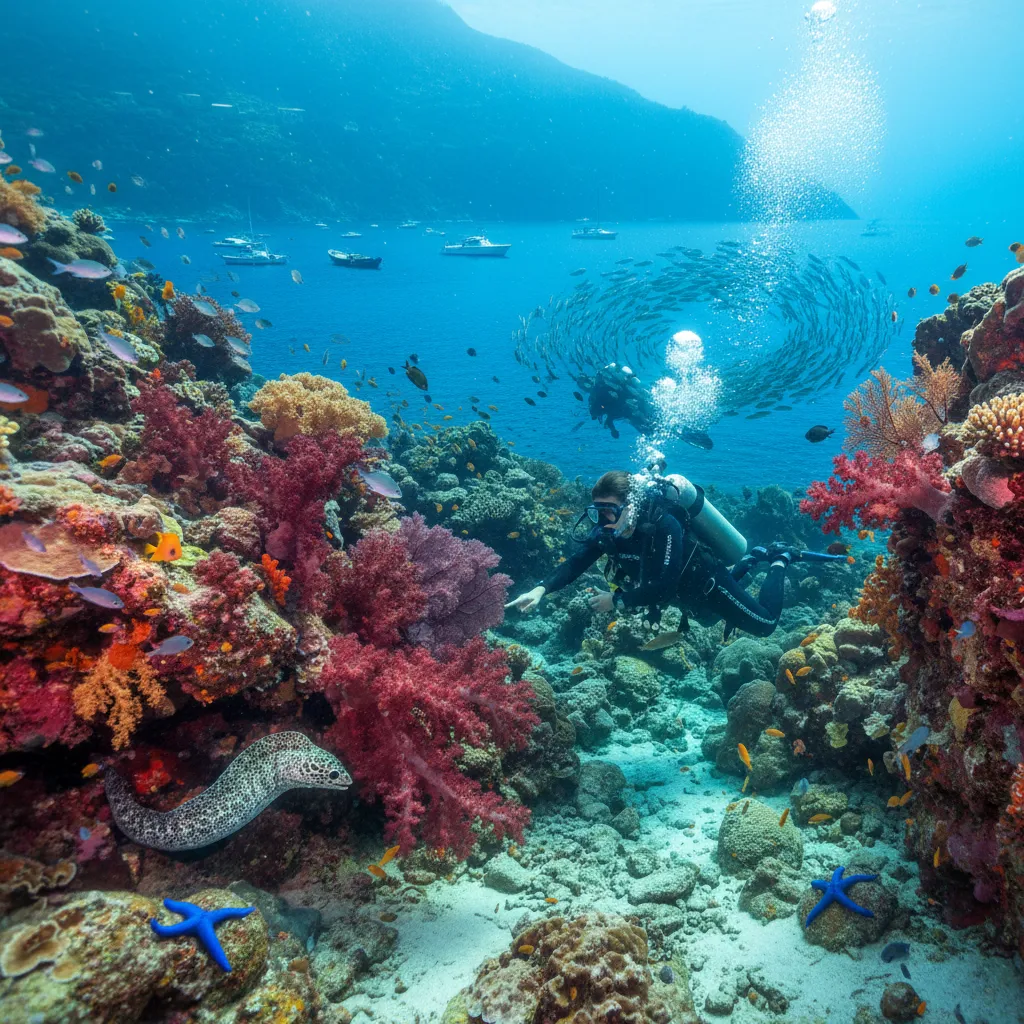
Diving in Portofino & Liguria
Why dive here
Portofino & Liguria offers some of Italy's richest diving, with 70+ marine species recorded in the area - including blue sharks, dolphins, humpback whales, mobula rays (devil rays) and oceanic whitetip sharks. Water ranges 14-27°C, warmest July, August, September.
The Italian Riviera might conjure images of pastel villages and yacht-dotted harbours, but drop beneath the surface at Portofino and Liguria, and you’ll find some seriously compelling diving. We love the dramatic topography here - sheer walls draped in red gorgonian fans, secret caves, and pinnacles that scrape the surface. Keep an eye out for curious painted combers zipping through the crevices and we've even spotted loggerhead turtles cruising by on occasion. This is quintessential Mediterranean diving, where the magic lies in the details and the feeling of exploring ancient underwater landscapes. Our favourite time to visit is late spring or early autumn. You dodge the biggest crowds, and the water still holds a pleasant warmth. We’d suggest focusing on the Portofino Marine Protected Area for the best chance of encountering healthy gorgonian forests and schools of blacktail bream. The wrecks are a real highlight too; they've become artificial reefs, providing shelter for scorpionfish and morays. Currents can pick up, particularly around the exposed pinnacles, so it’s always worth chatting with the local dive centres about conditions on the day.
Portofino & Liguria Dive Site Map
Dive sites and dive centres in Portofino & Liguria
Portofino & Liguria Dive Sites
216 dive sites in Portofino & Liguria
Airplane Wreck WWII
There’s something about a plane wreck that just hits differently than a ship, isn’t there? The Airplane Wreck in Portofino Bay delivers that unique, eerie charm. We love diving this site because it feels like stepping into a moment frozen in time, a poignant reminder of WWII just off the Italian coast. You’ll drop down onto the sandy seabed and find the remains of a German Junkers JU 88 bomber, scattered but still recognisable. The cockpit section is particularly striking, often home to a grumpy moray eel peeking out from the gloom. We’ve spent whole dives just exploring the various pieces, imagining the impact, the sudden silence. Look closely at the wings and fuselage – they’re encrusted now with vibrant gorgonians and sponges, providing shelter for colourful nudibranchs and small schools of damselfish. The visibility here can be excellent, especially in late summer, giving the wreck a dreamlike quality. It's a fairly shallow dive, around 20 metres, making it accessible for open water divers who want a taste of historical wreck diving without the deep saturation. Our favourite time to go is first thing in the morning; you avoid the boat traffic and often get the wreck to yourself.
ALFREDO CAPPELLINI
The Alfredo Cappellini wreck, just off Portofino, is one of those sites we always recommend, especially if you’re looking for something a bit different, and shallow. At just seven metres deep, it’s a brilliant second dive or a relaxed day out, making it ideal for newer divers or anyone keen on a longer bottom time. This isn’t a grand, intact vessel. The Cappellini was a submarine, scuttled during WWII, and time has definitely taken its toll. What you find now are the scattered remnants of a wreck, strewn across a sandy bottom, with fragments of metal and machinery creating a really interesting landscape. We love how the parts have become artificial reefs, attracting groups of damselfish and small wrasse that dart in and out of the crevices. Look closely and you’ll spot nudibranchs, often several different species, clinging to the rusty metal. We often find ourselves just slowly drifting, peering under plates of steel, imagining the submarine’s past. It’s a contemplative dive, rather than an adrenaline rush, perfect for practising buoyancy and getting truly absorbed in the details.
Ancorone
Ancorone offers a straightforward dive along the Portofino coast. You'll navigate a rocky wall, exploring small crevices where moray eels often hide. It’s a reliable spot for seeing typical Mediterranean fish like damselfish and the occasional octopus, making it a good choice for newer divers or those looking for a relaxed afternoon dip.
Andrea Ghisotti (ex Scoglio del Raviolo)
Andrea Ghisotti, or the Raviolo as many still call it, sits just off the Portofino coast. It’s a solid Mediterranean dive, particularly if you’re into the smaller, more intricate stuff. You'll find a good collection of pink sea fans here, swaying gently, providing shelter for slipper lobsters and sometimes even a common lobster tucked away in the nooks. We’ve had pleasant dives watching painted combers dart through schools of damsel fish, and if you’re lucky, a conger eel might peek out from its hiding spot. Visibility can be excellent on a calm day, making it a nice spot for a relaxed exploration rather than a deep, dramatic wall dive. It’s a good choice for newer divers or those who prefer to take their time.
Argentarola Caves
Dropping into the Argentarola Caves, you’ll find a series of interconnected passages, each with a different character. Sunlight filters through openings, illuminating sponges and some small fish hiding in the crevices. It’s a straightforward cave system, suitable for divers comfortable in overhead environments who want something beyond a simple reef dive. We’d suggest a dive light to really pick out the details.
ARMATAN III
The Armatan III sits in a modest 22 metres, an old sailing vessel, not a grand freighter, but there’s a quiet beauty to it. We particularly love the bow, often draped in a shimmering curtain of damselfish, their scales catching the light. It's an easy dive, perfect for a relaxed afternoon, and the wreck itself, while not huge, offers enough nooks and crannies to keep you poking around for a good while. Look closely at the mast, now thickly encrusted, where we’ve often spotted small scorpionfish blending in perfectly. What makes the Armatan III special, for us, isn’t its size, but how it’s become part of the seabed. The wooden hull has long since given way in places, creating swim-throughs where you can glide past walls of jewel anemones. We always take our time here, circling the main structure, watching for moray eels tucked into the darker sections. It’s a gentle introduction to wreck diving in Liguria, suitable for anyone comfortable at this depth, and you’ll often have it mostly to yourselves, especially on a weekday. The visibility here can be variable, so aim for a calm morning after a few days of settled weather; it really makes a difference.
ASD POSIDONIA
Dropping into ASD Posidonia, you’re often greeted by the soft sway of the seagrass meadow, a crucial habitat here in Liguria. It’s a good spot for patiently observing some of the quieter residents, like the Mediterranean slipper lobster or maybe a well-camouflaged conger eel peeking from a crevice. We’ve had pleasant dives here, watching brown combers glide between the blades and occasionally spotting the flash of a horse mackerel passing through. While it might not have the dramatic drops of other Portofino sites, it’s a calm, rewarding dive for those who appreciate the subtle beauty of a healthy seagrass bed.
Baia di Castiglioncello
Baia di Castiglioncello sits tucked away near Portofino, a friendly spot for anyone just getting their fins wet. With a maximum depth of 10 metres, it's pretty forgiving, letting you relax and get comfortable. You’ll find schools of small fish zipping through the seagrass beds, and if you take your time, you might spot a shy octopus or a colourful nudibranch clinging to a rock. We've always found it a good place to brush up on skills or simply enjoy a quiet dip without the pressure of deeper or more challenging dives.
Bettolina
The Bettolina offers a straightforward dive to 30 meters, good for intermediate divers comfortable with that depth. You'll find the typical Mediterranean array here: moray eels peering from crevices and a decent population of groupers. It's a solid choice if you're in the Portofino area and looking for a reliable dive without strong currents.
Biboz
Biboz is a dive for technical divers, dropping to 49 metres. The wall is covered in red gorgonians, with plenty of resident lobsters and moray eels in the cracks. You'll often spot pelagics cruising by in the blue, though the visibility can be variable. This site is best for those comfortable with deep, dark diving.
Bigo
Bigo is a good spot for newer divers in Portofino, sitting at a comfortable 26 meters. The site gets its name from an old wooden crane, the bigo, that once stood here. Now, the remaining timbers create shelter for a surprising amount of Mediterranean fish. Look for moray eels tucked into crevices and schools of ornate wrasse darting between the rocks. It’s a relaxed dive, ideal for getting comfortable in the water.
BOLZANETO
Bolzaneto is one of those wrecks we keep coming back to. Built in 1918, she’s a big girl at 90 metres long, sunk by a British submarine in 1943. She sits upright on the seabed at 55 metres, an imposing silhouette emerging from the blue. Dropping down, you feel the water cool a few degrees, and the light dims to a hazy green. We love exploring her bow, a jumble of twisted metal and plates that offer plenty of swim-throughs for those with the right training. Her stern is our favourite, though, with the propeller still largely intact, a real magnet for schooling snapper and barracuda. The current can pick up here, so good buoyancy is key. Look closely at the cargo holds – they’re full of brittle stars and the occasional moray eel peeking out from the shadows. The sheer scale of Bolzaneto makes it a proper deep-diving adventure, best suited for experienced technical divers who appreciate a piece of history and the marine life that now calls it home.
Show all 216 dive sites in Portofino & Liguria
- BR20
- BR-20 Wreck
- Calafuria
- Cala Grande
- Cala Grande - Punta nord
- Cala Grande - Punta Sud
- Calcarolle
- Campione
- Canyon
- Canyon Terra
- Capo d Enfola
- Capo Noli
- Capo Poro
- CARLOTTA MARIA & ANNA MADRE
- Casa del Sindaco
- Casetta Bianca
- Cebello
- CHEMICAL CHALLENGER
- Chiatta
- Chiesa di San Giorgio
- Christ of the Abyss
- Ciappa del Lupo
- CICNUS
- CITTA DI SASSARI
- Colombara
- Comballo di Piona il Luisin
- Controfrati
- Corallo Nero
- Cristo redentore
- Croce
- DINA ACCAME
- Dragone
- Due Colonne
- EA
- Elefante Bianco
- Formiche della Zanca
- Fortullino
- GALLIANO PADRE
- Garage
- GEIERFELS
- GENEPESCA
- Genepesca Wreck
- Genesio Point
- GENOA
- GILDA
- GIONATA
- Grotta Byron
- Grotta del Grongo
- Grotta Dell Eremita
- Grotta Giusti
- Grotte à Corail
- HMMS 168
- HMMS 170
- HMS Simoom
- HMS Simoom
- Il Canalone
- Il Cristo Degli Abissi
- Il Cristo di Riva del Garda
- Il Nordovest, Calafuria
- Isola del Garda
- Isole Gemini
- Isolotto dei Topi
- Isuela
- JOAN DE ASTIGARRAGA
- KT Eros UJ-2216
- Lacona
- Laghetto di Godego
- Laghetto Standiana
- Lago D Olen
- Lago Gad
- Lago Gardanella
- Lago Laux
- Lago Miserin
- Lago Nero
- La Grotta Dei Gamberi
- Lamacrèxia
- Le ghiaie
- Le Gorgonie, Calafuria
- Le macchine di Moregallo
- LENEO
- LENEO
- Lido di Miami
- Logo di Levico
- LONDON VALOUR (BOW SECTION)
- Lo scoglietto
- Lo Scoglione
- Malgrate
- Marcella
- MAREN 1
- Marina Diving
- MELANIA
- Melania wreck
- Milford Haven Wreck
- Mohawk Deer Wreck
- MoM - Miniera Olgiate Molgora - Level 1
- MONTONE
- Morcone Bay
- MOROSINI
- MV Equa (Wreck)
- Nautilus (Como Lake)
- NOA NOA V
- Orrido di Sant Anna
- OUED TIFLET (PROBABLY)
- PACE
- Palestra subacquea Arenzano
- Parco Aquatico Olimpionica Bologna
- Parete di San Sivino
- PIER FOSCARI
- Pinnacoli
- Piscina di Chiavari
- Piscina la Goccia
- Pool-Piscina-Imperia
- Pozza Volpiano
- Presepe degli Abissi di Albisola
- Pria dell acqua Arsiero
- Punta Chiappa Levante
- Punta del Faro
- Punta del Faro di Portofino
- Punta della Civitata
- Punta dell'Altare
- Punta della Madonna
- Punta della Targhetta
- Punta della Torretta
- Punta della Zanca
- Punta dell'Indiano
- Punta dell Isola Palmaria
- Punta del Tino
- Punta del Turco
- Punta di Fetovaia
- Punta Manara
- Punta Mesco
- Punta Nera
- Punta Persico
- Punta Sciuscia
- Punta Vessinaro
- Rapa Nui
- Ratteghe
- Relitti di Ranco
- Relitti di Salò
- Relitto Bianchina
- Relitto Bolzaneto
- Relitto Cargo Armato
- Relitto Colosso
- Relitto Concordia (Wreck)
- Relitto del Croesus
- Relitto del Genova
- Relitto dell aereo
- Relitto dell Ischia
- Relitto dello Schooner
- Relitto del Melania
- Relitto Haven
- Relitto Sarchiapone
- Rimorchiatore Colosso
- Saint Nazaire
- San Guglielmo (Wreck)
- Sant'Anna
- Santa Lucia Bank
- Sant Andrea
- Santerenzo
- Saraghi-Imperia-18mts
- Scogliafina
- Scoglio Che Bara
- Scoglio del Diamante
- Scoglio delgi Altari
- Scoglio della Corbella Est
- Scoglio del sale
- Scoglio Ferale
- Scoglio Grimaldo
- Scoglio Nave
- Scoglio Quadro
- Secca Bibiz
- Secca del Garage
- Secca delle stelle
- Secca dell'Isuela
- Secca dello Scalino
- Secca del Magazzino
- Secca di Fetovaia
- Secca di Marassi
- Shore-Beach-Spiaggia-Imperia
- Sperone
- St Anna cerca
- STELLA MARINA
- Targa Gonzatti
- Tempesta
- Testa del Leone
- THEONIKA
- Tinetto
- Tirpitz
- Torbole
- Torri del benaco
- TRIESTE (PART OF)
- Tunnel
- Tyfliss Wreck
- U-455
- UMBERTO I (POSSIBLY)
- UNA 1
- UNION
- URSUS
- WASHINGTON
- Wrack `Genova`
- Wreck `Mohawk Deer`
- Wreck of MT Haven
- Wreck of Pomonte
- Y-40
Portofino & Liguria Dive Centres
116 dive shops and operators in Portofino & Liguria
2.0 Diving
7 Perle ASD
A 2.0
Abissi s.r.l.
Accademia Blu Diving Center
ACQUA ACADEMY ASD
Acquasport
ACQUE LIBERE SUB TORINO ASD
Show all 116 dive centres in Portofino & Liguria
- AQUAMICA
- A.S.D. BLU DIVING SCHOOL TORINO
- A.S.D. COLOGNO SUB
- ASD Cormorano Sub Forli
- A.S.D. DELPHINOS
- A.S.D. IMOLAMARE
- A.S.D. N.S.A. CHIERI
- ASD Sommozzatori Bresciani Leonessa
- Associazione Diving 5 Terre
- ASSOCIAZIONE SUB PISTOIA
- ATLANTISUB GRUPPO SUB OMBRIANO
- BLUE MIND ASD
- Blue Mind School Milano Associazione Sportiva Dile
- BOLOGNA SCUBA TEAM
- Borgo Marina Diving a.s.d.
- BUCANIERI SUB DIVING SCHOOL
- Buddy Dive
- Caccia e Pesca
- Centro Sub Cantu A.S.D.
- CIRCOLOBLU SUB ASD
- Club Subacqueo ACQUANAUTI
- DECOSTOP
- DEEP BLUE SUB
- DEEP WATERS MILANO ASD
- Diamanta Dive Academy
- DIVE and FUN - SCUOLA SUBACQUEA LODI
- DIVECREW
- DIVING CENTER SERVICE NEREO SUB
- DIVING CENTER SIVINOS
- DIVING DEGLI ETRUSCHI
- DIVING GROUP PORTOFINO
- DIVING ZONE
- DM SCUBA INSTRUCTOR
- ESC SOCIETA SPORTIVA DILETTANTISTICA SRL
- Eurosub
- Foto Shark
- Fraco Sub
- FREE MOVE APNEA CENTER
- Friendivers A.S.D.
- Gianluca Genoni Apnea Team
- GIBIELLE
- GRUPPO SUBACQUEO FERRARESE
- HAVEN DIVING CENTER SRL
- IGEA ACADEMY
- Il Faro Azzurro
- INCANTOBLU ASD
- JOLLY ROGERS W.S.E.
- LA BASSAMAREA CODOGNO
- L’ALTRA MAREA
- LAPNEA JUNIOR A.S.D.
- LE CAVALLETTE DIVING SNC
- LEGA NAVALE ITALIANA - SEZIONE GENOVA QUINTO
- L'Elica Marine Services
- LERICI FREEDIVING
- LIBECCIO TEK DIVING
- LORENZO SUB DIVING CENTER
- MACANA MALDIVES DI MACANA SRL
- Manta Sub
- Marina Diving Service
- MASSUB DIVING CENTER - PORTOFINO
- M.A.T. APNEA ASD
- MAXI SPORT MERATE
- Maxi Sport S.p.a.
- MAXI SPORT SPA PRO
- Moving Limits SSD arl
- NAUTICA MARE SRL
- NAUTILUS ASD
- NAUTILUS TDC
- NEMO SUB VALDELSA ASD
- OKEANOS
- OP SUB ACADEMY ASD
- Passione Sub
- Poggisub ASD
- Polisportiva Fondazione ATM
- POLISPORTIVA GIOVANNI MASI ASD
- PRINCESS SARA
- PROFONDAMENTE A.S.D.
- Profondo blu
- Punto Mare
- PUNTO SUB DI BONASSI PIERO E C. SAS
- QDA
- Red's Swimming & Diving Shop
- Salto Nel Blu
- San Fruttuoso diving center
- SARTI SPORT SRL
- SCUBA BOOM SCUOLA SUBACQUEA GE-VOLTRI
- Scubalandia
- SCUOLA SUB FIRENZE
- SCUOLA SUB FIRENZE/PRATO HEI MATAU A.S.D
- Seasub
- SEA SUB MODENA A.S.D.
- SHARK SCUOLA SUB FIRENZE
- SII - Scuola Italiana d’Immersione A.S.D.
- SOMMOZZATORI BERGAMO A.S.D.
- SOTTOSOPRA SUB MANTOVA
- SSI Scuba Diving
- SubAMAndo
- SUB ATLANTIDE FORLI’
- Sub e Sci
- SUB FUORICURVA BOLOGNA
- SUB TIME CLUB
- Tek Evolution
- T-REX DIVERS
- UNDERWATERTALES ASD
- UN ONDA NEL BLU S.A.S.
- WE Dive SRL
- WE Dive SSD A RL
- XR SCUBA ACADEMY A.S.D.
Ocean Wildlife in Portofino & Liguria
70 species recorded in Portofino & Liguria
Portofino & Liguria Daylight & Sunrise/Sunset
Sunrise and sunset times for Portofino & Liguria, calculated from coordinates
Today - Sunday 11 October
Sunrise
06:32
Sunset
17:47
Daylight
11h 15m
Golden Hour
17:08
First light (dawn) at 06:03 · Last light (dusk) at 18:16
Monthly Averages
| Month | Sunrise | Sunset | Daylight |
|---|---|---|---|
| Jan | 07:55 | 17:08 | 9h 12m |
| Feb | 07:24 | 17:50 | 10h 26m |
| Mar | 06:38 | 18:27 | 11h 49m |
| Apr | 05:41 | 19:05 | 13h 23m |
| May | 04:58 | 19:41 | 14h 43m |
| JunLongest | 04:39 | 20:07 | 15h 28m |
| Jul | 04:52 | 20:05 | 15h 13m |
| Aug | 05:25 | 19:31 | 14h 6m |
| Sep | 06:01 | 18:37 | 12h 36m |
| OctNow | 06:36 | 17:42 | 11h 6m |
| Nov | 07:17 | 16:58 | 9h 42m |
| DecShortest | 07:50 | 16:45 | 8h 54m |
Times are approximate local times based on longitude. Actual times may vary slightly depending on the exact timezone observed in Portofino & Liguria.
Where to Stay near Portofino & Liguria
Prices from Booking.com. We may earn a commission at no extra cost to you.
Marine Protected Areas near Portofino & Liguria
56 protected areas near Portofino & Liguria - please respect local regulations when diving
Pelagos Sanctuary For The Conservation Of Marine Mammals
Santuario per i Mammiferi Marini
Tutela del Tursiops truncatus
Tutela del Tursiope Mar Ligure
Parco nazionale dell' Arcipelago Toscano
Isola di Capraia - area terrestre e marina
Isola di Capraia - area terrestre e marina
Isola di Gorgona - area terrestre e marina
Isola di Gorgona - area terrestre e marina
Area marina protetta Secche della Meloria
Secche della Meloria
Isola di Pianosa - area terrestre e marina
Showing 12 largest of 56
Getting to Portofino & Liguria
Genova (GE)
Pisa (PI)
Segrate (MI)
Plan & book
Ways to dive Portofino & Liguria, from day trips to liveaboards.
Day trips & courses
via GetYourGuideGuided dives, courses and snorkel trips with instant booking.
Find dive trips in Portofino & LiguriaPlaces to stay
via Booking.comHotels and dive resorts near Portofino & Liguria.
Search stays in Portofino & LiguriaDive insurance
Most travel insurance excludes or limits scuba. Check what you need before you go.
Dive insurance explainedPartner links: we may earn a commission if you book, at no extra cost to you. How we make money